Chronologie aller Bände (1 - 2)
Die Reihenfolge beginnt mit dem Buch "Financial Crime in Romania". Wer alle Bücher der Reihe nach lesen möchte, sollte mit diesem Band von Monica Violeta Achim beginnen. Der zweite Teil der Reihe "Crypto and Decentralized Finance Under Stress" ist am 29.08.2026 erschienen. Mit insgesamt 2 Bänden wurde die Reihe über einen Zeitraum von ungefähr 3 Jahren fortgesetzt. Der neueste Band trägt den Titel "Crypto and Decentralized Finance Under Stress".
- Anzahl der Bewertungen für die gesamte Reihe: 0
- Ø Bewertung der Reihe: 0
- Start der Reihe: 21.05.2023
- Neueste Folge: 29.08.2026
Diese Reihenfolge enthält 2 unterschiedliche Autoren.

- Autor: Achim, Monica Violeta
- Anzahl Bewertungen: 0
- Ø Bewertung:
- Medium: Buch
- Veröffentlicht: 21.05.2023
- Genre: Krimi
Financial Crime in Romania
This book explores financial crime and corruption in Romanian society based on a community pulse study. It examines the main behavioral patterns of Romanian society in relation to financial crime variables such as tax compliance, tax morale, corruption in public institutions, and money laundering. The authors also investigate how various demographic aspects (e.g., age, gender, region, professional status, education, etc.) are associated with financial crime. The results of the enclosed survey help policy makers consider best practices in financial governance to reduce the level of financial crime in the region.
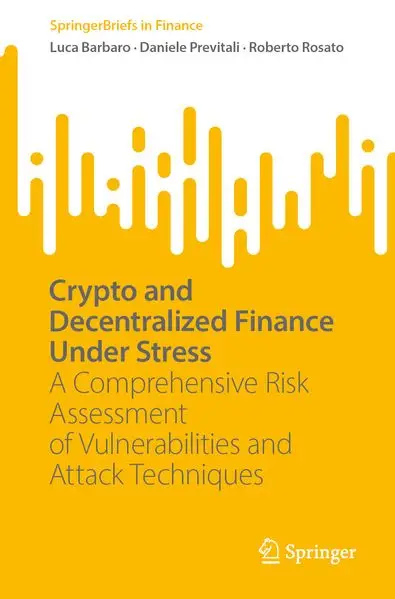
- Autor: Luca Barbaro
- Anzahl Bewertungen: 0
- Ø Bewertung:
- Medium: Buch
- Veröffentlicht: 29.08.2026
- Genre: Krimi
Crypto and Decentralized Finance Under Stress
The book offers an overview of the main financial and operational risks in cryptocurrency markets and Decentralized Finance. It outlines the role of stablecoins, crypto-investment products, and multi-function ecosystems, highlighting vulnerabilities linked to reserves, leverage, and protocol interdependencies. The book distinguishes traditional risks from those rooted in smart-contract logic, oracle manipulation, governance failures, and cross-chain bridges. An empirical section analyzes attack frequency, stolen amounts, and evolving exploit techniques, showing a shift toward complex schemes using flash loans and oracle distortions. The book also examines mixers and presents the Ronin case. The final chapters discuss technical and governance measures to mitigate risks and provide regulatory recommendations.