Advances in Asian Human-Environmental Research
Environmental Change and Development in Ladakh, Indian Trans-Himalaya
Chronologie aller Bände (1 - 2)

Die Reihenfolge beginnt mit dem Buch "Environmental Change and Development in Ladakh, Indian Trans-Himalaya". Wer alle Bücher der Reihe nach lesen möchte, sollte mit diesem Band von Blaise Humbert-Droz beginnen. Der zweite Teil der Reihe "Snow Cover Distribution and Dynamics" ist am 23.05.2024 erschienen. Die Reihe umfasst derzeit 2 Bände. Der neueste Band trägt den Titel "Snow Cover Distribution and Dynamics".
- Anzahl der Bewertungen für die gesamte Reihe: 0
- Ø Bewertung der Reihe: 0
- Start der Reihe: 19.11.2023
- Neueste Folge: 24.05.2025
Diese Reihenfolge enthält 2 unterschiedliche Autoren.
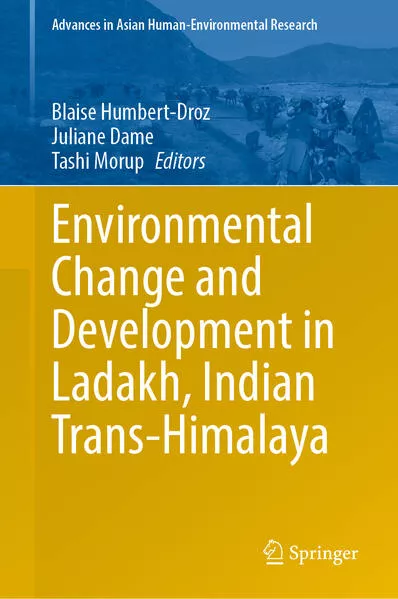
- Autor: Humbert-Droz, Blaise
- Anzahl Bewertungen: 0
- Ø Bewertung:
- Medium: Buch
- Veröffentlicht: 19.11.2023
- Genre: Politik
Environmental Change and Development in Ladakh, Indian Trans-Himalaya
The Trans-Himalayan region of Ladakh has witnessed important changes linked to its geo-strategic importance, the rapid development of means of communication with other parts of India, socio-economic transformation processes and the effects of climate change. The sixteen chapters document these key changes, ranging from melting glaciers and extreme weather events to the exponential increase in infrastructure, tourist and military activities. The book examines the impact these changes are having on the environment and on the socio-economics and identity of Ladakhi communities. The book also attempts to evaluate the likely direction of future changes, identify some of the main environmental challenges faced by Ladakh in the 21st century, and provide perspectives for sustainable development of the high mountain region.
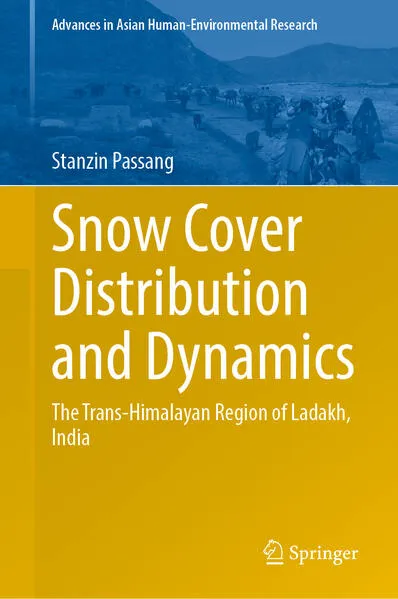
- Autor: Passang, Stanzin
- Anzahl Bewertungen: 0
- Ø Bewertung:
- Medium: Buch
- Veröffentlicht: 23.05.2024
- Genre: Sonstiges
Snow Cover Distribution and Dynamics
This comprehensive book examines a high mountain snow-covered expanse, spanning an investigation period of almost two decades. Leveraging advanced remote sensing and innovative algorithms, it meticulously maps the temporal and spatial dimensions of the snow cover extent of Ladakh, India. Rigorous statistical analyses, terrain examinations, and a groundbreaking snowfall prediction model contribute to a nuanced understanding. Grounded in empirical data, the volume not only enriches the research framework but also serves as a guiding compass for sustainable development amid the challenges of global warming. Seamlessly blending scientific rigour with a passion for discovery, the book invites readers to immerse themselves in a captivating snow-clad terrain, unlocking the secrets of its unique environment.
Snow Cover Distribution and Dynamics: The Trans-Himalayan Region of Ladakh, India is divided into five chapters. The book begins with an introduction and a comprehensive overview of the materials and methods used in the study. The focus is on the application of the MODIS NDSI snow mapping algorithm, validated using Landsat images. The research also involves the development of innovative algorithms for the removal of clouds from MODIS data and for forecasting snowfall. The study is further enriched by on-ground measurements and the deployment of terrestrial cameras across diverse topographies for data validation. Chapter 3 presents the results, including observed patterns and trends of the snow cover distribution, and the application of an ARIMA model for future snowfall predictions. The final two chapters discuss the findings in detail, draw conclusions, and provide a future outlook, thereby offering a comprehensive understanding of the subject matter.