De Gruyter Contemporary Social Sciences Handbooks
De Gruyter Handbook of Contemporary Welfare States
Chronologie aller Bände (1 - 2)

Die Reihenfolge beginnt mit dem Buch "De Gruyter Handbook of Contemporary Welfare States". Wer alle Bücher der Reihe nach lesen möchte, sollte mit diesem Band von Bent Greve beginnen. Mit insgesamt 2 Bänden wurde die Reihe über einen Zeitraum von ungefähr 3 Jahren fortgesetzt. Der neueste Band trägt den Titel "De Gruyter Handbook of Digital Criminology".
- Anzahl der Bewertungen für die gesamte Reihe: 0
- Ø Bewertung der Reihe: 0
- Start der Reihe: 06.09.2022
- Neueste Folge: 17.03.2025
Diese Reihenfolge enthält 2 unterschiedliche Autoren.
- Band: 1
- Autor: Greve, Bent
- Anzahl Bewertungen: 0
- Ø Bewertung:
- Medium: Buch
- Veröffentlicht: 06.09.2022
- Genre: Politik
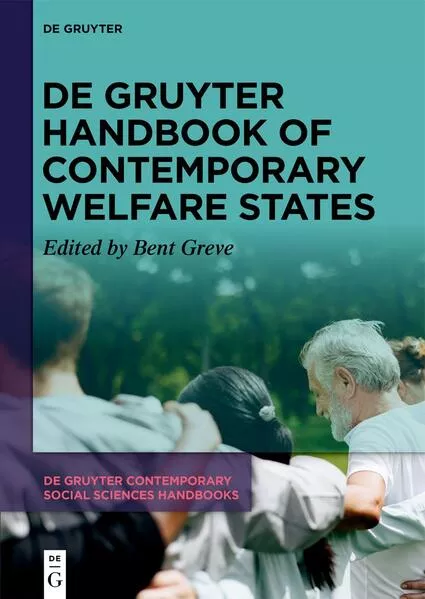
De Gruyter Handbook of Contemporary Welfare States
Globalisation, regionalisation, new technology, demography, voters’ expectations and re-structuring of societies are expected to influence welfare state development for years to come. This handbook analyses how different welfare state models and regimes will be able to cope with contemporary and future challenges, providing a variety of evidence based tools that make it essential reading for students, researchers and policy makers alike.
- Band: 6
- Autor: Kaufmann, Mareile
- Anzahl Bewertungen: 0
- Ø Bewertung:
- Medium: Buch
- Veröffentlicht: 17.03.2025
- Genre: Krimi
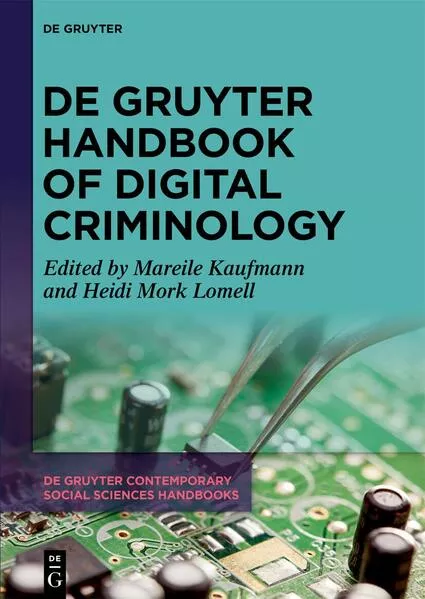
De Gruyter Handbook of Digital Criminology
The De Gruyter Handbook of Digital Criminology examines how digital devices spread and cut across all fields of crime and control. Providing a glossary of key theoretical, methodological and criminological concepts, the book defines and further establishes a vibrant and rapidly developing field. At the same time, Digital Criminology is not only presented as a novelty, but also as a continuation of the discipline's history.
Each chapter can be read as a free-standing contribution or texts can be combined to gain a more holistic understanding of Digital Criminology or to design a research project. Expert contributions vary from Criminology, Sociology, Law, Science and Technology Studies, to Information Science and Digital Humanities. Together, these supply readers with rich and original perspectives on the digitization of crime and control.
All contents of the De Gruyter Handbook of Digital Criminology are openly accessible. Open access has been funded by the European Research Council, as outlined in the respective chapters, and by the Department of Criminology and Sociology of Law at the University of Oslo.
Mareile and Heidi would like to thank Vilde B. Winge for her commitment and excellent research assistance in the realization of this book project. Thanks are also due to Gerhard Boomgaarden and his team at De Gruyter who saw this book through to production.