Chronologie aller Bände (1 - 6)
Die Reihenfolge beginnt mit dem Buch "Journal of Soviet and Post-Soviet Politics and Society". Wer alle Bücher der Reihe nach lesen möchte, sollte mit diesem Band von Julie Fedor beginnen. Der zweite Teil der Reihe "Journal of Soviet and Post-Soviet Politics and Society" ist am 23.06.2025 erschienen. Mit insgesamt 6 Bänden wurde die Reihe über einen Zeitraum von ungefähr 3 Jahren fortgesetzt. Der neueste Band trägt den Titel "Journal of Soviet and Post-Soviet Politics and Society".
- Anzahl der Bewertungen für die gesamte Reihe: 0
- Ø Bewertung der Reihe: 0
- Start der Reihe: 10.10.2022
- Neueste Folge: 23.06.2025
- Autor: Fedor, Julie
- Anzahl Bewertungen: 0
- Ø Bewertung:
- Medium: Buch
- Veröffentlicht: 10.10.2022
- Genre: Politik
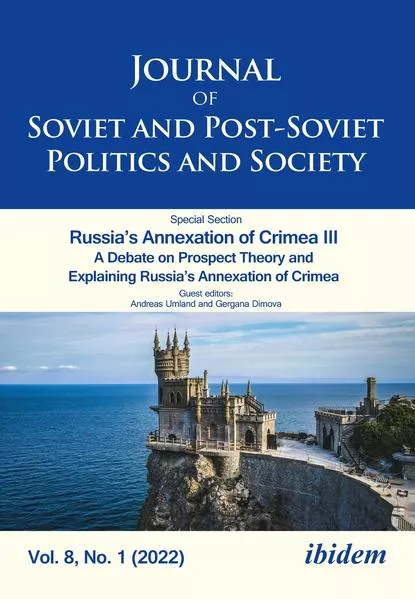
Journal of Soviet and Post-Soviet Politics and Society
Special Section: Russia`s Annexation of Crimea III
Gergana Dimova and Andreas Umland: Introduction. Perspectives on Russia’s 2014 Annexation of Crimea: Empirical and Theoretical Explorations
Greta Lynn Uehling: The Personal Stakes of Political Crisis: The 2014 Attempted Annexation of Crimea
Kerstin S. Jobst: “Dark” and “Golden” Times: The Crimean Tatar Population under Tsarist and Soviet Rule (1783–1941)
Jan Zofka: Agents of Separatism: Social Background to the Pro-Russian Movements in Crimea and the Moldovan Dniester Valley in Comparison (1989–95)
A Debate on Prospect Theory and Explaining Russia’s Annexation of Crimea
Ion Marandici: Loss Aversion, Neo-Imperial Frames, and Territorial Expansion: Using Prospect Theory to Examine the Annexation of Crimea
Discussion
Featuring contributions by Peter Rutland, Tor Bukkvoll, Mykola Kapitonenko, Rumena Filipova, Martin Malek, Ion Marandici
Articles
Chris Monday: Mikhail Putin (1894–1969) and Socialist Competition: Exploring a Neglected Branch of the Putin Family Tree
Reviews:
Inna Chuvychkina on Elizabeth Buchanan; Brendan M. McElmeel on Juliane Fürst; Olga Khabibulina on Hubertus Jahn; Elise Westin on Natalia Knoblock; Manne Wängborg on Andrei Kozyrev; Giulia Prelz Oltramonti on Anna Matveeva; Kimberly St. Julian-Varnon on David Rainbow; John (Ivan) Jaworsky on Josephine von Zitzewitz; Yana Ostapenko on Jessica Zychowicz; Dima Kortukov on Vladislav M. Zubok
- Autor: Fedor, Julie
- Anzahl Bewertungen: 0
- Ø Bewertung:
- Medium: Buch
- Veröffentlicht: 22.05.2023
- Genre: Politik
Journal of Soviet and Post-Soviet Politics and Society
- Autor: Fedor, Julie
- Anzahl Bewertungen: 0
- Ø Bewertung:
- Medium: Buch
- Veröffentlicht: 21.12.2023
- Genre: Politik
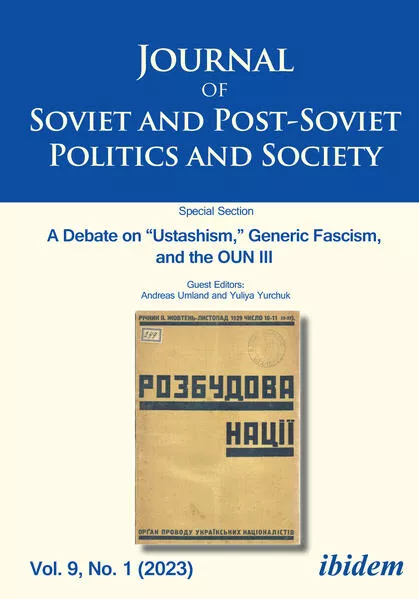
Journal of Soviet and Post-Soviet Politics and Society
Special Section:
A Debate on “Ustashism,” Generic Fascism, and the OUN III
Yuliya Yurchuk and Andreas Umland: Introduction. Continuing the Ustashism Debate
Oleksiy Panych: Fascism as Ideology and Practice and the OUN as a Social Movement
Yuri Radchenko: Once More on Ustashism: Remarks on the JSPPS Discussion
Articles
Felix Riefer: Think Tanks and Foreign Policy Design in the Russian Federation
- Autor: Fedor, Julie
- Anzahl Bewertungen: 0
- Ø Bewertung:
- Medium: Buch
- Veröffentlicht: 18.03.2024
- Genre: Politik
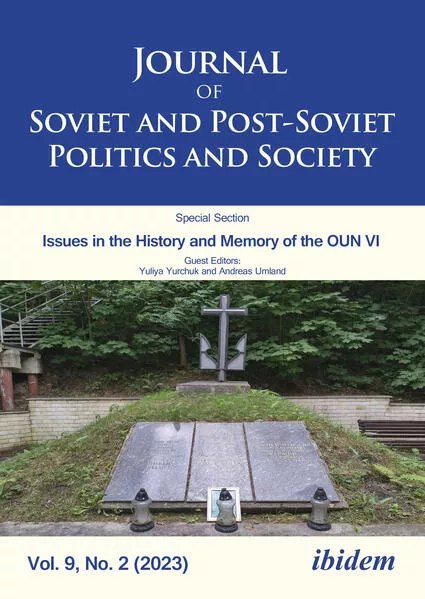
Journal of Soviet and Post-Soviet Politics and Society
Special Section:
Issues in the History and Memory of the OUN VI
Yuliya Yurchuk and Andreas Umland: Introduction. Reassessing Ukrainian Nationalism in the Light of Russia’s Full-Scale Invasion since 2022
Per Anders Rudling: “Benderites,” "UkroNazis" and "Rashizm": Studying the Historical Ukrainian Far Right in Times of Disinformation and Hybrid Warfare
Jakub Bornio: The Polish–Ukrainian Dispute over the Volhynian Massacres: Investigating the Logic behind the Polish Narrative
Article
Natia Gamkrelidze: From “Dependent” to “Neutral” Neighbor: The Evolution of Russian Images of Georgia from 1991 to 2020
Review Essay
Illia Chedoluma: Looking Back on a Century of Ukrainian Historiography: Reflections on Serhy Yekelchyk’s Writing the Nation: The Ukrainian Historical Profession in Independent Ukraine and the Diaspora (ibidem Press, 2023)

- Autor: Fedor, Julie
- Anzahl Bewertungen: 0
- Ø Bewertung:
- Medium: Buch
- Veröffentlicht: 10.02.2025
- Genre: Politik
Journal of Soviet and Post-Soviet Politics and Society
SPECIAL SECTION: TEACHING IR IN WARTIME
GUEST EDITORS:
KATERYNA ZAREMBO, MICHÈLE KNODT and MAKSYM YAKOVLYEV
Teaching the Russian War against Ukraine: Ukraine as
a Microcosm of the Paradigm Shift from International
Relations to Planetary Politics
IAN MANNERS
Will the Russian War against Ukraine Bring Changes to
the Teaching of International Relations?
OLENA KHYLKO
Teaching International Political Economy in Times of War
THOMAS FETZER
From Shock to Adaptation through National Unity and
Action: Third-year Undergraduate Students of Kyiv-
Mohyla Academy Reflect on the First Eighty Days of Russia’s
War against Ukraine
GALYNA SOLOVEI
ARTICLES
Narratives about Baikonur: City and Cosmodrome
KULSHAT MEDEUOVA and ULBOLSYN SANDYBAYEVA
From Decentralization to Warfare Resistance: Building
a Cohesive Ukraine
OLEKSANDRA DEINEKO and AADNE AASLAND
Epic Indigenization: Literature and Nation on the Soviet-
Finnish Borders under Stalinism
DIEGO BENNING WANG

- Autor: Fedor, Julie
- Anzahl Bewertungen: 0
- Ø Bewertung:
- Medium: Buch
- Veröffentlicht: 23.06.2025
- Genre: Politik
Journal of Soviet and Post-Soviet Politics and Society
CONTENTS
Special Issue: Symbols and Narratives of Ukrainian Resistance. Part I
Guest editor: Yuliya Yurchuk
Introduction. Understanding Ukrainian Spirit: Symbols and Narratives of Ukrainian Resistance and Resilience
Yuliya Yurchuk
Feeding the Feed: How Food Memes Reflect Resilience in Daily Life in a War-torn Ukraine
Daria Antsybor and Michel Bouchard
Cultural Memory and Decolonization: The Case of the Motherland Monument in Kyiv
Yana Prymachenko
The Pain of Courage: Re-Imagining Militarization and Masculinity in Ukrainian Digital Illustrations of Soldiers
Colby Fleming
This special issue proposes to approach Ukrainian resistance from the cultural studies perspective. It brings together scholars from different disciplines who address different aspects of resilience and resistance focusing on gender, humor, literature, visual representations, and memes. The authors approach these widely circulated images and narratives as expressions of deep cultural structures that produce meanings. They are rooted in history, past lived experiences, and societal structures that govern human activities and interactions. These images and narratives signal changes in the self-perception of people and shifts in worldviews shattered by war. Although the material analyzed by the authors is very different, they all come to the main overarching conclusion: Ukrainians at time of war actively renegotiate their identities and recalibrate their understanding of history and the place of Ukraine in the world.
Overall, the special issue contributes to the discussions on Ukrainian resistance relying on the evidence found in the grassroots local context. The articles collected here shed light on the deeper structures that enable production of images and narratives that we see on the surface. These structures are rooted in history, cultural memory, gender regimes, and politics. These structures too undergo renegotiations, transformation, and recalibration. To a certain extent, the articles not only analyze but also document and archive the cultural products created by Ukrainian society in the first years of the full-fledged invasion. As such, they will be also valuable as historical sources to be used by researchers in the future.