Chronologie aller Bände (1 - 4)
Die Reihenfolge beginnt mit dem Buch "The Second World War in the Twenty-First-Century Museum". Wer alle Bücher der Reihe nach lesen möchte, sollte mit diesem Band von Stephan Jaeger beginnen. Mit insgesamt 4 Bänden wurde die Reihe über einen Zeitraum von ungefähr 4 Jahren fortgesetzt. Der neueste Band trägt den Titel "Memories of Antiquity".
- Anzahl der Bewertungen für die gesamte Reihe: 0
- Ø Bewertung der Reihe: 0
- Start der Reihe: 31.01.2022
- Neueste Folge: 03.11.2025
Diese Reihenfolge enthält 4 unterschiedliche Autoren.
- Band: 26
- Autor: Jaeger, Stephan
- Anzahl Bewertungen: 0
- Ø Bewertung:
- Medium: Buch
- Veröffentlicht: 31.01.2022
- Genre: Sonstiges
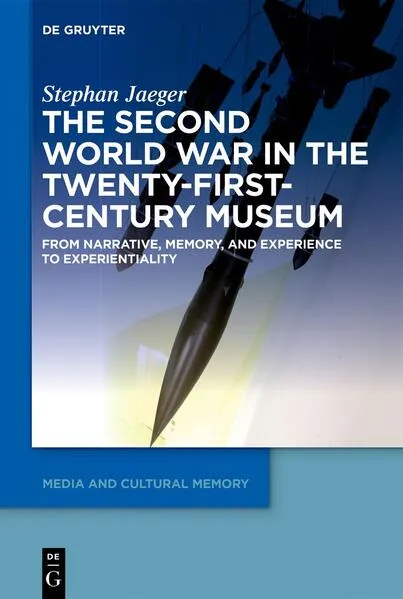
The Second World War in the Twenty-First-Century Museum
The Second World War is omnipresent in contemporary memory debates. As the war fades from living memory, this study is the first to systematically analyze how Second World War museums allow prototypical visitors to comprehend and experience the past. It analyzes twelve permanent exhibitions in Europe and North America – including the Bundeswehr Military History Museum in Dresden, the Museum of the Second World War in Gdańsk, the House of European History in Brussels, the Imperial War Museums in London and Manchester, and the National WWII Museum in New Orleans – in order to show how museums reflect and shape cultural memory, as well as their cognitive, ethical, emotional, and aesthetic potential and effects. This includes a discussion of representations of events such as the Holocaust and air warfare. In relation to narrative, memory, and experience, the study develops the concept of experientiality (on a sliding scale between mimetic and structural forms), which provides a new textual-spatial method for reading exhibitions and understanding the experiences of historical individuals and collectives. It is supplemented by concepts like transnational memory, empathy, and encouraging critical thinking through difficult knowledge.
- Band: 27
- Autor: Kirn, Gal
- Anzahl Bewertungen: 0
- Ø Bewertung:
- Medium: Buch
- Veröffentlicht: 18.07.2022
- Genre: Sonstiges
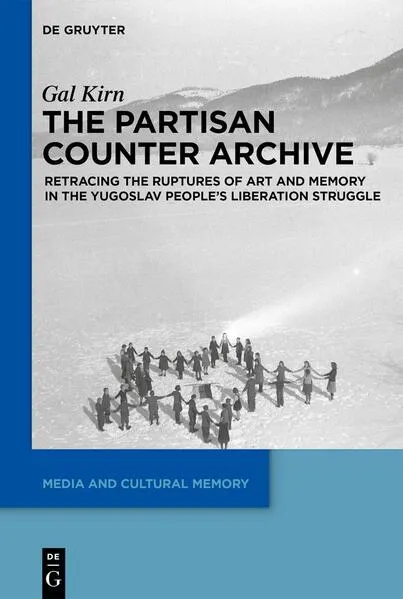
The Partisan Counter-Archive
- Band: 37
- Autor: Antweiler, Katrin
- Anzahl Bewertungen: 0
- Ø Bewertung:
- Medium: Buch
- Veröffentlicht: 20.03.2023
- Genre: Politik
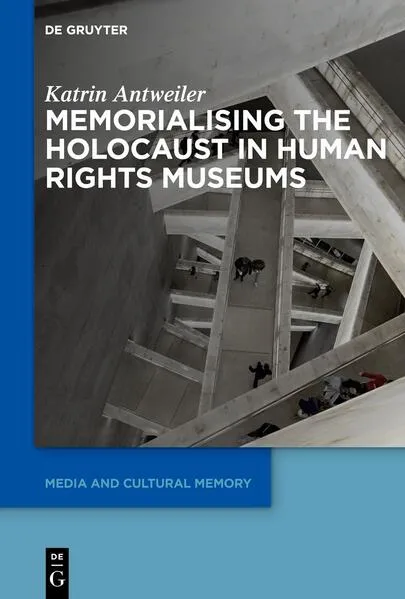
Memorialising the Holocaust in Human Rights Museums
"Honourable Mention" in the "Best First Book" Award of the Memory Studies Association (2025)
This book provides an analysis of the forms and functions of Holocaust memorialisation in human rights museums by asking about the impact of global memory politics on how we imagine the present and the future. It compares three human rights museums and their respective emplotment of the Holocaust and seeks to illuminate how, in this specific setting, memory politics simultaneously function as future politics because they delineate a normative ideal of the citizen-subject, its set of values and aspirations for the future: that of the historically aware human rights advocate. More than an ethical practice, engaging with the Holocaust is used as a means of asserting one’s standing on "the right side of history"; the memorialisation of the Holocaust has thus become a means of governmentality, a way of governing contemporary citizen-subjects. The linking of public memory of the Holocaust with the human rights project is often presented as highly beneficial for all members of what is often called the "global community". Yet this book argues that this specific constellation of memory also has the ability to function as an exercise of power, and thus runs the risk of reinforcing structural oppression. With its novel theoretical approach this book not only contributes to Memory Studies but also connects Holocaust memory to Studies of Global Governmentality and the debate on decolonising memory politics.

- Band: 45
- Autor: Scherer, Madeleine
- Anzahl Bewertungen: 0
- Ø Bewertung:
- Medium: Buch
- Veröffentlicht: 03.11.2025
- Genre: Sonstiges
Memories of Antiquity
While the study of antiquity and its reception has been an important subject of study for centuries, theoretical approaches to the ways in which reception operates in practice have proven difficult to establish. Classical works, images, and narratives have a long- and wide-ranging reception history and in tracing this history, scholarship has long emphasized that classical receptions shift over time. Given the enduring and, indeed, expanding popularity of the classics, more recent approaches have started to explore those complex receptions as matters of mnemohistory, or cultural histories of memory. Memories of Antiquity builds on this view of classical reception as a mnemohistory by collecting a set of global and transcultural examples in which the study of classical reception is usefully conceptualised through the lens of memory. The collection is fundamentally interdisciplinary, featuring investigations of literature, pop art, photography, film, and even an actual play podcast. The broad scope of the volume creates a multitude of comparative points on how ancient stories and myths are reframed and remembered in different contexts, opening a dialogue for further inquiries into this rich and complex area of research.