
- Publikationen ca: 2
- Fragen & Antworten
Shani D. Carter
- Shani D. Carter is Associate Director of assesment at Stevens Institute of Technology (Hoboken, NJ). She also founded the Current Business Issues in African Countries Conference (CBIAC) in 2016 after attending the United Nations Conference on Trade and Development (UNCTAD) in Nairobi, Kenya. Dr. Carter taught courses in human resource management, organizational behavior, and leadership for nearly 30 years. Dr. Carter has published more than 40 articles, book chapters, and conference proceedings on human resources and assessment of student learning.
· Andrea E. Smith-Hunter is Professor of management at Siena College, Loudonville, NY, USA. Her research is in women’s entrepreneurship covering management issues, gender issues, ethnic issues, global issues, economic issues, and sociological issues. Her research has been published across research journals,books, and book chapters, and conference proceedings.
· Laura Best is Program Manager for The Global Health Network. Previously, she was at the Office of Vice-Chancellor at Nelson Mandela University in South Africa, as well as Program Coordinator across multiple governmental departments and entities. Dr. Best is active internationally in research and policy advocacy with a particular focus on incorporating sustainability into consumer protection systems. She is a Member of the United Nations Conference on Trade and Development Group of Experts in Consumer Protection and the African Dialogue Consumer Policy Network.
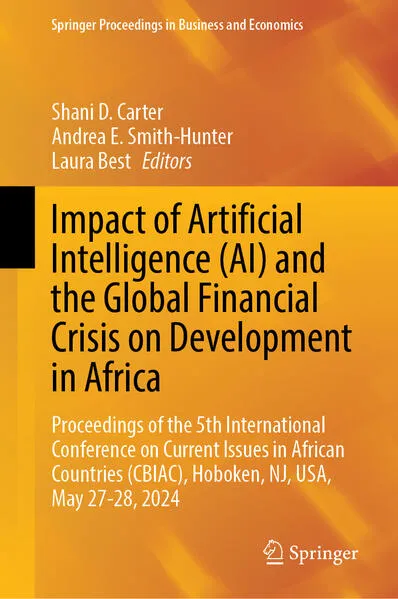
Impact of Artificial Intelligence (AI) and the Global Financial Crisis on Development in Africa
This book examines the impact of AI and the financial crisis on African nations and the issues that surround its reciprocal impact on global business, government, and society. The global financial crisis and artificial intelligence (AI) have an equal and synergistic impact on economic development in Africa.
Impact of Artificial Intelligence (AI) and the Global Financial Crisis on Development in Africa
This book examines the impact of AI and the financial crisis on African nations and the issues that surround its reciprocal impact on global business, government, and society. The global financial crisis and artificial intelligence (AI) have an equal and synergistic impact on economic development in Africa.