
- Publikationen ca: 1
- Fragen & Antworten
Paola Cordera
Paola Cordera is an Associate Professor at the Politecnico di Milano. Her studies have been supported by grants from the Getty Research Institute in Los Angeles, the Institut National d’Histoire de l’Art (INHA) in Paris, and the Kress Foundation. In 2016, she was the Leon Levy Fellow at the Center for the History of Collecting at the Frick Art Reference Library in New York, and in 2024, a Visiting Scholar at the American Academy in Rome. Drawing on a multidisciplinary background, her scholarship focuses on three key areas: craft and decorative art, their (permanent and ephemeral) displays, and their cultural contexts. Spanning Medieval and Renaissance art, architecture, and decorative arts, as well as their reception in the 19th and 20th centuries, her research explores (re)production, industrialization, the history of taste, the art market, and exhibition strategies. Grounded in unexplored archival sources and case studies – including 19th-century art dealer F. Spitzer, Art Nouveau cabinet-maker E. Quarti, and postwar exhibitions in the US – it situates these topics within their artistic and historical contexts, uncovering their cultural and aesthetic impact. This cross-disciplinary approach bridges art history with economic and cultural analysis, offering new insights into exhibitions, collections, and taste. A key strand of her research examines the promotion and display of Italianness across exhibitions in Italy, France, and the United States from the 19th to the 20th century. Within this framework, she recently acted as Principal Investigator of the VO Project: Voices of Objects. The Italian Design from Museum to Home (School of Design, Politecnico di Milano, 2021), focusing on the traveling exhibition Italy at Work (1950–54).The project examined the actors, networks, and strategies that promoted Italian industry and decorative arts in the US in the context of postwar Marshall Plan funding.
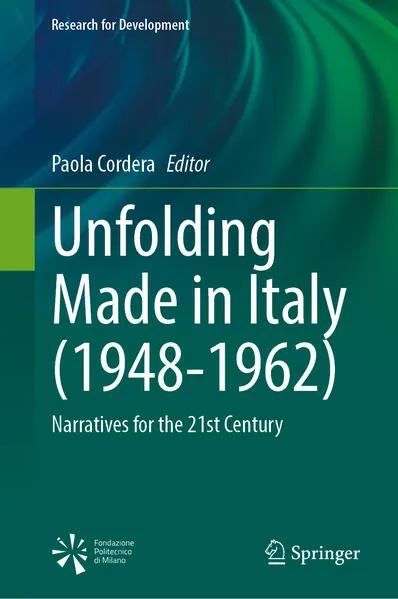
Unfolding Made in Italy (1948-1962)
This book examines postwar Italian craft and design (1948-1962) through a multidisciplinary lens, reassessing its significance today. It explores the enduring appeal of artifacts within and beyond museum contexts, emphasizing their role as dynamic tools that transcend historical value.