
- Publikationen ca: 2
- Fragen & Antworten
Atif Kubursi
Atif Kubursi is an Emeritus Professor of Economics at McMaster University. Dr. Kubursi was Visiting Scholar at University of Cambridge in 1974/75, Member of the Institute for Social and Economic Policy in the Middle East at Harvard University, 1987-1997, Acting as Executive Secretary of UNESCWA, 2006-2007. He is an Adjunct Professor at York University School of the Environment and Urban Change and President of Econometric Research Ltd., Burlington, Ontario, Canada.
Nathaniel K. Newlands is a Research Scientist with Agriculture and Agri-Food Canada (AAFC) in Summerland, British Columbia, Canada. He is Editor-in-Chief of the Journal of Environmental Statistics and Data Science, Co-chair of the Global Expert Working Group in Ecosystem-based Solutions (UN-FAO) and President-Elect of the International Environmetrics Society (TIES).
Amani Alfarra is Water Officer in the Land and Water Division of the United Nations Food and Agriculture Organization. She holds a PhD in water resources management from Karlsruhe Institute for Technology, Germany. Her work and research focused on addressing interconnected challenges, in the food-water-energy nexus and an ecosystem-based approach to address water management and integrated watershed issues.
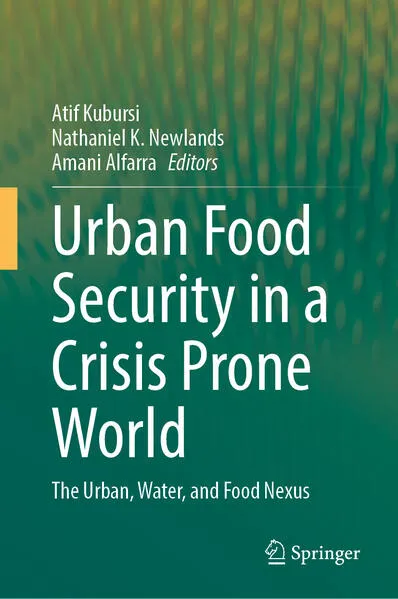
Urban Food Security in a Crisis Prone World
The world will likely exceed 9 billion people by 2050 and is unlikely to stabilize in the 21st century, requiring 70–100% more food production, while an increasing number of countries are reaching alarming levels of water scarcity. Water for irrigation and food production constitutes one of the greatest pressures on freshwater resources.
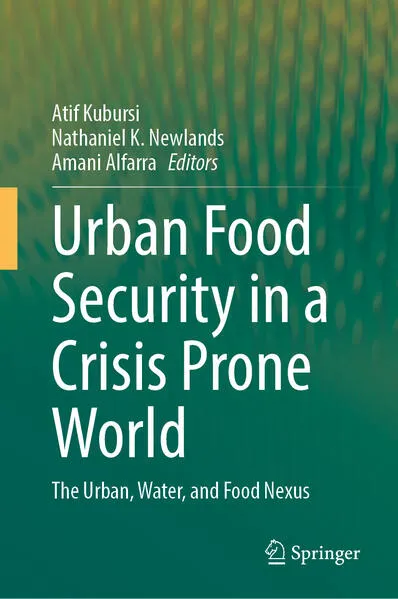
Urban Food Security in a Crisis Prone World
The world will likely exceed 9 billion people by 2050 and is unlikely to stabilize in the 21st century, requiring 70–100% more food production, while an increasing number of countries are reaching alarming levels of water scarcity. Water for irrigation and food production constitutes one of the greatest pressures on freshwater resources.