
- Publikationen ca: 3
- Fragen & Antworten
P. W. Preston
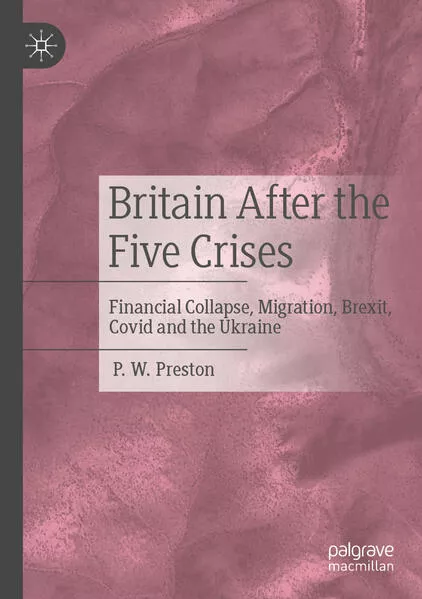
Britain After the Five Crises
The period 2008–2022 has seen the British state/government embroiled in a number of full-blown crises, each impacting the fundamental operations of the state and demanding, therefore, urgent responses from the government of the day. In the first case, the 2008 near-collapse and partial nationalization of the banking system consequent upon decades of irresponsible credit creation coupled to permissive regulation; in the second , the migration crisis of 2015, which saw waves of refugees moving through Europe, provoking anxious responses from European Union member states and opening-up related political debates in Britain; thus, third , the 2016 referendum in regard to membership of the European Union, which the London-based elite clearly thought they would navigate easily before, to their evident shock, losing, an event itself precipitating further extraordinary Westminster manoeuvring; and then fourth the 2020 Covid- 19 pandemic, met with an initial casualsangfroid before the government, its actions informed by epidemiological modelling, made an abrupt shift to ‘lockdown’, with dramatic social and economic consequences.

Britain After the Five Crises
The period 2008–2022 has seen the British state/government embroiled in a number of full-blown crises, each impacting the fundamental operations of the state and demanding, therefore, urgent responses from the government of the day. In the first case, the 2008 near-collapse and partial nationalization of the banking system consequent upon decades of irresponsible credit creation coupled to permissive regulation; in the second , the migration crisis of 2015, which saw waves of refugees moving through Europe, provoking anxious responses from European Union member states and opening-up related political debates in Britain; thus, third , the 2016 referendum in regard to membership of the European Union, which the London-based elite clearly thought they would navigate easily before, to their evident shock, losing, an event itself precipitating further extraordinary Westminster manoeuvring; and then fourth the 2020 Covid- 19 pandemic, met with an initial casualsangfroid before the government, its actions informed by epidemiological modelling, made an abrupt shift to ‘lockdown’, with dramatic social and economic consequences.
Britain After the Five Crises
The period 2008–2022 has seen the British state/government embroiled in a number of full-blown crises, each impacting the fundamental operations of the state and demanding, therefore, urgent responses from the government of the day. In the first case, the 2008 near-collapse and partial nationalization of the banking system consequent upon decades of irresponsible credit creation coupled to permissive regulation; in the second , the migration crisis of 2015, which saw waves of refugees moving through Europe, provoking anxious responses from European Union member states and opening-up related political debates in Britain; thus, third , the 2016 referendum in regard to membership of the European Union, which the London-based elite clearly thought they would navigate easily before, to their evident shock, losing, an event itself precipitating further extraordinary Westminster manoeuvring; and then fourth the 2020 Covid- 19 pandemic, met with an initial casualsangfroid before the government, its actions informed by epidemiological modelling, made an abrupt shift to ‘lockdown’, with dramatic social and economic consequences.