
- Publikationen ca: 1
- Fragen & Antworten
Dorothee Rummel
Dorothee Rummel is Junior Professor of Urban and Regional Design (Stadt Raum Entwerfen) at Bauhaus-Universität Weimar. Previously, she spent over ten years teaching and researching as a research assistant at the Chair of Sustainable Urbanism at the Technical University of Munich and the Institute for Urban Design and Urban Theory at the Munich University of Applied Sciences. Dorothee
Rummel studied Architecture at the University of California, Berkeley, the Universität der Künste Berlin, and the Karlsruhe Institute of Technology, where she also completed her dissertation on urban space reserves (Der Wert des Restraums). Dorothee Rummel is a member of the international and interdisciplinary research community Urban Environments Initiative. Her research and publications focus on urban spatial reserves, inclusion in public spaces, principles and models of coexistence in urban and rural areas, and the interactions between urban space and the human psyche. As a co-founder of XOstudio for architecture and urban planning in Munich, she has been working as a planner and consultant in urban and local development since 2007, alongside her teaching and research activities.
Rummel studied Architecture at the University of California, Berkeley, the Universität der Künste Berlin, and the Karlsruhe Institute of Technology, where she also completed her dissertation on urban space reserves (Der Wert des Restraums). Dorothee Rummel is a member of the international and interdisciplinary research community Urban Environments Initiative. Her research and publications focus on urban spatial reserves, inclusion in public spaces, principles and models of coexistence in urban and rural areas, and the interactions between urban space and the human psyche. As a co-founder of XOstudio for architecture and urban planning in Munich, she has been working as a planner and consultant in urban and local development since 2007, alongside her teaching and research activities.
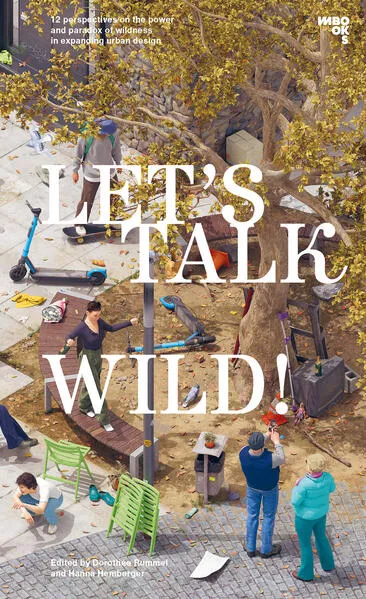
Let’s Talk Wild!
At first glance, urban design and wildness seem to form an oxymoron. Yet, as urban space and the tasks it needs to fulfill are evolving, wildness emerges as a dynamic urban resource of its own—in a material, as well as a cognitive manner. From urban gardening and cohabitation to revitalization and renaturation projects, wild spaces and practices seem to be springing up everywhere.