Kein Foto

Markus Steinbach

Nina-Kristin Meister (geborene Pendzich) hat an der Georg-August-Universität Göttingen Deutsche Philologie und Geschichte studiert und in Germanistischer Linguistik zum Thema »Lexikalische nichtmanuelle Markierungen in der Deutschen Gebärdensprache (DGS)« promoviert. Seit 2017 ist sie Leiterin des Experimentellen Gebärdensprachlabors am Seminar für Deutsche Philologie der Georg-August-Universität Göttingen und unterrichtet Germanistische Linguistik mit Schwerpunkt in der DGS. Ebenfalls seit 2017 ist sie in der Redaktion der Fachzeitschrift »Linguistische Berichte« tätig.

Linguistische Berichte Heft 281

Linguistische Berichte Heft 281

Vorwort – Nina-Kristin Meister & Markus Steinbach: Barrierefreie PublikationenBeiträge aus Forschung und AnwendungClare Patterson, Umesh Patil, Caterina Ventura, Maria Lialiou, Petra B. Schumacher & Stefan Hinterwimmer: Why register might be more important than modality for the choice of demonstrative pronounsJana Hasenäcker, Juliane Wettmann & Frank Domahs: Kann Leichte Sprache zu leicht sein? Eine zielgruppenorientierte Studie zur Wirksamkeit der GenitivvermeidungLea Schäfer: Variation oder Wandel? Der Fall von selbst und selberPraktisches aus Forschung und LehrePatrick C.

Linguistische Berichte Heft 281

Linguistische Berichte Heft 281

Vorwort – Nina-Kristin Meister & Markus Steinbach: Barrierefreie Publikationen Beiträge aus Forschung und Anwendung - Clare Patterson, Umesh Patil, Caterina Ventura, Maria Lialiou, Petra B. Schumacher & Stefan Hinterwimmer: Why register might be more important than modality for the choice of demonstrative pronounsAbstract: Demonstrative pronouns have been shown to direct the attention to an entity that is currently not the most prominent entity in discourse.

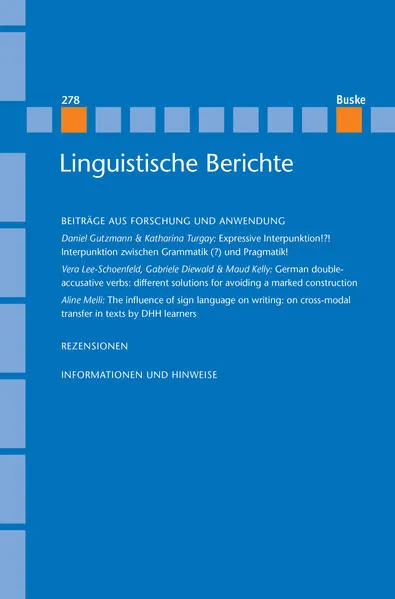
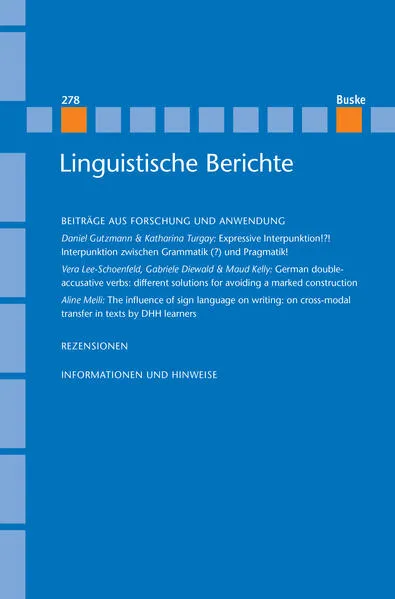
Linguistische Berichte Heft 278

Linguistische Berichte Heft 278

Beiträge aus Forschung und Anwendung– Daniel Gutzmann & Katharina Turgay: Expressive Interpunktion!?! Interpunktion zwischen Grammatik (?) und Pragmatik!Abstract: Whereas the use of most punctuation marks is thought to be governed by grammatical rules, some punctuation marks can be used in a more expressive way that rather reflects emotions and/or attitudes of the writer instead of grammatical properties.

Linguistische Berichte Heft 278

Linguistische Berichte Heft 278

Beiträge aus Forschung und Anwendung– Daniel Gutzmann & Katharina Turgay: Expressive Interpunktion!?! Interpunktion zwischen Grammatik (?) und Pragmatik!Abstract: Whereas the use of most punctuation marks is thought to be governed by grammatical rules, some punctuation marks can be used in a more expressive way that rather reflects emotions and/or attitudes of the writer instead of grammatical properties.