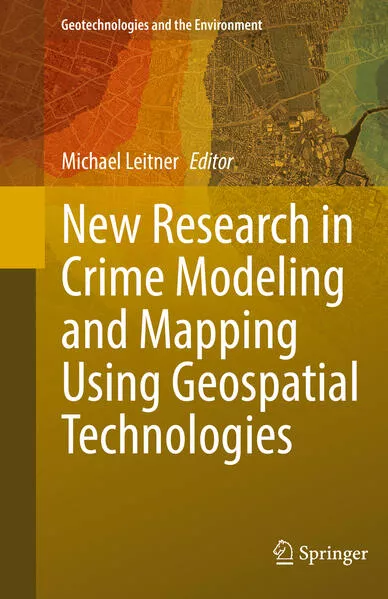
New Research in Crime Modeling and Mapping Using Geospatial Technologies
This edited volume offers innovative research and applications in the analysis, modelling, and mapping of crime using geospatial and GeoAI technologies. This is a follow-up publication of an edited volume by the same editor with a similar title, Crime Modeling and Mapping Using Geospatial Technologies, published by Springer in its popular Geotechnologies and the Environment series in 2013.
The book comprises sixteen chapters authored by some of the most esteemed researchers in the field. These chapters are organized into four sections: big data and microspaces (Part I), mobility (Part II), drugs (Part III), and additional geospatial applications (Part IV).
Part I includes five chapters focusing on interactive crime mapping by using large data sets obtained from social media and analyzing these data using AI applications; a fundamental spatial problem that considers spatial properties of a crime dataset to determine an adequate areal unit size; different aspects of the influence or prediction of crime in microspaces; and the use of sampled surface pollen to model the search space for documented forensic cases. Part II has four chapters that introduce two route generation heuristics that automate the creation of hot spots policing patrol routes; discuss how to optimize police response with two different maximal covering location problems; and examine how human mobility patterns impact crime trends and modelling. Part III consists of three chapters addressing opioid overdose patterns using a spatial mixed methods approach; spatial-temporal changes in hot spots of drug-related offences; and how geospatial technology can be used to empower stakeholders to make informed policy decisions about alcohol-related motor vehicle collisions. Part IV comprises four diverse chapters that do not fit under a single theme. The topics discussed include: the impact of video surveillance on the spatial distribution of crime; the identification of the location of missing persons outreach events with spatial clustering analysis methods; an examination of the distribution patterns of all types of juvenile delinquency to investigate underlying factors; and a review and comparison of GeoAI methods for detecting and mapping illegal logging.
This book would be useful to faculty, students and research scholars from geography, sociology, criminal justice, criminology, forensic sciences, and other related disciplines as well as to crime analysts working for law enforcement agencies at the local, state, or federal levels from around the world.


Unterstütze den lokalen Buchhandel
Nutze die PLZ-Suche um einen Buchhändler in Deiner Nähe zu finden.
Bestelle dieses Buch im Internet


| Veröffentlichung: | 10.03.2025 |
| Seiten | 374 |
| Art des Mediums | E-Book [Kindle] |
| Preis DE | EUR 203.29 |
| Preis AT | EUR 209.00 |
| Reihe | Earth and Environmental Science (R0) 27 |
| ISBN-13 | 978-3-031-81580-5 |
| ISBN-10 | 3031815807 |

Über den Autor
Michael Leitner is a Professor at the Department of Geography and Anthropology at the Louisiana State University in Baton Rouge (USA).
At LSU, he is teaching courses in (advanced) computer cartography, GIS, methods of spatial analysis, aerial photo interpretation, and how GPS collected data can be used for the analysis, modeling, and visualization in a GIS environment.
His current research interests include automated map generalization, the visualization of data quality and its effect on spatial decision support, the utilization of GPS for computer mapping, GIS, and spatial analysis, and the development of new techniques (for example, spatial association) for the spatial analysis of crime data. His research has been published in refereed journals and proceedings and has been presented at (inter)national conferences.
He also works for the Center of Geoinformatics at the University of Salzburg, Austria.
Diesen Artikel teilen
0 Kommentar zu diesem Buch
.... weitere Publikationen von Springer International Publishing











Formalwissenschaftlicher Beweis der Existenz Gottes über kalkül - Mathematische Philosophie und Philosophie der Grammatik
Bewerbungsfrist bis zum: 29.10.2026