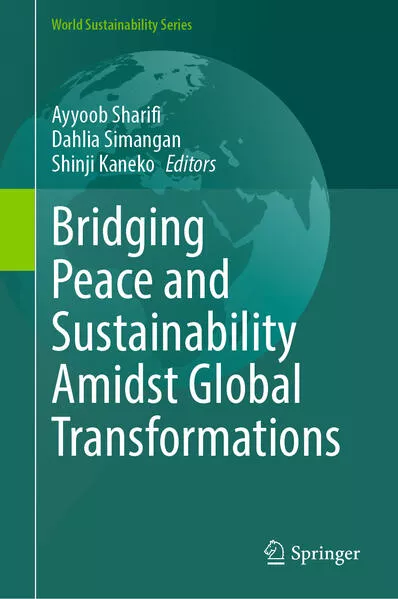
Bridging Peace and Sustainability Amidst Global Transformations
This book is the sequel to a well-received book titled ‘Integrated Approaches to Peace and Sustainability’ that aims to further advance the understanding of the dynamic interactions between various components of peace and sustainability. How are peace and sustainability linked to each other, and what are the key parameters that define the nexus between them? This book addresses those questions through a combination of theoretical studies and empirical research that contextualize peace and sustainability issues amid global transformations. The conceptual and empirical linkages between peace and sustainability are widely recognized in academic and policy circles. The adoption of the 2030 Agenda for Sustainable Development confirms this recognition. However, many of the initiatives on peace and sustainability operate in silos, undermining the positive and mutually reinforcing relationship between them. Enhanced integration of peace and sustainability components is imperative for addressing complex challenges that come with global transformations that are manifested environmentally, socially, politically, and economically across levels. It is, therefore, crucial to identify the pathways that enhance the peace-promoting potential of sustainability and the sustainability-promoting potential of peace. The contributions in this edited book elaborate on such pathways by offering insights related to different social, economic, and environmental aspects of the peace-sustainability nexus. Given its inter- and trans-disciplinary focus, the book is of interest to policymakers and researchers working in different areas of peace and sustainability. It contributes to ongoing academic and policy discussions surrounding the outcomes of and challenges to achieving the Sustainable Development Goals (SDGs), particularly SDG 16 on peace, justice and strong institutions.


Unterstütze den lokalen Buchhandel
Nutze die PLZ-Suche um einen Buchhändler in Deiner Nähe zu finden.
Bestelle dieses Buch im Internet



| Veröffentlichung: | 23.12.2023 |
| Höhe/Breite/Gewicht | H 23,5 cm / B 15,5 cm / - |
| Seiten | 267 |
| Art des Mediums | Buch [Gebundenes Buch] |
| Preis DE | EUR 139.09 |
| Preis AT | EUR 142.99 |
| Auflage | 1. Auflage |
| Reihe | World Sustainability Series |
| ISBN-13 | 978-9-819-97571-6 |
| ISBN-10 | 9819975719 |

Über den Autor
Ayyoob Sharifi is Professor at the Graduate School of Humanities and Social Sciences, Hiroshima University. He also is Core Member of the Network for Education and Research on Peace and Sustainability (NERPS). His research is mainly focused on climate change mitigation and adaptation. Ayyoob actively contributes to global change research programmes such as the Future Earth and has served as Lead Author for the Sixth Assessment Report (AR6) of the Intergovernmental Panel on Climate Change (IPCC). The ultimate goal of his education and research activities is to inform actions towards building sustainable and peaceful communities.Dahlia Simangan is Associate Professor at Hiroshima University’s Graduate School of Humanities and Social Sciences where she teaches Global Governance and Peacebuilding Case Studies. She is former Kanagawa University JSPS Postdoctoral Research Fellow (nominated by the United Nations University-Centre for Policy Research in Tokyo). She obtained her Ph.D. in International, Political and Strategic Studies from the Australian National University in 2017, her M.A. in International Relations from the International University of Japan in 2010, and her B.A. in Sociology from the University of the Philippines, Diliman, in 2006. Her research interest in peace and conflict studies includes topics on international peacebuilding, the United Nations peacekeeping operations, and International Relations in the Anthropocene. She is Assistant Editor of Peacebuilding and Member of the Planet Politics Institute.
Shinji Kaneko is Executive Vice President for Global Initiatives and Professor at the Graduate School of Humanities and Social Science at Hiroshima University. He graduated from the School of Engineering at Kyushu University majoring in water engineering (Dr. of Engineering). Immediately after the completion of his doctoral programme, he joined the Institute for Global Environmental Strategies (IGES) in 1999 as Researcher and conducted research on urban climate policy in Asian megacities for three years. He also worked at global Change System for Analysis, Research and Training (START) as Research Fellow for three years from 2005. In 2018, he was appointed as Director of Network for Education and Research on Peace and Sustainability (NERPS) at Hiroshima University. He has conducted numerous policy research on natural resources, energy, and the environment in developing countries.