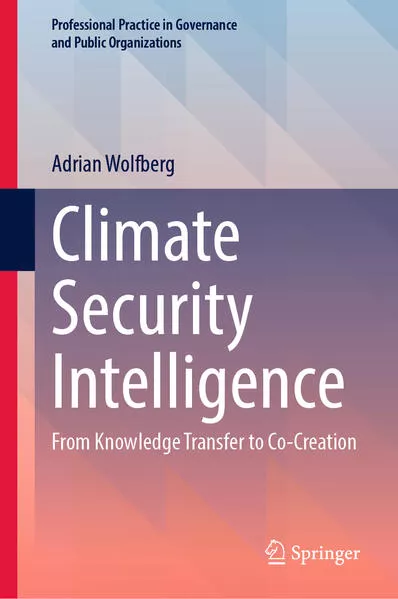
Climate Security Intelligence
From Knowledge Transfer to Co-Creation
Climate security intelligence is the capacity to warn national and sub-national security organizations of the physical effects of climate change that can have a negative societal effect on nations, governments, and their populations. This book discusses the uniqueness of climate security intelligence, the maturity of its development as a knowledge domain, and its possible future. Written by an intelligence analyst with over forty years of experience, this book centers upon the challenges that organizations may face when analysts, their managers, and their organizations are given the task of warning policymakers and decision-makers about threats to climate security. Taking a necessarily transdisciplinary approach, this book will be of interest to a wide audience of students, researchers, practitioners, and policy-makers concerned with how the impacts of climate change affect the social, cultural, political, and economic stability of national interests.
Unterstütze den lokalen Buchhandel
Nutze die PLZ-Suche um einen Buchhändler in Deiner Nähe zu finden.
Bestelle dieses Buch im Internet



| Veröffentlichung: | 22.04.2025 |
| Seiten | 436 |
| Art des Mediums | Digital [Kindle] |
| Preis DE | EUR 106.99 |
| Reihe | Professional Practice in Governance and Public Organizations |
| ISBN-13 | 978-3-031-86259-5 |
| ISBN-10 | 3031862597 |

Über den Autor
Adrian Wolfberg is the founder of Organizational Insight Consulting LLC and an adjunct professor at Case Western Reserve University’s Weatherhead School of Management. He has four decades of combined experience as a naval officer, intelligence officer, change agent, boundary spanner, scholarly researcher, and educator. As a naval officer, he was trained as an airborne electronic intelligence officer collecting and analyzing electromagnetic signals from weapon-associated radars on adversary ground-, sea-, and air-based systems. He flew intelligence gathering missions from aircraft carrier-based reconnaissance aircraft and, then, assigned as an Indications & Warning officer assigned to the Joint Staff Intelligence Directorate. He was employed by Defense Intelligence Agency (DIA) as a civilian intelligence analyst where he was a counterdrug analyst. While at DIA, he created and led an internal organizational consulting capability called the DIA Knowledge Lab. Its purpose was to help intelligence officers in the organization—regardless of seniority or formal position—learn how to help themselves in order to solve or make progress solving intractable problems. While assigned to DIA, he graduated from the National War College, spent four years supporting the Office of National Drug Control Policy, four years teaching at the United States Army War College, and two years conducting research at the National Intelligence University. He earned a Ph.D. in organizational science from Case Western Reserve University. Adrian’s scholarly research has focused on factors that affect the intelligence analyst’s ability to create and communicate knowledge, and how consumers of intelligence receive and absorb knowledge. His experiences as an intelligence analyst, leading the DIA Knowledge Lab, and his scholarly research have addressed the challenges of confronting and navigating different knowledge boundaries.
Diesen Artikel teilen
0 Kommentar zu diesem Buch
.... weitere Publikationen von Springer International Publishing

Verlockung und Gefahr: Der schwarze Kuss
Bewerbungsfrist bis zum: 10.01.2026