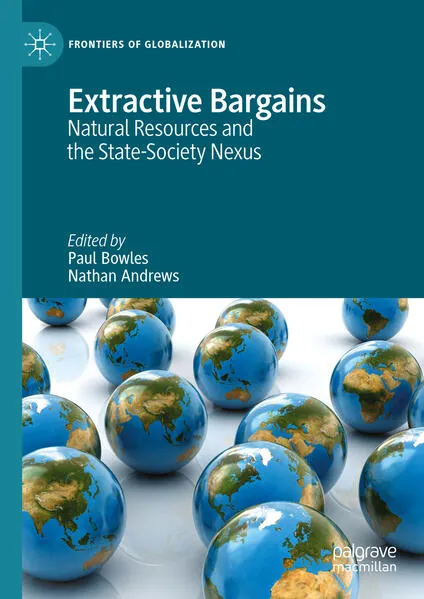
Extractive Bargains
Natural Resources and the State-Society Nexus
This book is the first to focus on state-led ‘extractive bargains,’ designed to reach a social consensus on the extent of extractive activities, how they should be governed and their negative consequences mitigated. These state-led ‘bargains’ have taken a number of different forms and offer varying degrees of promise in meeting environmental and social concerns. The book critically examines ‘bargains’ in states across the Global North and the Global South, incorporates Indigenous issues, and judiciously assesses their prospects for promoting long-term sustainability. It focusses on mineral and fossil fuel extraction in particular including bargains designed to govern the former as the demand for minerals used in “green energy” increases and to limit the use of the latter.
The book will be of interest to students and researchers of global studies, global political economy, political science, political sociology, sustainability, environmental sociology, development studies and geography.Chapter 1 is available open access under a Creative Commons Attribution 4.0 International License via link.springer.com.


Unterstütze den lokalen Buchhandel
Nutze die PLZ-Suche um einen Buchhändler in Deiner Nähe zu finden.
Bestelle dieses Buch im Internet



| Veröffentlichung: | 09.09.2023 |
| Seiten | 361 |
| Art des Mediums | E-Book [Kindle] |
| Reihe | Social Sciences (R0) |
| ISBN-13 | 978-3-031-32172-6 |
| ISBN-10 | 3031321723 |

Über die Autorin
Paul Bowles is Professor of Global and International Studies at the University of Northern British Columbia, Canada. He has published widely on global political economy and development and is the author or co-author of 11 books and over 100 journal articles or book chapters. He has recently published on topics related to extractivism drawing on research conducted in Canada, Mexico, Sweden and Greenland.Nathan Andrews is Associate Professor in the Department of Political Science at McMaster University, Canada where he works on topics around global political economy (of extraction and development), global governance, globalization, international relations and critical pedagogies. He has over 60 publications on these themes, including co-edited volumes, monographs, journal articles and book chapters.
Diesen Artikel teilen
0 Kommentar zu diesem Buch
.... weitere Publikationen von Springer International Publishing






Formalwissenschaftlicher Beweis der Existenz Gottes über kalkül - Mathematische Philosophie und Philosophie der Grammatik
Bewerbungsfrist bis zum: 29.10.2026