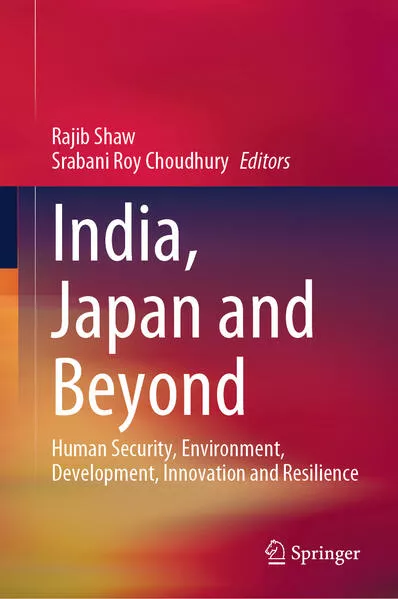
India, Japan and Beyond
Human Security, Environment, Development, Innovation and Resilience
Japan–India relations have traversed from "distantly friendly" to "indispensable partners." The significant development of the India-Japan strategic partnership, the convergence of bilateral strategies, and the addressing of broader economic relations and cultural dimensions signify that bilateral relations have entered a "new era" in Japan-India relations. Given the region's emerging geopolitics, diplomatic relations between these two nations have gained momentum beyond the traditional pillars of engagement. New dimensions, namely, human security, environment, disaster risk reduction, climate change issues, innovation, and resilience building have gained currency. Addressing these, this book covers the broader aspects of human security dimensions of India-Japan collaboration. Involving multi and trans-disciplinary research, including in-depth reviews and new data based on case studies from India and Japan, this book sheds light on new convergence frontiers between these two nations. Furthermore, the book suggests specific policy and action measures to enhance human security through the bilateral cooperation between India and Japan, which has a global impact.


Unterstütze den lokalen Buchhandel
Nutze die PLZ-Suche um einen Buchhändler in Deiner Nähe zu finden.
Bestelle dieses Buch im Internet



| Veröffentlichung: | 28.06.2024 |
| Höhe/Breite/Gewicht | H 23,5 cm / B 15,5 cm / - |
| Seiten | 284 |
| Art des Mediums | Buch [Gebundenes Buch] |
| Preis DE | EUR 149.79 |
| Preis AT | EUR 153.99 |
| Auflage | 1. Auflage |
| ISBN-13 | 978-9-819-73281-4 |
| ISBN-10 | 9819732816 |

Über den Autor
Rajib Shaw is a professor in the Graduate School of Media and Governance at Keio University, Japan. He is also the Senior Fellow of the Institute of Global Environmental Strategies (IGES) Japan, and the Chairperson of SEEDS Asia and CWS Japan, two Japanese NGOs. He is also co-founder of a Delhi (India) based social entrepreneur startup Resilience Innovation Knowledge Academy (RIKA). Earlier, he was the Executive Director of the Integrated Research on Disaster Risk (IRDR) and was a Professor at Kyoto University. His expertise includes disaster governance, community-based disaster risk management, climate change adaptation, urban risk management, and disaster and environmental education. Professor Shaw was the Chair of the United Nations Science Technology Advisory Group (STAG) for disaster risk reduction, and currently the Co-chair of the Asia Pacific Science Technology Academic Advisory Group (ASTAAG). He is also the CLA (Coordinating Lead Author) for the Asia chapter of IPCC’s 6th Assessment Report. He is the editor-in-chief of the journal “Progress in Disaster Science”, and series editor of a Springer book series on disaster risk reduction. Prof. Shaw has published 52 books and over 400 academic papers and book chapters.
Anjula Gurtoo is a professor at the Indian Institute of Science, Bangalore, India. She is also the Chairperson of the Policy Centre at the Institute. She works in the area of public policy including informal economy, urban infrastructure, and public systems. Prof. Gurtoo has published 2 books and over 70 academic papers and book chapters. She is the recipient of the Chevening/Rolls-Royce Science and Innovation Leadership Fellowship, British High Commission, United Kingdom, (2017), Pt. Jawaharlal Nehru National Award for her outstanding contribution in the field of Public Policy and Social Science from the Department of Science and Technology, Government of Madhya Pradesh, India (2010-12), and the Social Science Research Award for overall contribution to research, by the International Development Research Centre (IDRC), Canada (2009). She is an expert member in several governmental committees including Karnataka Bio Economy Report 2020 (KBER), Rajasthan Public Service Commission, Empanelment Committee of Karnataka Evaluation Authority, and Professional Technical Advisory Committee, Karnataka Municipal Data Society.