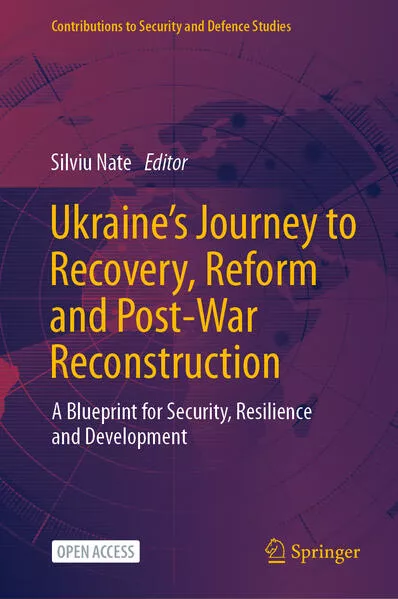
Ukraine's Journey to Recovery, Reform and Post-War Reconstruction
A Blueprint for Security, Resilience and Development
This open access volume explores Ukraine's challenges post-war, focusing on economic revival and sustainable development. Addressing scholars, policymakers, and practitioners the book discusses pivotal issues for the rebuilding of Ukraine, such as institutional changes, economic hurdles, social stability, and environmental rejuvenation.
The book highlights the inevitable need for Ukraine's institutional transformation, essential for EU and NATO integration. It goes on to examine the global geopolitical and economic repercussions and emphasizes the pivotal role of energy independence in the European landscape.
Through a multi-disciplinary lens encompassing political science, economics, and law, this book provides evidence-based insights and policy recommendations. Offering a comprehensive presentation of post-war challenges, it offers an invaluable guide for policymakers and practitioners interested in the complexities of Ukraine's reconstruction.
This is an open access book.


Unterstütze den lokalen Buchhandel
Nutze die PLZ-Suche um einen Buchhändler in Deiner Nähe zu finden.
Bestelle dieses Buch im Internet



| Veröffentlichung: | 13.11.2024 |
| Höhe/Breite/Gewicht | H 23,5 cm / B 15,5 cm / - |
| Seiten | 315 |
| Art des Mediums | Buch [Gebundenes Buch] |
| Preis DE | EUR 53.49 |
| Preis AT | EUR 54.99 |
| Reihe | Contributions to Security and Defence Studies |
| ISBN-13 | 978-3-031-66433-5 |
| ISBN-10 | 3031664337 |

Über den Autor
Silviu Nate is an Associate Professor of Security Studies at Lucian Blaga University of Sibiu, Romania, as well as the Director of the Global Studies Center (GSC). He holds a PhD in Military Sciences and Intelligence and is a member of the Euro-Atlantic Council Romania/Atlantic Treaty Association and the Romanian Association of International Relations and European Studies. Nate's expertise includes fellowships from institutions like Georgetown University, the Geneva Centre for Security Sector Governance (DCAF), and the NATO Science for Peace and Security Program. As GSC's leader, he guides the think-tank's involvement in the Crimea Platform and the EU's Eastern Partnership network. His policy-focused initiatives have secured research grants and influenced significant decisions, exemplified by the adoption of a bill to enhance the US and allied naval presence in the Black Sea.
Diesen Artikel teilen
0 Kommentar zu diesem Buch
.... weitere Publikationen von Springer International Publishing









Formalwissenschaftlicher Beweis der Existenz Gottes über kalkül - Mathematische Philosophie und Philosophie der Grammatik
Bewerbungsfrist bis zum: 29.10.2026