Bibliotheca Lichenologica
Biology of Lichens - Symbiosis, Ecology, Environmental Monitoring, Systematics and Cyber Applications
Chronologie aller Bände (1 - 2)
Die Reihenfolge beginnt mit dem Buch "Biology of Lichens - Symbiosis, Ecology, Environmental Monitoring, Systematics and Cyber Applications". Wer alle Bücher der Reihe nach lesen möchte, sollte mit diesem Band von Thomas (2) Nash beginnen. Mit insgesamt 2 Bänden wurde die Reihe über einen Zeitraum von ungefähr 6 Jahren fortgesetzt. Der neueste Band trägt den Titel "Lichens of Mexico".
- Anzahl der Bewertungen für die gesamte Reihe: 0
- Ø Bewertung der Reihe: 0
- Start der Reihe: 30.09.2010
- Neueste Folge: 17.10.2016
Diese Reihenfolge enthält 2 unterschiedliche Autoren.

- Band: 105
- Autor: Nash, Thomas (2)
- Anzahl Bewertungen: 0
- Ø Bewertung:
- Medium: Buch
- Veröffentlicht: 30.09.2010
- Genre: Comedy
Biology of Lichens - Symbiosis, Ecology, Environmental Monitoring, Systematics and Cyber Applications
Lichens dominate ca. 8% of the world's terrestrial ecosystems and play important ecological roles in many other ecosystems, such as foliicolous lichens in the tropics that provide a model system for studying the development of their symbiotic relationship in the fi eld. In any discussion of symbiosis, the lichenized fungi play a prominent role. Not only is a lichen a combination of fungus and alga(e) and/or a cyanobacterium, but also hosts specifi c bacteria and potentially other lichenicolous fungi. Accordingly, this volume of Bibliotheca Lichenologica opens with a modern review of symbiosis and closes with a paper on the selectivity of the photobiont. The possible origin of the symbiosis from a paleoecological perspective is also considered. The ecological role of lichens in the widely distributed, arid soil crusts, as well as several specifi c aspects of their community ecology, are also discussed in other chapters. For nearly two centuries lichens have been used in environmental monitoring, especially in relation to air pollution, new aspects of such monitoring relative to cumene hydroperoxide, Hg, NH3, O3, and various organopollutants are covered in separate chapters. Several systematic papers dealing with the Parmeliaceae and lichenicolous fungi are also presented. Cyber applications are now providing a wealth of information from literature records back to the 1500s to vastly improved identifi cation tools, to access to millions of collection records, and to integrating biodiversity networks.
- Band: 110
- Autor: Herrera-Campos, Maria
- Anzahl Bewertungen: 0
- Ø Bewertung:
- Medium: Buch
- Veröffentlicht: 17.10.2016
- Genre: Comedy
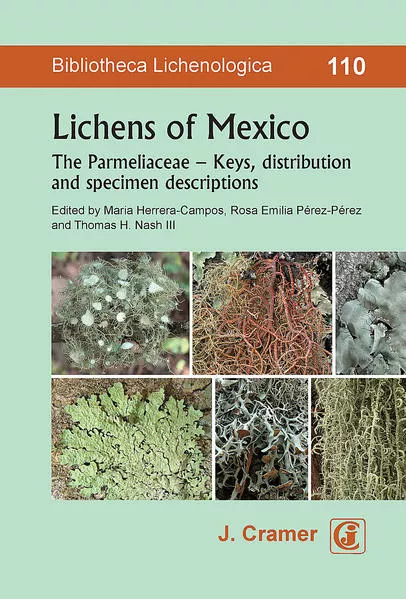
Lichens of Mexico
With well over 2000 species the Parmeliaceae is the largest family of lichenized fungi. Mexico with its huge topographic relief and wide range of habitats is one of the major biodiversity hot spots in the world. Accordingly, it is not surprising that this volume documents over 20% of the world’s Parmeliaceae from this country. In fact a vast majority of the Parmeliaceae known from North America are covered in this volume. Descriptions (morphological and chemical), keys, distribution information and extensive specimen citations covering all states in Mexico are provided in the systematic treatments covering 450 species from Alectoria, Anzia, Bryoria, Bulbothrix, Canoparmelia, Cetraria, Cetrelia, Hypotrachyna, Flavoparmelia, Hypogymnia, Imshaugia, Kaernefelita, Letharia, Melanelixia, Melanohalea, Menegazzia, Montanelia, Myelochroa, Nodobryoria, Oropogon, Parmelia, Parmelina, Parmelinella, Parmeliopsis, Parmotrema, Parmotremopsis, Phacopsis, Protoparmelia, Pseudephebe, Pseudevernia, Pseudoparmelia, Punctelia, Relicina, Remototrachyna, Tuckermanella, Tuckermannopsis, Usnea, and Xanthoparmelia. Keys to genera are based on the most recent molecular data. All the species of Parmotrema known for North America are covered in the keys. The book begins with a review of the physiographic aspects and biodiversity of Mexico and proceeds to the first lichen community phylogenetic analysis for the major ecological communities in Mexico based on the Parmeliaceae. The book will be useful to anyone studying the lichens of Mexico as well as adjacent regions in Central America, the Caribbean, and the United States.