Thinking Gender in Transnational Times
Cultural Representations of Gender Vulnerability and Resistance
Chronologie aller Bände (1 - 3)

Die Reihenfolge beginnt mit dem Buch "Cultural Representations of Gender Vulnerability and Resistance". Wer alle Bücher der Reihe nach lesen möchte, sollte mit diesem Band von Maria Isabel Romero-Ruiz beginnen. Der zweite Teil der Reihe "Cultural Representations of Gender Vulnerability and Resistance" ist am 12.05.2022 erschienen. Mit insgesamt 3 Bänden wurde die Reihe über einen Zeitraum von ungefähr 3 Jahren fortgesetzt. Der neueste Band trägt den Titel "Affective Activisms and the Right to Have Rights in Turkey".
- Anzahl der Bewertungen für die gesamte Reihe: 4
- Ø Bewertung der Reihe: 1.5
- Start der Reihe: 12.05.2022
- Neueste Folge: 27.02.2025
Diese Reihenfolge enthält 3 unterschiedliche Autoren.
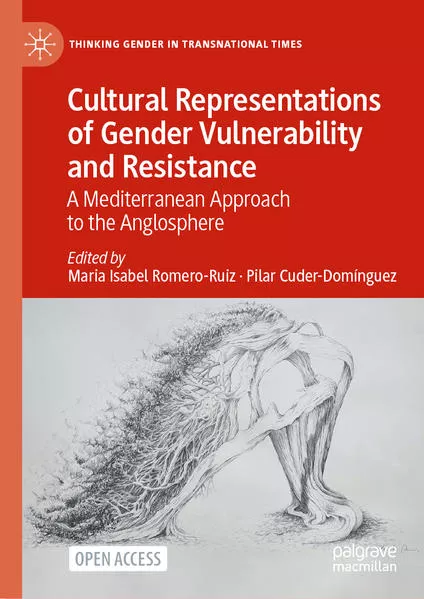
- Autor: Romero-Ruiz, Maria Isabel
- Anzahl Bewertungen: 2
- Ø Bewertung: 1.5
- Medium: Buch
- Veröffentlicht: 13.05.2022
- Genre: Krimi
Cultural Representations of Gender Vulnerability and Resistance
Grant FFI2017-84555-C2-1-P (research Project “Bodies in Transit: Genders, Mobilities, Interdependencies”) funded by MCIN/AEI/ 10.13039/501100011033 and by “ERDF A way of making Europe.”
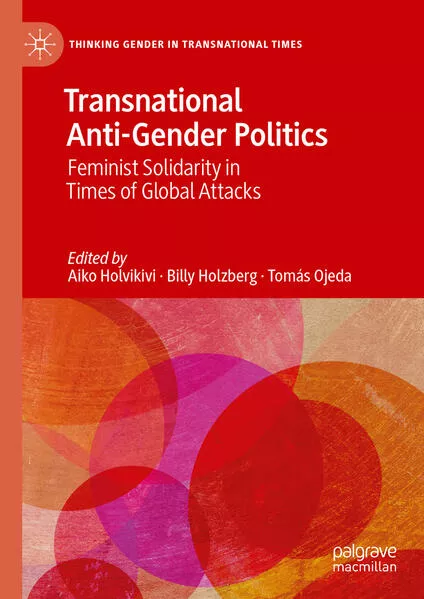
- Autor: Holvikivi, Aiko
- Anzahl Bewertungen: 0
- Ø Bewertung:
- Medium: Buch
- Veröffentlicht: 09.06.2024
- Genre: Politik
Transnational Anti-Gender Politics
In recent years, attacks on the rise of ‘gender ideology’ and ‘genderism’ as a political force, on gender studies as an academic field, and on feminist, queer and trans individuals seen to be their embodied representatives, have grown in scope and intensity. This edited volume understands such attacks as a global force in need of urgent analytical and political attention. Drawing on contributions from and about a varied range of geographical locations including Argentina, Chile, China, Germany, the Persian Gulf, Hungary, India, Pakistan, Peru, South Africa, Spain, Turkey, Uganda, the UK and the US, this book explores how anti-gender mobilisations work as a transnational formation shaped by the legacies of colonialism, racial capitalism, and resurgent nationalisms and how these can be resisted. By transnationalising our inquiries into the epistemic, affective and political nature of the anti-gender phenomenon, this volume troubles the ‘origin stories’ we tell about where anti-genderpolitics come from, and helps to better locate the various sources, actors, and networks behind these attacks, contesting the notion that anti-gender politics derive solely from right-wing nationalist or conservative religious actors, to show how they also derive from more centrist, liberal, leftist and even presumably feminist positions. The book thus invites us to sharpen and rethink the conceptual vocabularies and strategies we use to understand and resist anti-gender attacks, opening up space for envisioning new political imaginaries and transnational feminist solidarities.
Chapter 1 is available open access under a Creative Commons Attribution 4.0 International License via link.springer.com.

- Autor: Avramopoulou, Eirini
- Anzahl Bewertungen: 0
- Ø Bewertung:
- Medium: Buch
- Veröffentlicht: 27.02.2025
- Genre: Politik
Affective Activisms and the Right to Have Rights in Turkey
This book presents a novel approach to the study of contemporary social movements and activism. Based on extensive ethnographic research of the life and politics of feminist, LGBTQI+, and women’s religious groups in Istanbul from 2007 to 2015, it explores the affects, meanings, and interpretations these groups express in their activism—in particular, their strategic use of human rights’ language to claim institutional and social legitimacy and their reinterpretation of gender/queer theory across politics of difference to make sense of global dynamics that affect their everyday lives. Chapters interweave personal accounts and life histories of individual activists with specific historical events to demonstrate the activists’ dissidence regarding the conditions that have defined their differently marginalised positions in Turkey and the significance of the formation of unexpected alliances. The ambivalent, yet inescapable, bargaining tool of rights is analysed as a demand over affective democratic visions, citizenship and a life worth living, and thus the right to have rights, as it is argued, pushes us to reflect on how power works when the political and affective surplus value invested in the need to rethink of rights (even beyond human rights themselves) lies both in the search for ways of institutionalising and implementing rightful demands, as well as in outlining more affective visions of political resistance.
By arguing that activism is a performative and affective language that is defined by intersectional hopes, desires and dreams, as much as it engages with legal battles that define who or what might appear as being broken under specific historical and social settings, Affective Activisms employs gender and sexuality as analytical tools to make sense of local and transnational politics of resistance in the face of the re-emergence of authoritarian regimes, sexual harassment, gender violence, homo/trans phobia, and Islamophobia in Turkey and worldwide. It will be of interest to students and scholars across the fields of women's, gender and sexuality studies, queer theory, critical human rights and political theory, sociology, and social anthropology.