Chemistry and Material Science (R0)
Proceedings of the 10th International Symposium on Superalloy 718 and Derivatives
Chronologie aller Bände (1 - 3)

Die Reihenfolge beginnt mit dem eBook "Re-envisioning Plastics Role in the Global Society". Wer alle eBookz der Reihe nach lesen möchte, sollte mit diesem Band von Ololade Olatunji beginnen. Der zweite Teil der Reihe "Environmental Consequences of International Conflicts" ist am 23.01.2025 erschienen. Mit insgesamt 3 Bänden wurde die Reihe über einen Zeitraum von ungefähr 3 Jahren fortgesetzt. Der neueste Band trägt den Titel "Essential Properties of Materials".
- Anzahl der Bewertungen für die gesamte Reihe: 0
- Ø Bewertung der Reihe: 0
- Start der Reihe: 01.01.2024
- Neueste Folge: 11.12.2026
Diese Reihenfolge enthält 3 unterschiedliche Autoren.
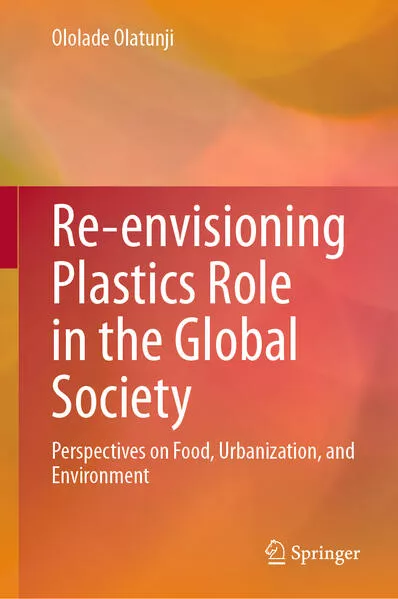
- Autor: Olatunji, Ololade
- Anzahl Bewertungen: 0
- Ø Bewertung:
- Medium: E-Book
- Veröffentlicht: 01.01.2024
- Genre: Politik
Re-envisioning Plastics Role in the Global Society
This book covers the challenges and opportunities presented by plastics in the modern era and sheds light on the complex interplay of technology, environment, and socio-economic dynamics. With a thorough exploration of the history, uses, and potential of plastics, the book reviews the impact of plastics beyond single-use plastics, and critiques multiple long-term plastic applications that are significant for food security, water resource management, ecological conservation/restoration, and sustainable urbanization. It also explores frameworks for achieving a more sustainable plastic economy aligned with sustainable development goals.
This book comprises 13 chapters, commencing with a critical assessment of plastics in the context of sustainable development and global society. It proceeds with a historical overview of plastics' evolution, showcasing pivotal milestones and innovations in modern industry and daily life. Subsequent chapters delve into diverse topics: the intricate relationships between plastics, food security, and sustainable urbanization; plastics' impact on water safety, management, distribution, and conservation; their potential as an alternative energy source; and their innovative applications in sustainable transportation and energy generation. Emphasis is placed on plastics' role in waste reduction and recycling, as well as the latest sustainable alternatives like biodegradable and recyclable materials. In the book's final sections, readers will learn about green buildings and climate-resilient cities constructed using innovative plastic materials, and plastics' significance in space exploration. The book concludes with a forward-looking perspective on plastics' future, accompanied by recommendations for a more sustainable coexistence between society and these versatile materials.
This book is a valuable resource for researchers, policymakers, industry professionals, and concerned citizens seeking to navigate the intricate landscape of plastics, their environmental implications, and their potential for sustainable development.
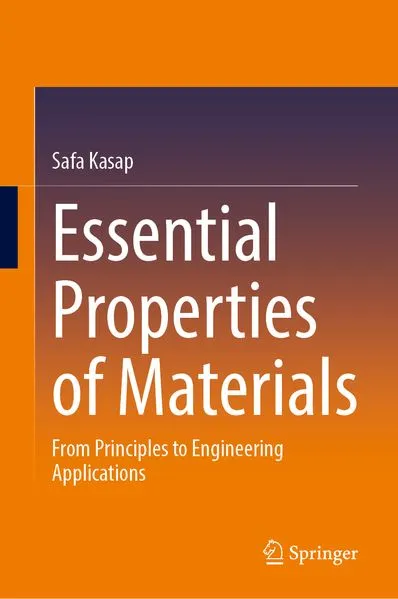
- Autor: Kasap, Safa
- Anzahl Bewertungen: 0
- Ø Bewertung:
- Medium: Digital
- Veröffentlicht: 11.12.2026
- Genre: Sonstiges
Essential Properties of Materials
This textbook presents a multi-faceted treatment of the essential properties of materials from basic fundamentals to engineering applications for all undergraduates at the second-year level in sciences and engineering with no prior exposure to modern physics. Clear explanations with examples are supported throughout the whole book with over 300 professionally prepared color diagrams, and a selection of scientific photographs. Each chapter has numerous solved problems and worked examples, many unique with practical significance, and engineering-related case studies. Carefully prepared definitions of important and useful terms at the end of each chapter are one of the most appealing features of the book for both students and practicing scientists and engineers. End-of-chapter problems with solutions provide students with a unique self-learning experience outside the classroom and add to an enhanced learning experience. Topics that require further physics and mathematics are collected under Additional Topics to maintain readability and to allow the book to be used in short courses.
- Develops principles with a minimum of mathematics, emphasizing physical concepts, with summaries of equations/concepts
- Includes chapter-end problems with solutions and explanations, with more-difficult problems highlighted and case studies
- Features many practical or engineering applications with color diagrams; important terms bolded or defined
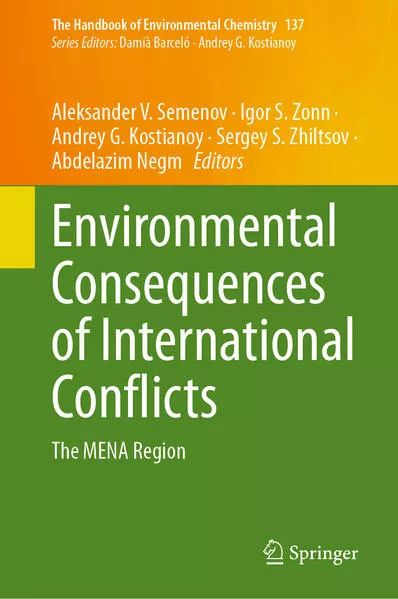
- Band: 137
- Autor: Semenov, Aleksander V.
- Anzahl Bewertungen: 0
- Ø Bewertung:
- Medium: E-Book
- Veröffentlicht: 23.01.2025
- Genre: Politik
Environmental Consequences of International Conflicts
This is the first of two volumes that, taken together, provide an integrated picture of the environmental consequences arising from international conflicts. The volumes build upon the successful book Environmental Consequences of War and Aftermath published in The Handbook of Environmental Chemistry in 2009. The books focus on environmental consequences only and discuss land degradation, erosion, water scarcity and pollution, water resources management, air pollution, desertification, deforestation, food scarcity and radioactive contamination, among others. This volume addresses conflicts in the MENA region (Middle East and North Africa), covering historical and more recent events such as water conflicts, military conflicts, migration and overpopulation, and infrastructure projects. Readers will also find several chapters in this book on the theory of international conflicts and their impact on the environment in general. Given its breadth, this book appeals to environmental scientists, policy makers, and researchers interested in the environmental impacts of international conflicts.