Lecture Notes in Educational Technology
Digital Transformation and Human-Machine Collaboration in Education
Chronologie aller Bände (1 - 2)

Die Reihenfolge beginnt mit dem Buch "Constructing Regional Smart Education Ecosystems in China". Wer alle Bücher der Reihe nach lesen möchte, sollte mit diesem Band von Haijun Zeng beginnen. Der zweite Teil der Reihe "Constructing Regional Smart Education Ecosystems in China" ist am 05.12.2023 erschienen. Die Reihe umfasst derzeit 2 Bände. Der neueste Band trägt den Titel "Digital Transformation and Human-Machine Collaboration in Education".
- Anzahl der Bewertungen für die gesamte Reihe: 0
- Ø Bewertung der Reihe: 0
- Start der Reihe: 17.11.2023
- Neueste Folge: 24.10.2025
Diese Reihenfolge enthält 2 unterschiedliche Autoren.
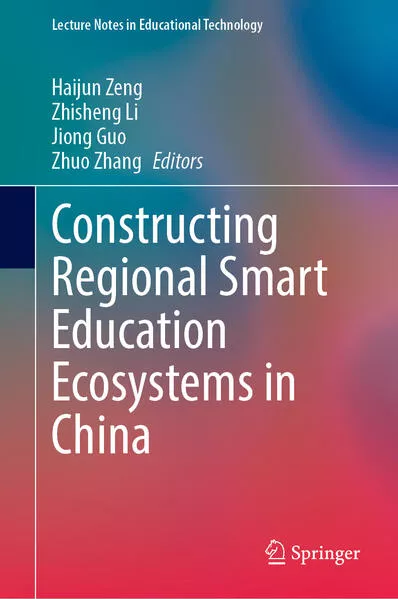
- Autor: Zeng, Haijun
- Anzahl Bewertungen: 0
- Ø Bewertung:
- Medium: Buch
- Veröffentlicht: 05.12.2023
- Genre: Politik
Constructing Regional Smart Education Ecosystems in China
This book enriches the understanding of regional smart education in China and promotes sharing of smart education case studies in China and abroad. It presents 46 case studies selected from a total of 644 case studies collected nationwide in China. These selected case studies focus on regional construction, research findings, and solutions. The case studies on regional construction mainly focus on the sustainable development mechanism of regional smart education. The research findings case studies showcase research results produced by research teams and individuals, which involve theories, models, technologies, practical investigations, or international comparisons related to smart education. Lastly, the solution case studies are technical solutions provided by enterprises for the development of smart education, which include application scenarios, methods, and effects in regions or schools around smart educational equipment, platforms, networks, tools, resources, or integrated solutions.
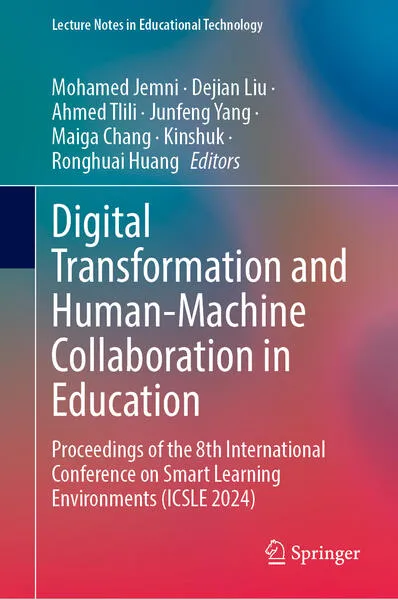
- Autor: Jemni, Mohamed
- Anzahl Bewertungen: 0
- Ø Bewertung:
- Medium: Buch
- Veröffentlicht: 24.10.2025
- Genre: Sonstiges
Digital Transformation and Human-Machine Collaboration in Education
This book is the proceedings of the 2024 International Conference on Smart Learning Environments (ICSLE 2024). It focuses on the interplay of pedagogy, technology, and the collaborative intelligence (human intelligence and artificial intelligence) towards the development of human-centered learning. This book covers various components of this interplay, including:
1) Next generation learning environments, such as AI powered learning environments, personalized learning environments, (multimodal) learning analytics, personalized and interoperable learning environment, and inclusive learning environments;
2) Human machine collaboration and synergy in education, namely the policies, applications, case studies and best practices of domain-specific/subject-specific smart learning, such as human-(ro) bot collaboration, human-AI collaboration, Avatars, digital twins and metaverse;
3) Pedagogy, learning approaches and instructional design, including collaborative intelligence (human intelligence and artificial intelligence), collaborative and group learning, and game-based learning and gamification;
4) Digital transformation for catalyzing online, and immersive and open learning spaces, including e-learning, blended/hybrid learning, and MOOCs;
5) Digital, machine and AI ethics in education, including ethical frameworks and policies in education, (Generative) AI ethics, teaching ethics, and responsible and human-centered AI in education.
This book serves as a useful reference for stakeholders in the field of education who are interested in the interplay of pedagogy, technology, and the collaborative intelligence towards the development of human-centered learning, such as researchers, postgraduate students, undergraduate students, as well as policymakers.