Berichte aus der Elektrotechnik
Regelsysteme zur Verlängerung der Lebensdauer von Leistungshalbleiterbauelementen in leistungselektronischen Stellgliedern
Chronologie aller Bände (1 - 2)
Die Reihenfolge beginnt mit dem Buch "Regelsysteme zur Verlängerung der Lebensdauer von Leistungshalbleiterbauelementen in leistungselektronischen Stellgliedern". Wer alle Bücher der Reihe nach lesen möchte, sollte mit diesem Band von Johannes Ruthardt beginnen. Der zweite Teil der Reihe "Integrated Circuits for Qubit Control in Trapped-Ion Quantum Computers" ist am 15.04.2025 erschienen. Die Reihe umfasst derzeit 2 Bände. Der neueste Band trägt den Titel "Integrated Circuits for Qubit Control in Trapped-Ion Quantum Computers".
- Anzahl der Bewertungen für die gesamte Reihe: 0
- Ø Bewertung der Reihe: 0
- Start der Reihe: 24.01.2024
- Neueste Folge: 15.04.2025
Diese Reihenfolge enthält 2 unterschiedliche Autoren.
- Autor: Ruthardt, Johannes
- Anzahl Bewertungen: 0
- Ø Bewertung:
- Medium: Buch
- Veröffentlicht: 24.01.2024
- Genre: Sonstiges
Regelsysteme zur Verlängerung der Lebensdauer von Leistungshalbleiterbauelementen in leistungselektronischen Stellgliedern
Diese Dissertation behandelt die regelungstechnische Verlängerung der Lebensdauer von Leistungshalbleiterbauelementen in leistungselektronischen Stellgliedern. Es wird der Betrieb des Stellglieds so beeinflusst, dass auftretende Sperrschichttemperaturhübe, welche zu einer Verkürzung der Lebensdauer der Leistungshalbleiterbauelemente führen, reduziert werden. Dazu wird der Einsatz einer aktiven Sperrschichttemperaturregelung vorgeschlagen. Verfahren zur Einflussnahme auf die Sperrschichttemperatur ohne Beeinträchtigung des regulären Betriebs, die Echtzeiterfassung jener Temperatur und geeignete Regelstrategien werden vorgestellt. Der Fokus liegt dabei auf einer allgemeinen Betrachtung, um die Anwendbarkeit der Verfahren nicht auf bestimmte Schaltungstopologien und bestimmter Anwendungsgebiete derer zu beschränken.
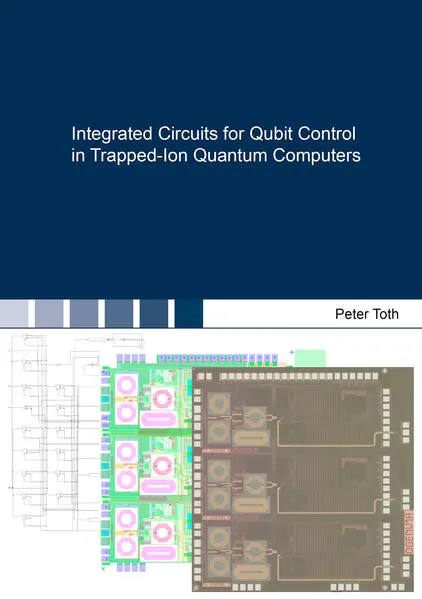
- Autor: Toth, Peter
- Anzahl Bewertungen: 0
- Ø Bewertung:
- Medium: Buch
- Veröffentlicht: 15.04.2025
- Genre: Sonstiges
Integrated Circuits for Qubit Control in Trapped-Ion Quantum Computers
Trapped ions (TI) are one of the leading platforms for realizing a universal quantum computer (QC). They feature several advantages compared to competing technologies based on superconducting-, semiconductor- and other qubit technology platforms.
This work presents a from-scratch design of two integrated system-on-chip (SoC) microwave generator solutions for the implementation of single and two-qubit gates and functionality for partial state preparation, and readout. First, the working principle of a TI QC system is described, which is the basis for deducing the system requirements of an integrated SoC solution. Two different system architectures are analyzed in depth and compared against each other, as well as the conventional RT-based controller. Hereafter, the implementation of the systemblocks in a SiGe 130 nmBiCMOS process are outlined.
Measurements of both microwave generator systems are presented and put in relation to the aforementioned system requirements. The work concludes with the application validation of the microwave generator performing state control of up to four TI-based qubits. Performance metrics such as gate time and fidelity are extracted and compared to the current state-of-the-art RT-based microwave generator and competing QC system realizations.
The proposed microwave generator system achieves identical performance as its RT-based counterpart in terms of qubit state manipulation and comparable performance in terms of gate fidelity. Yet it requires two orders of magnitude less power and seven orders of magnitude less volume. To the best of the author’s knowledge, this is the first demonstration of an integrated circuit solution for TI based qubit state manipulation.
This work presents a from-scratch design of two integrated system-on-chip (SoC) microwave generator solutions for the implementation of single and two-qubit gates and functionality for partial state preparation, and readout. First, the working principle of a TI QC system is described, which is the basis for deducing the system requirements of an integrated SoC solution. Two different system architectures are analyzed in depth and compared against each other, as well as the conventional RT-based controller. Hereafter, the implementation of the systemblocks in a SiGe 130 nmBiCMOS process are outlined.
Measurements of both microwave generator systems are presented and put in relation to the aforementioned system requirements. The work concludes with the application validation of the microwave generator performing state control of up to four TI-based qubits. Performance metrics such as gate time and fidelity are extracted and compared to the current state-of-the-art RT-based microwave generator and competing QC system realizations.
The proposed microwave generator system achieves identical performance as its RT-based counterpart in terms of qubit state manipulation and comparable performance in terms of gate fidelity. Yet it requires two orders of magnitude less power and seven orders of magnitude less volume. To the best of the author’s knowledge, this is the first demonstration of an integrated circuit solution for TI based qubit state manipulation.