Chronologie aller Bände (1 - 3)

Die Reihenfolge beginnt mit dem Buch "Digital Land Resources to Support Sustainable Development in Egypt". Wer alle Bücher der Reihe nach lesen möchte, sollte mit diesem Band von Abd-Alla Gad beginnen. Der zweite Teil der Reihe "Drowning Lands" ist am 09.10.2026 erschienen. Mit insgesamt 3 Bänden wurde die Reihe über einen Zeitraum von ungefähr 3 Jahren fortgesetzt. Der neueste Band trägt den Titel "River–Water–Livelihood Nexus in the Anthropocene".
- Anzahl der Bewertungen für die gesamte Reihe: 0
- Ø Bewertung der Reihe: 0
- Start der Reihe: 05.11.2023
- Neueste Folge: 06.12.2026
Diese Reihenfolge enthält 3 unterschiedliche Autoren.
- Autor: Gad, Abd-Alla
- Anzahl Bewertungen: 0
- Ø Bewertung:
- Medium: Buch
- Veröffentlicht: 05.11.2023
- Genre: Politik
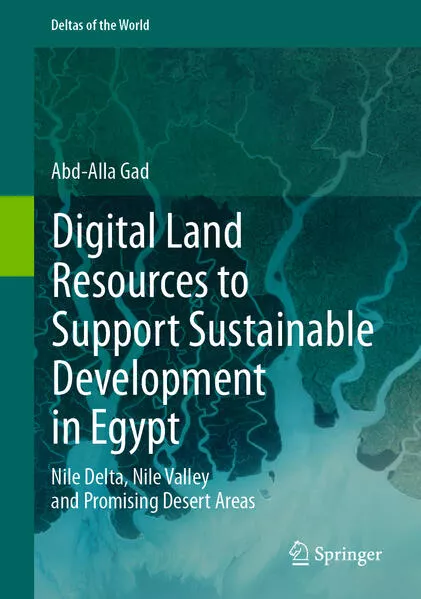
Digital Land Resources to Support Sustainable Development in Egypt
This book provides accurate and integrated information about land resources especially with the accelerated progress of information technology to help Egypt and similar countries to achieve the country sustainable development goals in the field of agriculture and natural resources. The Egyptian National sustainable development plans mainly aim to conserve the arable lands in the Nile Delta and the Nile Valley, in addition to the oases and desert fringes. Moreover, increasing land productivity is a vital national goal for filling the food gap. Consequently, providing accurate and integrated information about land natural resources using the recent technologies such as satellite data/images and geoinformatics techniques. Such information would be a base for planning, decision making and research needs all over the world due to the importance of Egypt as the biggest and leading country in the MENA regions.
The book provides land natural resources database as a platform, upon which additional thematic information can be added in the future to serve multi approached sustainable development. The book highlights the usage of digital information in monitoring urban planning and encroachment, in addition to soil and land capability classification. Moreover, networks of irrigation/drainages, railways, and utilities are added for a wide management range. Various available information systems were employed to initiate the targeted land resources database (e.g., ArcGIS, ERDAS IMAGINE and ENVI). Data of previous soil survey projects were the basis for the created digital database including High Dam Soil Survey, Soil map of Egypt and Land Master Plane.
The Digital Elevation Model (DEM) was elaborated using SRTM space images, in addition to spot heights and contour lines derived from the topographic maps (scale 1:50,000) produced by the Egyptian Survey Authority (ESA). The resulted thematic layers were incorporated in the created GIS land resources database.
The book is a unique and a great source of information and knowledge for all researchers around the globe particularly for MENA regions. Researchers, graduate students, the policy planners and decision making will find this book very useful for them. are most people who could benefit from the book. We believe the book will be an added value to the existing information and knowledge.
- Autor: Sushobhan Majumdar
- Anzahl Bewertungen: 0
- Ø Bewertung:
- Medium: Buch
- Veröffentlicht: 09.10.2026
- Genre: Sonstiges
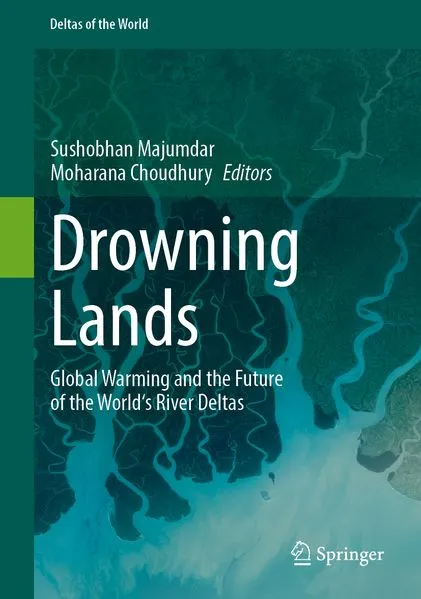
Drowning Lands
This book offers a comprehensive and forward‑looking examination of how global warming is reshaping the world’s river deltas, among the most vulnerable yet vital landscapes on Earth. It provides critical insights into the environmental, social, and political challenges faced by deltaic regions as intensifying climate pressures converge on low‑lying coastal areas.
The volume emphasizes the central importance of delta resilience for global climate adaptation and human security, particularly in the context of rising sea levels, extreme weather events, altered hydrological cycles, accelerated land loss, saltwater intrusion, biodiversity decline, and disruptions to food systems.
It covers key thematic areas including deltaic geomorphology, sea‑level rise, salinization, land subsidence, food security, climate‑induced migration, urban infrastructure risk, and the role of traditional knowledge in adaptation. In‑depth case studies from major delta systems, such as the Mekong, Nile, Ganges‑Brahmaputra, and Mississippi, highlight both shared vulnerabilities and region‑specific dynamics. It also examines governance challenges, financing mechanisms, and international cooperation in managing transboundary river systems, while assessing nature‑based solutions, managed retreat, and emerging adaptation technologies. By bringing together expert perspectives and evidence‑based research, it fills critical knowledge gaps and offers a clear roadmap for policy and future action.
The volume serves both as a scholarly contribution and a practical guide for policymakers, planners, environmental NGOs, climate professionals, and graduate students concerned with the future of deltaic environments under climate change.
- Autor: Aznarul Islam
- Anzahl Bewertungen: 0
- Ø Bewertung:
- Medium: Buch
- Veröffentlicht: 06.12.2026
- Genre: Sonstiges
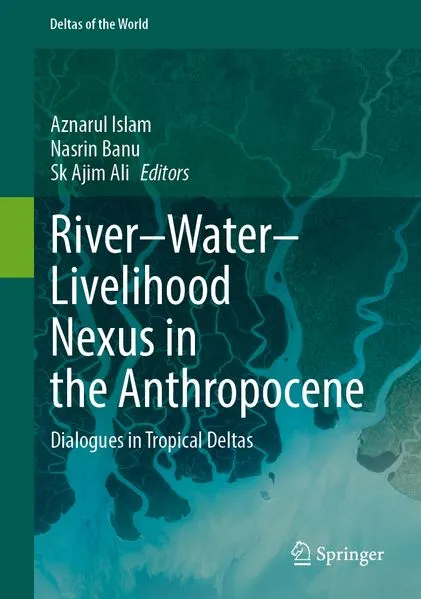
River–Water–Livelihood Nexus in the Anthropocene
River-Water-Livelihood Nexus in the Anthropocene: Dialogues in Tropical Deltas explores the interconnections between river systems, water dynamics, and livelihoods in an era of increasing climatic and anthropogenic pressures. The book aims to bridge natural hazards research with Disaster Risk Reduction (DRR) by examining how exposure, sensitivity, and adaptive capacity interact within river basins and floodplains. Using interdisciplinary approaches including geographical analysis, socio-hydrological modelling, vulnerability assessment, spatial analytics (GIS and remote sensing), and participatory methods it demonstrates how disaster risk can be better mapped, understood, and managed when environmental and social dimensions are considered together.
The study also examines governance challenges in river basin management, particularly in transboundary contexts where ecological systems intersect with political boundaries. Institutional fragmentation, policy silos, and unequal power structures often constrain effective risk mitigation. In alignment with global frameworks such as the Sendai Framework for Disaster Risk Reduction and the Sustainable Development Goals, the book advocates integrated river basin management, ecosystem-based strategies, and community-centered adaptation.
Conceptually, the book advances the River–Water–Livelihood Nexus as an integrative framework that links physical geography, socio-hydrology, disaster studies, and development policy. It situates disaster risk within the broader context of the Anthropocene, where human interventions such as dams, embankments, urban expansion, and land-use change actively reshape hazard regimes. Moving beyond hazard-centered perspectives, the work emphasizes vulnerability, adaptive capacity, and livelihood transformation, highlighting how risk is socially produced and unevenly distributed among river-dependent populations. By combining natural science, social science, and policy perspectives, the book offers practical and policy-relevant insights for strengthening resilience and promoting sustainable riverine development in an increasingly uncertain hydro-climatic environment.