Herrschaft und soziale Systeme in der Frühen Neuzeit
Militär und Recht vom 16. bis 19. Jahrhundert
Chronologie aller Bände (1 - 2)

Die Reihenfolge beginnt mit dem Buch "Militär und Recht vom 16. bis 19. Jahrhundert". Wer alle Bücher der Reihe nach lesen möchte, sollte mit diesem Band von Maria R. Boes beginnen. Der zweite Teil der Reihe "Soldgeschäfte, Klientelismus, Korruption in der Frühen Neuzeit" ist am 13.08.2018 erschienen. Die Reihe umfasst derzeit 2 Bände. Der neueste Band trägt den Titel "Soldgeschäfte, Klientelismus, Korruption in der Frühen Neuzeit".
- Anzahl der Bewertungen für die gesamte Reihe: 0
- Ø Bewertung der Reihe: 0
- Start der Reihe: 07.11.2016
- Neueste Folge: 13.08.2018
Diese Reihenfolge enthält 2 unterschiedliche Autoren.
- Autor: Maria R. Boes
- Anzahl Bewertungen: 0
- Ø Bewertung:
- Medium: Buch
- Veröffentlicht: 07.11.2016
- Genre: Sonstiges
Militär und Recht vom 16. bis 19. Jahrhundert
The relationship between the military and law has been recognised as a desideratum for quite some time, particularly with regard to the early modern period. The edited volume intends to fill this historiographical gap. It explores a hitherto neglected field in the history of early modern Europe at the crossroads between the histories of law, crime and criminal justice as well as war. The collected essays revolve around the central questions of legal norms in the context of historical change, the formation and institutionalisation of specific jurisdictions as well as the underlying transformation of early modern (military) societies. Furthermore, the volume explores the legal practice of the period, its evolution and the associated scholarly discourse, with the latter forming the background for a discussion of the continuities and ruptures vis-à-vis the 19th century.
- Autor: Affolter, Andreas
- Anzahl Bewertungen: 0
- Ø Bewertung:
- Medium: Buch
- Veröffentlicht: 13.08.2018
- Genre: Sonstiges
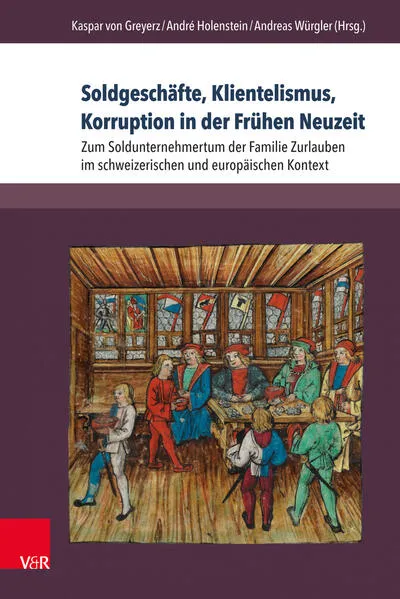
Soldgeschäfte, Klientelismus, Korruption in der Frühen Neuzeit
Mercenary trade was an important component of Swiss and European history in the early modern age. On the one hand, it promoted clientelism and on the other hand it provoked criticism of corruption. In the light of this, the authors analyse the economic and political activities of the family Zurlauben from Zug in Switzerland, which became extinct in 1799. However, contributions on clientelism, patronage, criticism of corruption and on transnational markets of violence of the 17th and 18th century depict the European aspects of this issue and its different economic, political and social dimensions. The present volume is published in connection with the completion of the Edition of the Acta Helvetica of the family Zurlauben.