Chronologie aller Bände (1 - 2)

Die Reihenfolge beginnt mit dem Buch "Globalisation Impacts". Wer alle Bücher der Reihe nach lesen möchte, sollte mit diesem Band von Amitendu Palit beginnen. Der zweite Teil der Reihe "Globalisation Impacts" ist am 04.01.2022 erschienen. Mit insgesamt 2 Bänden wurde die Reihe über einen Zeitraum von ungefähr 2 Jahren fortgesetzt. Der neueste Band trägt den Titel "The Wretched of the Global South".
- Anzahl der Bewertungen für die gesamte Reihe: 0
- Ø Bewertung der Reihe: 0
- Start der Reihe: 04.01.2022
- Neueste Folge: 08.03.2024
Diese Reihenfolge enthält 2 unterschiedliche Autoren.
- Autor: Palit, Amitendu
- Anzahl Bewertungen: 0
- Ø Bewertung:
- Medium: Buch
- Veröffentlicht: 05.01.2022
- Genre: Politik
Globalisation Impacts
The book reviews globalisation by identifying causes behind the discontent it has produced in recent years. It variously engages in economics, political economy, development and policy discourses to study experiences of countries and institutions in managing and adjusting to globalisation. Extending the analysis to latest global developments, including the remarkable advance of technology and digitalisation, and political and economic upheavals caused by COVID19, the book collects varied academic perspectives and reflects on the present as well as future. Comprising chapters written by distinguished academics and policy experts, the book is a rare collection of cross-disciplinary objective evaluations of globalisation.
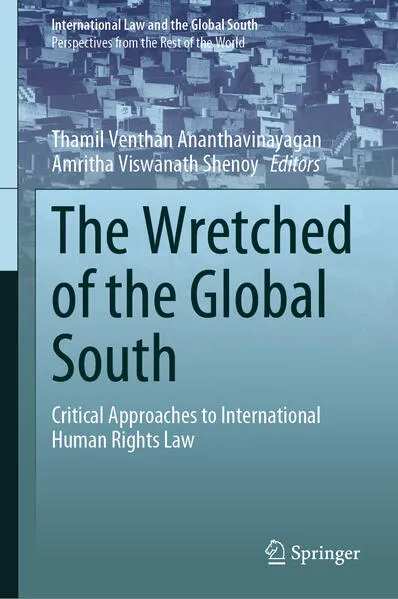
- Autor: Venthan Ananthavinayagan, Thamil
- Anzahl Bewertungen: 0
- Ø Bewertung:
- Medium: Buch
- Veröffentlicht: 08.03.2024
- Genre: Sonstiges
The Wretched of the Global South
The books aims to discuss and present an alternative epistemology of human rights, against the background of the globalization from below. The interdependent network of transnational networks, ranging from social movements, NGOs, and other groupings, questions the neoliberal paradigm and a particular set of human rights. This book wishes to transform this discourse on human rights and amplify the subaltern voices. The book also aims to highlight alternative practices of freedom that decenter human rights as a liberation discourse. Following Julia Suarez-Krabbe in “Race, Rights and Rebels”, the authors aim to amend to practices of freedom that center different orders of knowledge on subjectivity and agency. The proposed book, first, situates the problem of representation of the marginalized voices in contemporary legal and political discourse. Second, it offers critiques in theory, and, third, followed by alternative practices that emanate from marginalized localities. In particular, this book wishes to reflect upon alternatives rooted in legal and non-legal responses to address human rights grievances. In the end, this book envisages, along the lines of Frantz Fanon, to vision the possibility of the human by a new concept, addressing the concerns in various ways: As Fanon argued for “a new start”, “a new way of thinking”, and for the creation of a “new man”, it is pertinent to trigger a human rights project from the below.< p="">^