Chronologie aller Bände (1 - 2)
Die Reihenfolge beginnt mit dem eBook "Pandemics and Ethics". Wer alle eBookz der Reihe nach lesen möchte, sollte mit diesem Band von Andreas Reis beginnen. Der zweite Teil der Reihe "How and Why Do Courts Cite?" ist am 24.10.2025 erschienen. Mit insgesamt 2 Bänden wurde die Reihe über einen Zeitraum von ungefähr 2 Jahren fortgesetzt. Der neueste Band trägt den Titel "How and Why Do Courts Cite?".
- Anzahl der Bewertungen für die gesamte Reihe: 0
- Ø Bewertung der Reihe: 0
- Start der Reihe: 06.07.2023
- Neueste Folge: 24.10.2025
Diese Reihenfolge enthält 2 unterschiedliche Autoren.
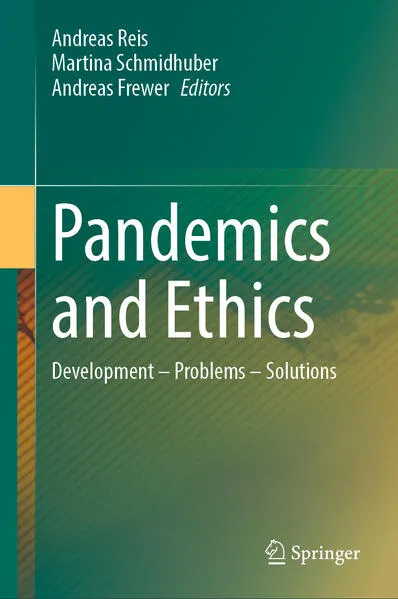
- Autor: Reis, Andreas
- Anzahl Bewertungen: 0
- Ø Bewertung:
- Medium: E-Book
- Veröffentlicht: 06.07.2023
- Genre: Sonstiges
Pandemics and Ethics
Pandemics such as Covid-19, Ebola, SARS, and influenza, as well as the necessary measures for their research, prevention, and treatment, raise a number of ethical issues that confront science, the medical profession, and health policy.
This overview volume, written by renowned experts from medicine, the humanities, and the social sciences, addresses the central ethical issues in pandemics. Focusing on the disciplines of philosophy, public health, bioethics, and law, the book discusses issues of resource allocation, triage, and research, as well as restrictions on freedom, rights and duties of health professionals, and ethical aspects of digital medicine in crises. The volume is intended to serve as a handbook and to provide physicians as well as nurses, politicians and interested laypersons with valuable advice on how to deal with the difficult moral problems of epidemics and pandemics.
With expert contributions by Steffen Augsberg (Giessen), Klaus Bergdolt (Cologne), Nikola Biller-Andorno (Zurich), Walter Bruchhausen (Bonn), Christiane Druml (Vienna), Hans-Jörg Ehni (Tuebingen), Alice Faust (Berlin), Sophia Forster (Erlangen-Nuremberg), Andreas Frewer (Erlangen-Nuremberg), Sara Gerke (Boston/Cambridge), Patrik Hummel (Eindhoven), Elena Jirovsky-Platter (Vienna), Katharina Kieslich (Vienna), Otmar Kloiber (Ferney-Voltaire), Ulrich H. J. Körtner (Vienna), Eva Kuhn (Bonn), Georg Marckmann (Munich), Timo Minssen (Copenhagen), Tim Nguyen (Geneva), Barbara Prainsack (Vienna), Andreas Reis (Geneva), Anita Rieder (Vienna), Stephan Rixen (Bayreuth), Lana Saksone (Berlin), Martina Schmidhuber (Graz), Harald Schmidt (Philadelphia), Annabel Seebohm (Brussels), Daniel Strech (Berlin), Sebastian Wäscher (Zurich), Hans-Werner Wahl (Heidelberg), Stefanie Weigold (Berlin), and Lena Woydack (Berlin).
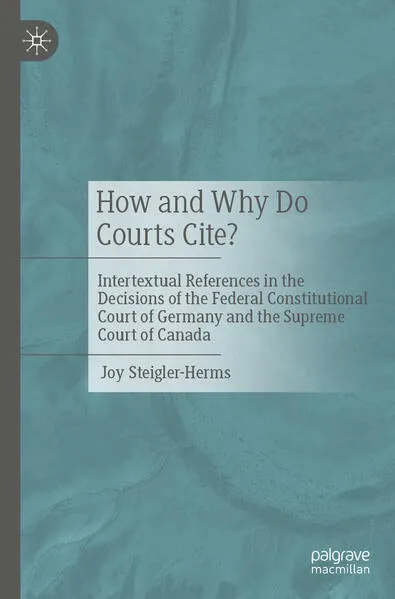
- Autor: Steigler-Herms, Joy
- Anzahl Bewertungen: 0
- Ø Bewertung:
- Medium: Digital
- Veröffentlicht: 24.10.2025
- Genre: Sonstiges
How and Why Do Courts Cite?
Court decisions can neither be made nor drafted without references to other texts; citations are omnipresent in judicial rulings. Every decision takes relevant normative texts or precedents into account, primarily to ensure coherent case law. Through the act of referencing, courts demonstrate that their decisions are based on an established legal doctrine. This integration into the existing doctrine legitimizes the decision and thus creates legal certainty through predictability.
Moreover, court decisions also contain references to texts that do not possess legal authority and therefore cannot be assigned such a function. Among the sources cited by courts, alongside statutory texts, are—for example—references to foreign law, scholarly sources, or even literary texts.
In view of this, the present study addresses the question of how and why courts cite. Using decisions from the Federal Constitutional Court of Germany and the Supreme Court of Canada as examples, the interdisciplinary study proposes both philological and legal evaluation criteria for the empirical reconstruction of citation functions and furthermore adopts a comparative perspective on jurisdiction-related differences in citation practices in courts.