Lecture Notes in Computer Science

EUROCAL '85. European Conference on Computer Algebra. Linz, Austria, April 1-3, 1985. Proceedings

Chronologie aller Bände (1 - 6)

Die Reihenfolge beginnt mit dem Buch "Algorithms in Bioinformatics". Wer alle Bücher der Reihe nach lesen möchte, sollte mit diesem Band von Bruno Buchberger beginnen. Der zweite Teil der Reihe "EUROCAL '85. European Conference on Computer Algebra. Linz, Austria, April 1-3, 1985. Proceedings" ist am 30.06.2005 erschienen. Mit insgesamt 6 Bänden wurde die Reihe über einen Zeitraum von ungefähr 9 Jahren fortgesetzt. Der neueste Band trägt den Titel "Algorithms in Bioinformatics".

  • Anzahl der Bewertungen für die gesamte Reihe: 0
  • Ø Bewertung der Reihe: 0
  • Start der Reihe: 30.06.2005
  • Neueste Folge: 01.09.2014

Diese Reihenfolge enthält 6 unterschiedliche Autoren.

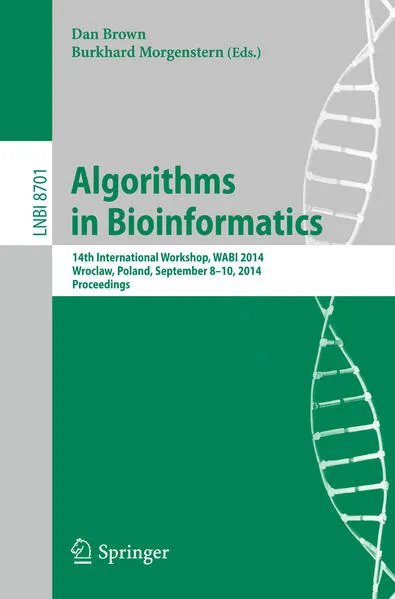
Cover: Algorithms in Bioinformatics
  • Autor: Brown, Dan
  • Anzahl Bewertungen: 0
  • Ø Bewertung:
  • Medium: Buch
  • Veröffentlicht: 01.09.2014
  • Genre: Sonstiges

Algorithms in Bioinformatics

This book constitutes the refereed proceedings of the 14th International Workshop on Algorithms in Bioinformatics, WABI 2014, held in Wroclaw, Poland, in September 2014. WABI 2014 was one of seven conferences that were organized as part of ALGO 2014. WABI is an annual conference series on all aspects of algorithms and data structure in molecular biology, genomics and phylogeny data analysis. The 26 full papers presented together with a short abstract were carefully reviewed and selected from 61 submissions. The selected papers cover a wide range of topics from sequence and genome analysis through phylogeny reconstruction and networks to mass spectrometry data analysis.
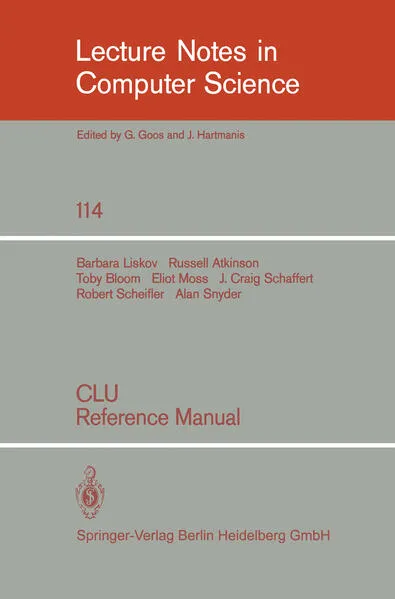
Cover: CLU
  • Band: 114
  • Autor: Liskov, B.
  • Anzahl Bewertungen: 0
  • Ø Bewertung:
  • Medium: E-Book
  • Veröffentlicht: 11.04.2006
  • Genre: Sonstiges

CLU

Inhaltsverzeichnis

  • Modules.
  • Data types.
  • Semantics.
  • The library.
  • Notation.
  • Lexical considerations.
  • Types, type generation, and type specifications.
  • Scopes, declarations, and equates.
  • Assignment and invocation.
  • Expressions.
  • Statements.
  • Exception handling and exits.
Cover: EUROCAL '85. European Conference on Computer Algebra. Linz, Austria, April 1-3, 1985. Proceedings
  • Band: 203
  • Autor: Buchberger, Bruno
  • Anzahl Bewertungen: 0
  • Ø Bewertung:
  • Medium: E-Book
  • Veröffentlicht: 30.06.2005
  • Genre: Sonstiges

EUROCAL '85. European Conference on Computer Algebra. Linz, Austria, April 1-3, 1985. Proceedings

Inhaltsverzeichnis

  • Computer algebra: Past and future.
  • MACSYMA: Capabilities and applications to problems in engineering and the sciences.
  • A preview of the next IBM-PC version of muMATH.
  • Current developments in LISP.
  • Computer algebra as a research tool in physics.
  • Symbolic computation and chemistry.
  • Computational geometry: Selected algorithms and paradigms.
  • Algebraic and symbolic computation in digital signal processing, coding and cryptography.
  • Computer algebra and practical analysis.
  • A new arithmetic for scientific computation with exact evaluation of expressions.
  • Algorithmic methods in automatic programming.
  • Proof theory and the synthesis of programs: Potential and limitations.
  • Constructions: A higher order proof system for mechanizing mathematics.
  • Scientific computation: The integration of symbolic, numeric and graphic computation.
Cover: EUROCAL '85. European Conference on Computer Algebra. Linz, Austria, April 1-3, 1985. Proceedings
  • Band: 204
  • Autor: Caviness, Bob F.
  • Anzahl Bewertungen: 0
  • Ø Bewertung:
  • Medium: E-Book
  • Veröffentlicht: 14.07.2005
  • Genre: Sonstiges

EUROCAL '85. European Conference on Computer Algebra. Linz, Austria, April 1-3, 1985. Proceedings

Inhaltsverzeichnis

  • Algorithms for polynomial division.
  • Sparse hensel lifting.
  • Heugcd: How elementary upperbounds generate cheaper data.
  • Gaussian elimination over a euclidean ring.
  • Demonstration of reduce3 as implemented on a stand-alone Motorola 68000 based microcomputer.
  • The Scratchpad II computer algebra language and system.
  • The SAC-2 computer algebra system.
  • DOE-MACSYMA: Progress report.
  • Towards practical implementations of syllogistic.
  • Path resolution and semantic graphs.
  • Fast subsumption algorithms.
  • Substitution expressions: Extracting solutions of non-Horn clause proofs.
  • The complexity of elementary problems in archimedean ordered groups.
  • Progress on the equivalence problem.
  • Symbol representations of noncommutative algebras.
  • Algebraic computations in elementary catastrophe theory.
  • Bifurcation theory and computer algebra: An initial approach.
  • Factorization of polynomials by transcendental evaluation.
  • Factorization of rational polynomials in the Zassenhaus — Norm.
  • On decomposable and commuting polynomials.
  • Fast polynomial decomposition algorithms.
  • A program system for root finding.
  • A program system for factorization of polynomials with rational coefficients.
  • THKLISP as a base of formula manipulation systems.
  • AMP a system for algebraic computations.
  • The program ortocartan for applications in Einstein's relativity theory.
  • Sheep and classification in general relativity.
  • Norcan — A computer calculus program.
  • Demo of stensor.
  • Visual environments for symbolic computation.
  • Syntactic equivalences inducing semantic equivalences.
  • The Algos computational system.
  • Retrieval in a module library using formal specifications: Preliminary search using syntactic properties.
  • The J-Machine: Functional programming with combinators.
  • Symbolic algebra in problems ofnonlinear mechanics.
  • Macsyma's computation of dirac-bergmann algorithm for Hamiltonian syytems with constraints.
  • Infinite dimensional computer Lie algebra ?.
  • Application of computer algebra to the theory of the vibration-rotational spectra of diatomic molecules.
  • Algorithms for the character theory of the symmetric group.
  • Worst-case analysis of algorithms for computational problems on abelian permutation groups.
  • A completion of some coxeter groups.
  • A CAYLEY file of finite simple groups.
  • On some laws in PSL(2, q).
  • An adjacency algorithm for cylindrical algebraic decompositions of three-dimensional space.
  • A cluster-based cylindrical algebraic decomposition algorithm.
  • On mechanical quantifier elimination for elementary algebra and geometry: Solution of a nontrivial problem.
  • Gröbner bases using SAC2.
  • A polynomial-time algorithm for the topological type of a real algebraic curve.
  • An improved projection operation for cylindrical algebraic decomposition.
  • Arithmetic in quadratic fields with unique factorization.
  • About a new method for computing in algebraic number fields.
  • An algebraic implementation of packages.
  • The SMP pattern matcher.
  • An expression compression package for REDUCE based on factorization and controlled expansion.
  • STENSOR uses disc automatically for very large computations.
  • Numerical methods with automatic verification.
  • ACRITH — High accuracy arithmetic subroutine library.
  • Floating-point computation in PASCAL-SC with verified results.
  • PASCAL-SC demonstration accurate arithmetic for verified results.
  • A solution to the polynomial hensel-code conversion problem.
  • A posteriori interval analysis.
  • Symbolic manipulations on a computer and their application to generation and investigation of difference schemes.
  • Completeness in data typespecifications.
  • On solving the equality problem in theories defined by Horn clauses.
  • Reducing the complexity of the Knuth-Bendix completion algorithm: A „unification“ of different approaches.
  • A confluence criterion based on the generalised Newman Lemma.
  • ERIL — Equational reasoning: an interactive laboratory.
  • Implementation of a general completion procedure parameterized by built-in theories and strategies.
  • Computer algebra in Norway.
  • Goppa codes: Algorithmic problems.
  • Gcd's and factoring multivariate polynomials using Grobner bases.
  • A note on the complexity of constructing standard bases.
  • Some algorithmic questions on ideals of differential operators.
  • Obtaining complete sets of reductions and equations without using special unification algorithms.
  • An overview of completion algorithms.
  • The optimisation by „code motion“ of user programs for an algebraic manipulation system.
  • An improved plotting package for VAXIMA.
  • On logic programs with data-driven computations.
  • Darwin, a system designed for the study of enumerative combinatorics.
  • Correctness proofs of the implementation of abstract data types.
  • Using prolog for constructing geometric objects defined by constraints.
  • The role of symbolic computation in the management of scientific information.
  • CIM (computer integrated manufacturing) — A challenge for symbolic computation.
  • Symbolic and algebraic computation may support secondary education.
  • Software toolkit for input stage measurement in symbolic compuation.
  • The algebraic manipulation systems on the electrical power systems.
  • A new method of computing fundamental units in algebraic number fields.
  • The generalized Voronoi-algorithm in totally real algebraic number fields.
  • An algorithm for the computation of perfect polyhedral cones over realquadratic number fields.
  • Explicit determination of non-trivial torsion structures of elliptic curves over quadratic number fields.
  • p-Adic algorithms and the computation of zeros of p-adic l-functions.
  • On the solution of the diophantine equation Gn=pz.
  • Term orderings on the polynomial ring.
  • An algorithmic approach to local rings.
  • A reduction strategy for the taylor resolution.
  • From polynomials to Galois groups.
  • A system for parallel computer algebra programs.
  • Unification in parallel with refined linearity test: An example of recursive network structure in FP2, a functional parallel programming language.
  • The parallel L-machine for symbolic computation.
  • Unification in conditional-equational theories.
  • Mechanical translation of set theoretic problem specifications into efficient RAM code — A case study.
  • A methodology for automatic programming based on the constructive matching strategy.
  • The structural synthesis of programs: New means.
  • Taking advantage of symmetry in the automatic generation of numerical programs for finite element analysis.
  • Automatic generation of optimized programs.
  • Canonical form for rational exponential expressions.
  • Elementary and Liouvillian solutions of linear differential equations.
  • Analytical decoupling, decision of compatibility and partial integration of systems of nonlinear ordinary and partial differential equations.
  • Symbolic integration of exponential polynomials.
  • A REDUCE package for determining first integrals of autonomous systems of ordinary differential equations.
  • A package of tools for manipulation of sums and series.
  • Theory of summation in finite terms.
  • Abstract of the manuscript entitled „symbol manipulation and symmetry breaking“.
  • On improving approximate results of Buchberger's algorithm by Newton's method.
Cover: E-Voting and Identity
  • Band: 7985
  • Autor: Heather, James
  • Anzahl Bewertungen: 0
  • Ø Bewertung:
  • Medium: E-Book
  • Veröffentlicht: 08.07.2013
  • Genre: Comedy

E-Voting and Identity

This book constitutes the thoroughly refereed conference proceedings of the 4th International Conference on E-Voting and Identity, Vote ID 2013, held in Guildford, UK, during July 17-19, 2013. The 12 revised full papers presented were carefully selected from 26 submissions. The papers include a range of works on end-to-end verifiable election systems, verifiably correct complex tallying algorithms, human perceptions of verifiability, formal models of verifiability and, of course, attacks on systems formerly advertised as verifiable.

Cover: Theory, Practice, and Applications of Rules on the Web
  • Band: 8035
  • Autor: Morgenstern, Leora
  • Anzahl Bewertungen: 0
  • Ø Bewertung:
  • Medium: E-Book
  • Veröffentlicht: 04.07.2013
  • Genre: Sonstiges

Theory, Practice, and Applications of Rules on the Web

This book constitutes the refereed proceedings of the 7th International RuleML Symposium, RuleML 2013, held in Seattle, WA, USA, in July 2013 - collocated with the 27th AAAI 2013. The 22 full papers,12 technical papers in main track, 3 technical papers in human language technology track, and 4 tutorials presented together with 3 invited talks were carefully reviewed and selected from numerous submissions. The accepted papers address topics such as rule-based programming and rule-based systems including production rules systems, logic programming rule engines, and business rules engines/business rules management systems; Semantic Web rule languages and rule standards; rule-based event processing languages (EPLs) and technologies; and research on inference rules, transformation rules, decision rules, production rules, and ECA rules.
Diesen Artikel teilen