Chronologie aller Bände (1 - 3)

Die Reihenfolge beginnt mit dem Buch "Combinatorial Algebraic Geometry". Wer alle Bücher der Reihe nach lesen möchte, sollte mit diesem Band von Aldo Conca beginnen. Der zweite Teil der Reihe "Random Simplices" ist am 25.12.2025 erschienen. Mit insgesamt 3 Bänden wurde die Reihe über einen Zeitraum von ungefähr 12 Jahren fortgesetzt. Der neueste Band trägt den Titel "Random Simplices".
- Anzahl der Bewertungen für die gesamte Reihe: 1
- Ø Bewertung der Reihe: 5
- Start der Reihe: 03.06.2014
- Neueste Folge: 25.12.2025
Diese Reihenfolge enthält 3 unterschiedliche Autoren.
- Autor: Conca, Aldo
- Anzahl Bewertungen: 0
- Ø Bewertung:
- Medium: Buch
- Veröffentlicht: 03.06.2014
- Genre: Sonstiges
Combinatorial Algebraic Geometry
Combinatorics and Algebraic Geometry have enjoyed a fruitful interplay since the nineteenth century. Classical interactions include invariant theory, theta functions and enumerative geometry. The aim of this volume is to introduce recent developments in combinatorial algebraic geometry and to approach algebraic geometry with a view towards applications, such as tensor calculus and algebraic statistics. A common theme is the study of algebraic varieties endowed with a rich combinatorial structure. Relevant techniques include polyhedral geometry, free resolutions, multilinear algebra, projective duality and compactifications.

- Autor: Benno van den Berg
- Anzahl Bewertungen: 0
- Ø Bewertung:
- Medium: Buch
- Veröffentlicht: 10.12.2022
- Genre: Sonstiges
Effective Kan Fibrations in Simplicial Sets
This book introduces the notion of an effective Kan fibration, a new mathematical structure which can be used to study simplicial homotopy theory. The main motivation is to make simplicial homotopy theory suitable for homotopy type theory. Effective Kan fibrations are maps of simplicial sets equipped with a structured collection of chosen lifts that satisfy certain non-trivial properties. Here it is revealed that fundamental properties of ordinary Kan fibrations can be extended to explicit constructions on effective Kan fibrations. In particular, a constructive (explicit) proof is given that effective Kan fibrations are stable under push forward, or fibred exponentials. Further, it is shown that effective Kan fibrations are local, or completely determined by their fibres above representables, and the maps which can be equipped with the structure of an effective Kan fibration are precisely the ordinary Kan fibrations. Hence implicitly, both notions still describe the same homotopy theory. These new results solve an open problem in homotopy type theory and provide the first step toward giving a constructive account of Voevodsky’s model of univalent type theory in simplicial sets.
- Autor: Kabluchko, Zakhar
- Anzahl Bewertungen: 1
- Ø Bewertung: 5.0
- Medium: Buch
- Veröffentlicht: 25.12.2025
- Genre: Sonstiges
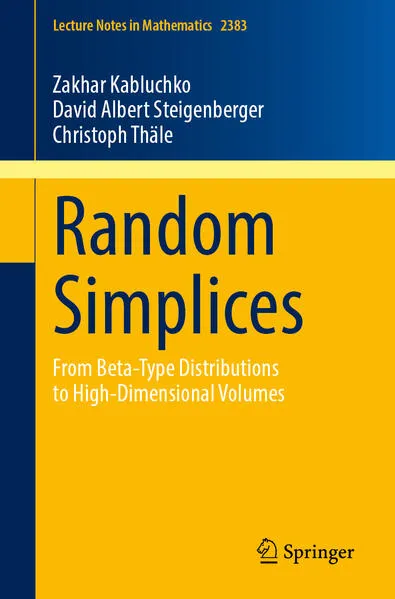
Random Simplices
This book provides an introduction to the theory of random beta-type simplices and polytopes, exploring their connections to key research areas in stochastic and convex geometry. The random points defining the beta-type simplices, a class of random simplices introduced by Ruben and Miles, follow beta, beta-prime, or Gaussian distributions in the Euclidean space, and need not be identically distributed. A key tool in the analysis of these simplices, the so-called canonical decomposition, is presented here in a generalized form and is employed to derive explicit formulas for the moments of the volumes of beta-type simplices and to prove distributional representations for these volumes. Three independent approaches are described, including the original Ruben–Miles method. In addition, a version of the canonical decomposition for beta-type polytopes is provided, characterizing their typical faces as volume-weighted beta-type simplices. This is then applied to compute various expected functionals of beta-type polytopes, such as their volume, surface area and number of facets. The formulas for the moments of the volumes are also used to investigate several high-dimensional phenomena. Among these, a central limit theorem is established for the logarithmic volume of beta-type simplices in the high-dimensional limit. The canonical decomposition further motivates the study of beta-type distributions on affine Grassmannians, a subject to which the last chapter is dedicated.
Largely self-contained, requiring minimal prior knowledge, the book connects these topics to a broad range of past and current research, serving as an excellent resource for graduate students and researchers seeking to engage with the field of stochastic and integral geometry.