Chronologie aller Bände (1 - 2)
Die Reihenfolge beginnt mit dem eBook "What Is Random?". Wer alle eBookz der Reihe nach lesen möchte, sollte mit diesem Band von Edward Beltrami beginnen. Der zweite Teil der Reihe "What Is Random?" ist am 30.07.2020 erschienen. Mit insgesamt 2 Bänden wurde die Reihe über einen Zeitraum von ungefähr 9 Jahren fortgesetzt. Der neueste Band trägt den Titel "The Legacy of Mario Pieri in Foundations and Philosophy of Mathematics".
- Anzahl der Bewertungen für die gesamte Reihe: 0
- Ø Bewertung der Reihe: 0
- Start der Reihe: 09.12.2011
- Neueste Folge: 02.04.2021
Diese Reihenfolge enthält 2 unterschiedliche Autoren.
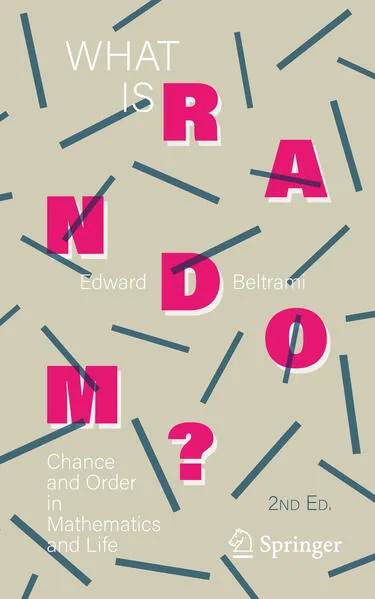
- Autor: Beltrami, Edward
- Anzahl Bewertungen: 0
- Ø Bewertung:
- Medium: E-Book
- Veröffentlicht: 30.07.2020
- Genre: Sonstiges
What Is Random?
We all know what randomness is. Or do we? Randomness turns out to be one of those concepts that works just fine on an everyday level, but becomes muddled upon close inspection. People familiar with quantum indeterminacy tell us that order is an illusion and that the world is fundamentally random. Yet these same people also say that randomness is an illusion: The appearance of randomness is only a sign of our ignorance and inability to detect the pattern.
By applying mathematical thinking, mathematician Edward Beltrami removes much of the vagueness that encumbers the concept of randomness. You will discover how to quantify what would otherwise remain elusive. As the book progresses, you will see how mathematics provides a framework for unifying how chance is interpreted across diverse disciplines. Communication engineering, computer science, philosophy, physics, and psychology join mathematics in the discourse to illuminate different facets of the same idea.Thisbook will provoke, entertain, and inform by challenging your ideas about randomness, providing different interpretations of what this concept means, and showing how order and randomness are really two sides of the same mysterious coin.
On the first edition:
I strongly recommend [What is Random?] to all who are interested in science and would like to see how the ideas of both theoretical mathematics and statistics have been observed and used in real life throughout history. The American Statistician
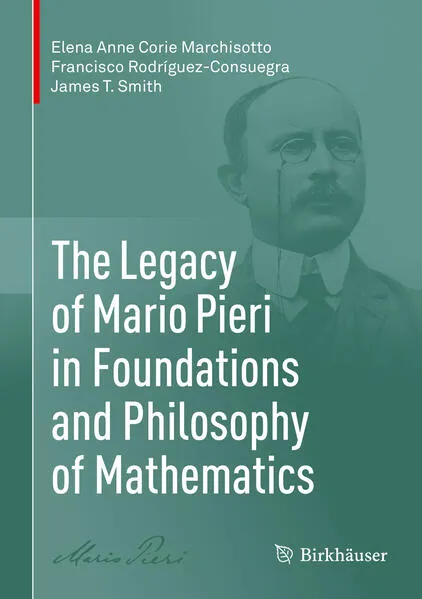
- Autor: Marchisotto, Elena Anne Corie
- Anzahl Bewertungen: 0
- Ø Bewertung:
- Medium: E-Book
- Veröffentlicht: 02.04.2021
- Genre: Sonstiges
The Legacy of Mario Pieri in Foundations and Philosophy of Mathematics
The Italian mathematician Mario Pieri (1860–1913) played a major role in the development of algebraic geometry and foundations of mathematics around the turn of the twentieth century. This volume is the second in a series intended to make Pieri’s research in diverse fields—mathematical logic and philosophy of mathematics, foundations of projective, inversive, and elementary geometry, algebraic and differential geometry, and vector analysis—accessible to today’s scholars and to assess its importance (yet little recognized) in historical and modern contexts.
The Legacy of Mario Pieri in Foundations and Philosophy of Mathematics examines Pieri’s underlying philosophy of mathematics and his research goals, highlighting one of his most influential achievements, his axiomatizations of projective and elementary geometry. Its chapters include three of Pieri’s pioneering works, translated by the authors and appearing in English for the first time, as well as an analysis of the role of this research in its larger context. Together, these translations and the accompanying interpretation accurately capture Pieri’s expository style, philosophical perspective, and his foundational research, which has influenced generations.
With an excellent index, exhaustive references, and engaging discussions that reveal Pieri’s work in its historical context, this volume will appeal to scholars and advanced students interested in the history and philosophy of mathematics and logic, as well as readers with a general knowledge of geometry at the intermediate level.
A list of errata can be found on the author Smith’s personal webpage.