Monumenta Sirletana Romanae Curiae
Register of letters to volume A.1: The Early Correspondence, 1539-1545, with references to Sirleto’s first curial works for Cardinal Marcello Cervini and other curial letters
Chronologie aller Bände (1 - 2)

Die Reihenfolge beginnt mit dem eBook "Section A: Epistulae, vol. 1". Wer alle eBookz der Reihe nach lesen möchte, sollte mit diesem Band von Filip Malesevic beginnen. Der zweite Teil der Reihe "Guglielmo Sirleto: Monumenta Sirletana Romanae Curiae. Operae / Rome’s Apostolic Heritage" ist am 14.10.2023 erschienen. Mit insgesamt 2 Bänden wurde die Reihe über einen Zeitraum von ungefähr 3 Jahren fortgesetzt. Der neueste Band trägt den Titel "Section A: Epistulae, vol. 1".
- Anzahl der Bewertungen für die gesamte Reihe: 0
- Ø Bewertung der Reihe: 0
- Start der Reihe: 14.10.2023
- Neueste Folge: 13.06.2026
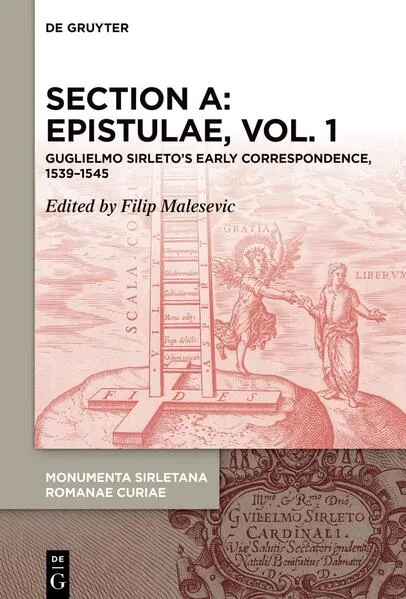
- Autor: Malesevic, Filip
- Anzahl Bewertungen: 0
- Ø Bewertung:
- Medium: E-Book
- Veröffentlicht: 13.06.2026
- Genre: Sonstiges
Section A: Epistulae, vol. 1
A critical edition of Guglielmo Sirleto’s unpublished letters is still missing. The partial transcriptions of this large collection of epistles in the volumes of the Concilium Tridentinum by Gottfried Buschbell only provided partial transcriptions relating to Cardinal Marcello Cervini’s legation during the Council of Trent betwen 1545 and 1547.
While scholars have recognized Sirleto’s assistance to Cardinal Cervini’s Tridentine exploitations and compositions of various critical decrees, the larger context of his entry into the household and Roman enterprises oft he powerful cardinal editore Cervini remain largely obscure. The following critical edition of Guglielmo Sirleto’s first letters, including other relevant correspondence between Sirleto’s arrival in Rome around 1539 and Marcello Cervini’s departure for Trent in 1545 by distinguished Roman ecclesiastical officeholders within the papal Curia, aims at demonstrating how the collaboration between Cervini’s enterpreneurial endeavors of his printing presses as well as his coordination of important theological brokers during the Dialogues of Religion in Germany, especially at the Diet of Regensburg in 1541, and Sirleto’s own ecclesiastical career emerged from a considerable failure at providing an authentic response to Lutheran as well as Protestant theological challenges.
The first volume of the edited correspondence between Sirleto and one of his first most important patron as well as ardent supporters, the Cardinal of Santa Croce Marcello Cervini, offers various hitherto largely disregarded original documents that allow it to perceive Guglielmo Sirleto’s first years in Rome as a result from a larger Curial failure in affirming its ecclesiological status and significance towards Lutheran and Protestant theological challenges.
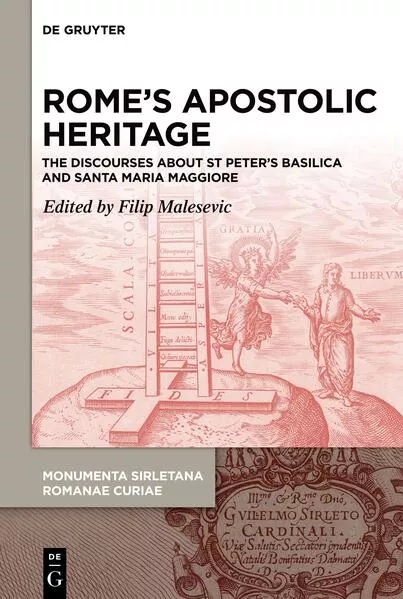
- Autor: Malesevic, Filip
- Anzahl Bewertungen: 0
- Ø Bewertung:
- Medium: Buch
- Veröffentlicht: 14.10.2023
- Genre: Roman
Guglielmo Sirleto: Monumenta Sirletana Romanae Curiae. Operae / Rome’s Apostolic Heritage
Guglielmo Sirleto has generally been acknowledged as a crucial contributor to defending the papacy’s claims over St Peter’s primacy, including the apostle’s legendary arrival to Rome before his martyrdom. Sirleto established himself as a pivotal prelate, who assisted Pope Paul IV in rearranging the ceremonial apparatus for the solemn celebrations of the Cathedra Petri (St Peter’s Throne).
Scholars, however, were unable to properly examine his De praestantia basilicae Vaticanae, because the manuscripts of this discourse were never completely identified. The edition of this treatise will therefore primarily provide a reconstruction of Sirleto’s working methods in readjusting the ceremonial solemnities prescribed for the feast day of the Cathedra Petri according to Curial Ceremony.
The second discourse concerns, on the other hand, a description of the basilica of Santa Maria Maggiore on the Esquiline Hill, which Sirleto composed for the Cardinal Bishop of Milan, Carlo Borromeo. In contrast to the edition of the first discourse in this volume, the Trattato sopra la chiesa di Santa Maria Maggiore is presented according to the correspondence between Borromeo and Sirleto.