Chronologie aller Bände (1 - 2)

Die Reihenfolge beginnt mit dem Buch "K-Theory for Group C*-Algebras and Semigroup C*-Algebras". Wer alle Bücher der Reihe nach lesen möchte, sollte mit diesem Band von Joachim Cuntz beginnen. Der zweite Teil der Reihe "K-Theory for Group C*-Algebras and Semigroup C*-Algebras" ist am 06.11.2017 erschienen. Mit insgesamt 2 Bänden wurde die Reihe über einen Zeitraum von ungefähr 6 Jahren fortgesetzt. Der neueste Band trägt den Titel "Metric Algebraic Geometry".
- Anzahl der Bewertungen für die gesamte Reihe: 0
- Ø Bewertung der Reihe: 0
- Start der Reihe: 24.10.2017
- Neueste Folge: 28.02.2024
Diese Reihenfolge enthält 2 unterschiedliche Autoren.

- Autor: Cuntz, Joachim
- Anzahl Bewertungen: 0
- Ø Bewertung:
- Medium: Buch
- Veröffentlicht: 06.11.2017
- Genre: Sonstiges
K-Theory for Group C*-Algebras and Semigroup C*-Algebras
This book gives an account of the necessary background for group algebras and crossed products for actions of a group or a semigroup on a space and reports on some very recently developed techniques with applications to particular examples. Much of the material is available here for the first time in book form. The topics discussed are among the most classical and intensely studied C*-algebras. They are important for applications in fields as diverse as the theory of unitary group representations, index theory, the topology of manifolds or ergodic theory of group actions.
Part of the most basic structural information for such a C*-algebra is contained in its K-theory. The determination of the K-groups of C*-algebras constructed from group or semigroup actions is a particularly challenging problem. Paul Baum and Alain Connes proposed a formula for the K-theory of the reduced crossed product for a group action that would permit, in principle, its computation. By work of many hands, the formula has by now been verified for very large classes of groups and this work has led to the development of a host of new techniques. An important ingredient is Kasparov's bivariant K-theory.
More recently, also the C*-algebras generated by the regular representation of a semigroup as well as the crossed products for actions of semigroups by endomorphisms have been studied in more detail.Intriguing examples of actions of such semigroups come from ergodic theory as well as from algebraic number theory. The computation of the K-theory of the corresponding crossed products needs new techniques. In cases of interest the K-theory of the algebras reflects ergodic theoretic or number theoretic properties of the action.
- Autor: Breiding, Paul
- Anzahl Bewertungen: 0
- Ø Bewertung:
- Medium: Buch
- Veröffentlicht: 28.02.2024
- Genre: Sonstiges
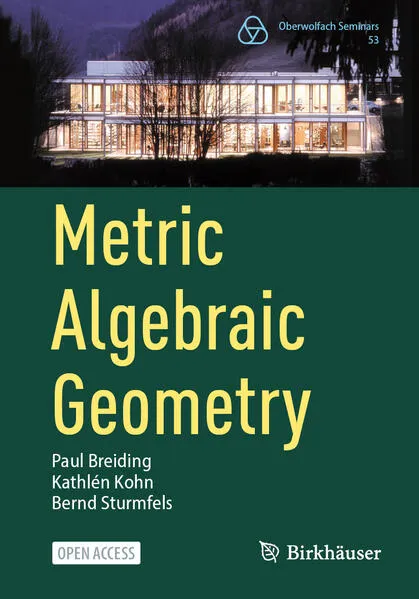
Metric Algebraic Geometry
Metric algebraic geometry combines concepts from algebraic geometry and differential geometry. Building on classical foundations, it offers practical tools for the 21st century. Many applied problems center around metric questions, such as optimization with respect to distances.
After a short dive into 19th-century geometry of plane curves, we turn to problems expressed by polynomial equations over the real numbers. The solution sets are real algebraic varieties. Many of our metric problems arise in data science, optimization and statistics. These include minimizing Wasserstein distances in machine learning, maximum likelihood estimation, computing curvature, or minimizing the Euclidean distance to a variety.
This book addresses a wide audience of researchers and students and can be used for a one-semester course at the graduate level. The key prerequisite is a solid foundation in undergraduate mathematics, especially in algebra and geometry.
This is an openaccess book.