Professional and Applied Computing
Enterprise Guide for Implementing Generative AI and Agentic AI
Chronologie aller Bände (1 - 13)
Die Reihenfolge beginnt mit dem eBook "Web Standards Creativity". Wer alle eBookz der Reihe nach lesen möchte, sollte mit diesem Band von Andy Budd beginnen. Der zweite Teil der Reihe "Modern Concurrency on Apple Platforms" ist am 14.11.2022 erschienen. Mit insgesamt 13 Bänden wurde die Reihe über einen Zeitraum von ungefähr 20 Jahren fortgesetzt. Der neueste Band trägt den Titel "Databricks Handbook for SAP Business Data Cloud".
- Anzahl der Bewertungen für die gesamte Reihe: 3
- Ø Bewertung der Reihe: 3.3
- Start der Reihe: 30.04.2007
- Neueste Folge: 16.12.2026
Diese Reihenfolge enthält 13 unterschiedliche Autoren.
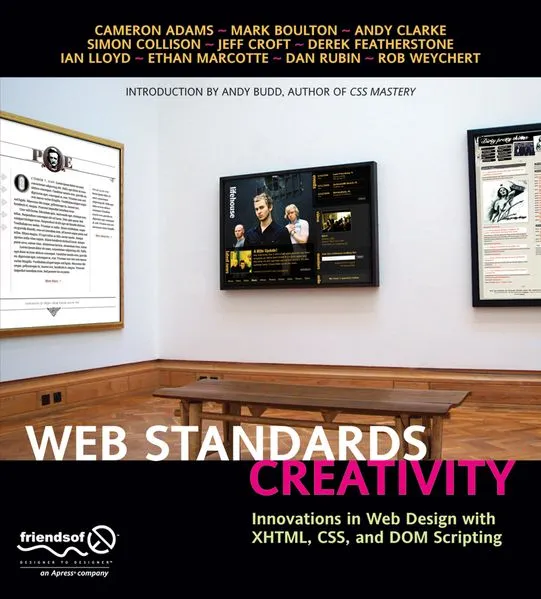
- Autor: Budd, Andy
- Anzahl Bewertungen: 0
- Ø Bewertung:
- Medium: E-Book
- Veröffentlicht: 30.04.2007
- Genre: Sonstiges
Web Standards Creativity
- Be inspired by 10 web design lessons from 10 of the world's best web designers
- Get creative with cutting-edge XHTML, CSS, and DOM scripting techniques
- Learn breathtaking design skills while remaining standards-compliant
Here at friends of ED, we know that as a web designer or developer, your work involves more than just working to pay the bills. We know that each day, you strive to push the boundaries of your medium, unleashing your creativity in new ways to make your websites more engaging and attractive to behold, while still maintaining cross-browser support, standards compliance, and accessibility.
That's why we got together 10 of the world's most talented web designers to share their secrets with you. Web Standards Creativity is jam-packed with fresh, innovative design ideas. The topics range from essential CSS typography and grid design, effective styling for CMS-driven sites, and astonishing PNG transparency techniques, to DOM scripting magic for creating layouts that change depending on browser resolution and user preference, and better print layouts for web pages. We're sure you will find something here to inspire you!
This full-color book's examples are not just stunning to look at, but also fully standards-compliant, up-to-date, and tested in current browsers including Internet Explorer 7. Playing by the rules doesn't have to mean drab or dull websites—Web Standards can be fun!
- Autor: Kautsch, Andrés Ibañez
- Anzahl Bewertungen: 0
- Ø Bewertung:
- Medium: E-Book
- Veröffentlicht: 14.11.2022
- Genre: Sonstiges
Modern Concurrency on Apple Platforms
Build solid software with modern and safe concurrency features. Concurrency is one of the hardest problems in computer science. For years, computer scientists and engineers have developed different strategies for dealing with concurrency. However, the original concurrency primitives are complicated and difficult to understand, and even harder to implement.
Using the new async/await APIs in Swift, this book will explain how your code can abstract a lot of the complexity with a simpler interface so you never have to deal with concurrency primitives such as semaphores, locks, and threads yourself. This will allow you to write concurrent code that is easier to read, easier to write, and easier to maintain. These new APIs are deeply ingrained into Swift, offering compile-level features that will keep you from writing dangerous concurrent code.You’ll start by exploring why concurrency is hard to implement in a traditional system. Explaining the definition of concurrency and what its primitives are will help you understand why they are hard to use correctly. These concepts will become clearer as you work through the sample projects. The book’s focus then shifts exclusively to the new APIs, helping you understand how the integration of the system with the language itself makes it easier for you to write concurrent code without overstepping the bounds of the concurrency safe zone.
By the end of the book, you’ll have a solid foundation for working safely with concurrent code using the new async/await APIs.
What You'll Learn
- Understand concurrency and its traditional problems
- Work with the new async/await API and all its features, from the basic usage and await keywords, to task groups and async sequences.
- Implement modern and safe concurrent code that you can start using right away
Who This Book Is For
Experienced iOS developers at a semi-senioror senior level. Knowledge on the Grand Central Dispatch is a bonus, but not required.
- Autor: Brusca, Victor G.
- Anzahl Bewertungen: 3
- Ø Bewertung: 3.3
- Medium: E-Book
- Veröffentlicht: 24.11.2022
- Genre: Sachbuch
Introduction to Java Through Game Development
With this book, you’ll get to work with three Java game projects and have access to the complete game code for each project, including a full Java game engine. After completing Introduction to Java through Game Development, you’ll be proficient in Java programming, having worked with the language’s fundamental aspects throughout the text, and will be ready to further your Java and game programming expertise with confidence.
What You'll
- Master the fundamentals of the Java programming language
- Use different data structures like arrays, lists, stacks, and queues
- Understand game programming basics including the main game loop
- Gain experience working with three different game projects via the book’s coding challenges
- Work with the 2D game engine that powers the book's included games and learn to create your own new game projects
- Understand advanced Java topics like classes, encapsulation, inheritance, and polymorphism
- Work with exceptions and how to use debugging techniques to trace through code
- Sharpen your skills with over a dozen coding challenges that test your abilities with a development task on a real game project
Who This Book Is For
This book requires little to no programming experience to understand and benefit from the text.
- Autor: Lilleaas, August
- Anzahl Bewertungen: 0
- Ø Bewertung:
- Medium: E-Book
- Veröffentlicht: 10.02.2023
- Genre: Sachbuch
Pro Kotlin Web Apps from Scratch
The book teaches the Kotlin language by building production-ready Kotlin code. You’ll gain a deep understanding of the idiomatic use of the Kotlin language along with knowledge of how to apply Kotlin in production-grade web apps. The book also bridges the gap between building from scratch and using existing frameworks. For example, you’ll learn how to integrate Spring Security-based authentication in web apps written from scratch, so you can leverage existing tooling in your organization without having to take on the entire Spring framework.
The first section of the book sets up thebase structure of your web app, such as routing, configuration files, and database migrations. The remaining chapters are broken into individual aspects of building production-ready web apps. Appendices at the end of the book explain how to use different libraries than the ones chosen in the main chapters, so you'll learn how to decouple your code from specific libraries, and choose between many different libraries to get the job done in your own web apps.
What You Will Learn
- Compose libraries and manage boilerplate code using idiomatic and powerful Kotlin
- Manage and query SQL databases without ORMs and mapping layers
- Write resilient and change-proof tests in support of test-driven development practices
- Create traditional, HTML-based web apps, APIs for JavaScript-based single-page web apps and native mobile apps
- Manage parallelism and external service calls using Kotlin co-routines
- Deploy to production using embedded servers, WAR files, and serverless approaches
- Bridge the gap between custom-built apps and enterprise, using Spring Context and Spring Security
Who This Book Is For
The expert developer who is ready to take full control of the tech stack, and use the Kotlin language, type system, and standard library, to ship production-ready web apps. Readers should have prior programming experience. Experience with Java or another JVM language is helpful.
- Autor: Kanagachidambaresan, G. R.
- Anzahl Bewertungen: 0
- Ø Bewertung:
- Medium: E-Book
- Veröffentlicht: 04.07.2023
- Genre: Sonstiges
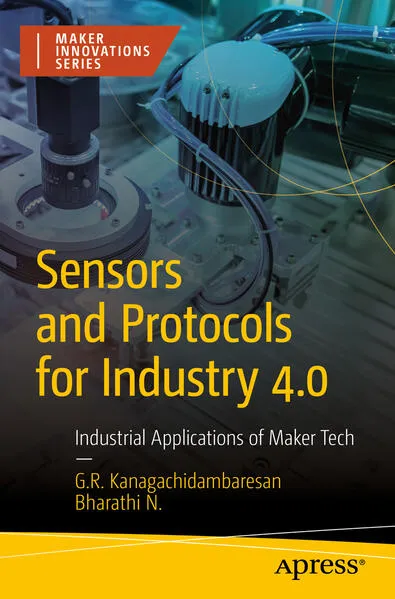
Sensors and Protocols for Industry 4.0
This book Identifies the right sensors and single board computers for any application to achieve the best performance in Industry 4.0 settings and applications. You’ll see what technologies apply the IIoT with elegant efficiency to drastically improve remote monitoring and controlling, decision making, and preventative maintenance.
Start by learning exactly what Industry 4.0 is and advance your knowledge from simple Internet of Things projects to full-on Industrial IoT deployment. You'll automate advanced processes, incorporate professional procedures, and take your IoT skills to a professional level. Then move into the protocols and standards expected for industrial applications of sensors at an industrial level. Match the right SBCs to the right use cases and sensor technologies to optimize efficiency and ensure peak performance. Then move into setting up a smart factory and monitoring your supply chain with tech. Finally, you'll dive into programming with theNode-Red platform and Python packages for CPS.
By the end of this book, you’ll have jumped from simple, home-based IoT systems up to industrial and professional applications. Conquer your supply chain and both forward and backward processes with accessible Maker tech!
What You'll Learn
- Support industrial applications of SBCs and Maker tech
- Achieve peak performance by combining the right sensors with the right processing boards
- Improve remote monitoring and controlling drastically for better decision making and preventative maintenance
Who This Book Is For
Students and aspiring professionals working with Internet of things technologies moving towards industrial applications. Prerequisite knowledge in basic Internet of Things, simple python concepts, automation, and industry procedures is required for this book. Engineers and scientists who are pursuing research and contributing to industrial internet of things might also benefit.
- Autor: Sung, Kelvin
- Anzahl Bewertungen: 0
- Ø Bewertung:
- Medium: E-Book
- Veröffentlicht: 19.12.2023
- Genre: Sonstiges
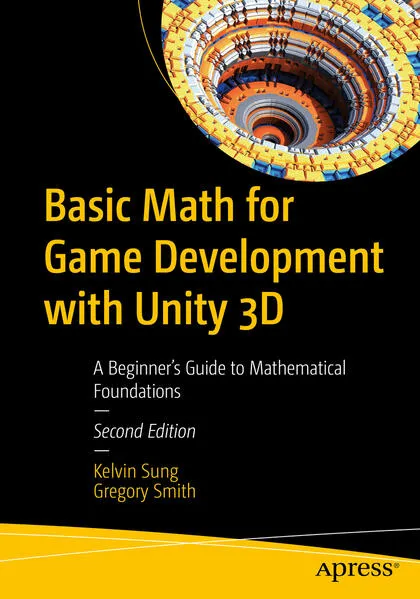
Basic Math for Game Development with Unity 3D
This book will teach you fundamental mathematical concepts using Unity-based custom examples, explaining the implementations and demonstrating how these concepts are applied in building modern video game functionality. You will learn the theoretical foundation of each concept, and then interact, examine, and modify the implementation to inspect the effects.
Basic Math for Game Development with Unity 3D begins by explaining points in the 3D Cartesian Coordinate system. From there, you’ll gain insight into vectors and details of dot and cross products, quaternions, rotation and decomposition of vectors. These basic mathematical foundations are illustrated through Unity-based example implementations. Associated with these concept presentations are separate examples of how the concepts are applied in creating typical video game functionality, such as collision support, motion simulations, autonomous behaviors, shadow approximations, and reflections off surfaces with arbitrary orientations.
After completing this book, you will have a thorough understanding of core mathematical concepts and how they are used to create compelling gameplay.
What You Will Learn
- Understand the basic concepts of points and vectors, and their applications in game development
- Grasp the details of autonomous behaviors such as facing a target, following and chasing an object, and more
- Apply mathematical concepts in implementing modern video game functionality such as ray casting, collision, and motion control
Who Is This Book For
Game enthusiasts, hobbyists, and anyone else who is interested in the implementation of interactive games but needs basic mathematical background or could just use a refresher with modern examples.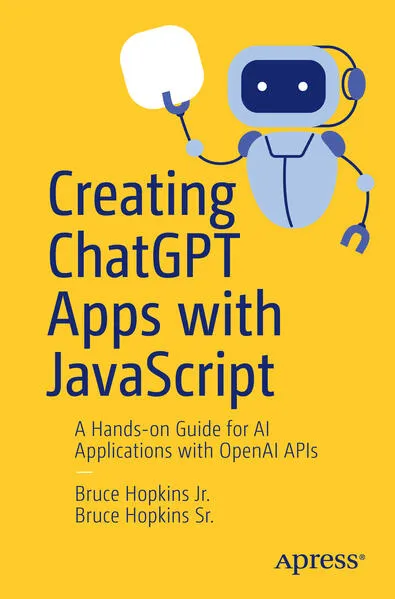
- Autor: Hopkins Jr., Bruce
- Anzahl Bewertungen: 0
- Ø Bewertung:
- Medium: E-Book
- Veröffentlicht: 26.03.2025
- Genre: Sonstiges
Creating ChatGPT Apps with JavaScript
Transform your JavaScript expertise through the power of Open AI API models using “Creating ChatGPT Apps with JavaScript.” This book will guide JavaScript developers to build smart applications while providing tangible knowledge of OpenAI’s API for text summarization, creating transcripts from audio files, generating images, and running models locally on your machine.
Through hands-on projects and code examples, readers will discover how to build AI-powered apps from scratch, such as using embeddings to train a Discord bot to answer customers’ questions in multiple languages. Readers will also learn to dictate text for writing articles or blogs with a localized integration of Whisper and generate hero images with Dall-E.
From seasoned developers to newcomers, this book offers something for everyone. Not only will readers learn to build apps with ChatGPT and JavaScript, but they will also learn best practices for prompt engineering. They’ll understand how AI models can enhance workplace efficiency and utilize natural language processing (NLP) to make interactions with applications feel…well, natural. The end result is expert knowledge in leveraging ChatGPT programmatically and incorporating the technology into diverse applications.
What You Will Learn:
- Gain a deeper understanding of ChatGPT and how OpenAI’s models work, and different ways to implement each of their various features.
- Authenticate with ChatGPT and OpenAI’s API and learn to send prompts with best practices with prompt engineering.
- Streamline productivity and content creation by leveraging transcription generation for dictation and image generation for creating hero images.
- Stay ahead of the game by incorporating different new features of OpenAI’s API and understanding more complex concepts like using GPT-4 to train a Discord bot with an FAQ to assist with multilingual tech support.
Who This Book is for:
This book is written for JavaScript developers and hobbyists that want to use OpenAI and ChatGPT to create intelligent applications and streamline productivity. No prior experience with ChatGPT or OpenAI APIs is required.
- Autor: Halder, Subhojit
- Anzahl Bewertungen: 0
- Ø Bewertung:
- Medium: Digital
- Veröffentlicht: 10.09.2025
- Genre: Sonstiges
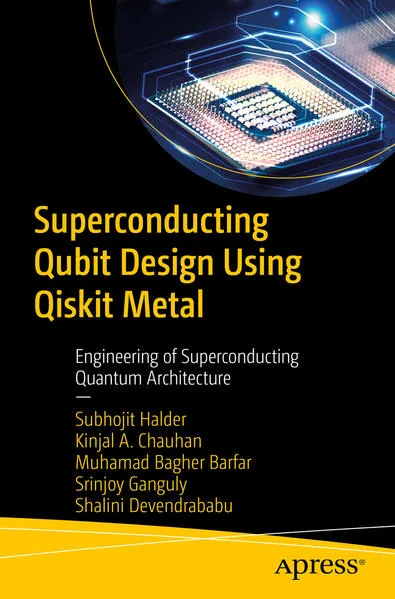
Superconducting Qubit Design Using Qiskit Metal
Understand and implement superconducting Qubit Design using Qiskit Metal in the Quantum Computing environment. This book provides practical knowledge and step-by-step guidance on designing, analyzing, and fabricating quantum chips.
The book begins with an introduction to the fundamentals of quantum computing, covering essential terms, concepts, and the history of quantum computers. It explores the differences between quantum and classical computers and provides an overview of superconducting qubits. Next, you will learn the theory and practical aspects of superconducting qubits. Detailed mathematical and computational analyses of different qubit types and circuits are provided, along with a comprehensive guide to creating quantum circuits using Qiskit and Qiskit Metal. You will learn to design quantum chips and analyze components such as Josephson junctions and qubit couplers, using advanced methods such as the Lumped Oscillator Model, Quasi-Lumped Oscillator Model, and Energy Participation Ratio Method. Finally, the book covers the fabrication of superconducting qubits, detailing the manufacturing process, requirements, and methods to address fabrication issues.
After reading this book, you will be able to advance your understanding and skills in this cutting-edge field, making complex concepts accessible and providing a roadmap for practical application.
What You Will Learn
- Install the Qiskit framework for creating basic quantum computing circuits
- Create your first superconducting qubit chip from scratch
- Formulate the back-end mathematical and computational model for the generated superconducting chips
- Understand the Quasi-LOM (lumped oscillator model) and how it differs from the LOM
Who This Book Is For
Quantum computing professionals working with superconducting qubits
- Autor: Jha, GS
- Anzahl Bewertungen: 0
- Ø Bewertung:
- Medium: E-Book
- Veröffentlicht: 26.09.2025
- Genre: Sonstiges
Securing the Enterprise
Cybersecurity is no longer just an IT issue; it is a business-critical function requiring executive oversight and strategic implementation. This book offers a practical approach to cybersecurity leadership, risk management, and frameworks such as NIST, MITRE ATT&CK, and Zero Trust.
The book blends executive strategy with hands-on cybersecurity methodologies, providing a holistic understanding for CXOs, CISOs, and IT security professionals.
By exploring real-world case studies and breaches, such as SolarWinds and Colonial Pipeline, this book equips you with proactive defense strategies, governance insights, and the technical knowledge required to secure enterprise infrastructures effectively.
What You Will Learn
- Align cybersecurity with business strategy and executive decision making
- Cover practical implementation of frameworks such as NIST CSF, ISO 27001, and Zero Trust
- Respond to cyber incidents and build a resilient security culture
- Understand key cybersecurity principles, including threat intelligence and risk management
- Study advanced cybersecurity topics, including AI-driven threats, ransomware, and cloud security
Who This Book Is For
Cybersecurity professionals, CISOs, CIOs, IT security architects, and risk managers; plus business executives, Chief Experience Officers (CXOs), board members, compliance officers, graduate students in cybersecurity
- Autor: Lisitano, Frank
- Anzahl Bewertungen: 0
- Ø Bewertung:
- Medium: Digital
- Veröffentlicht: 10.12.2025
- Genre: Sonstiges
The Evolune Metaverse
Welcome to "Evolune," a far-reaching adventure set in the year 11000, where the frontiers of Virtual Reality (VR), AI, Blockchain technology, and the Metaverse converge. In this advanced future, we explore the profound capabilities of a metaverse platform known as Evolune, which enables you to jump between universes. This realm is ruled by the powerful King Duncan and his corporate empire, The Gnos. This narrative intertwines with a mission to secure the potent Evolune energy, navigate diverse planetary systems, and resist the tyranny of The Gnos.
As you step into the role of an astronaut, warrior, and scientist, this book serves as both a guide and a companion. Each chapter, depicted as a unique planet within the Evolune universe, delves into the intricacies of cutting-edge technologies. With a focus on Generative AI solutions, the revolutionary potential of blockchain, and the transformative capabilities of computational graphics, we embark on a journey to unravel these complex domains. Through a blend of immersive storytelling, detailed technical descriptions, and practical insights, the narrative is designed to demystify these technologies while integrating the lore of Evolune.
Part fiction, part field guide, The Evolune Metaverse caters to a diverse audience—from Metaverse and spatial computing visionaries and blockchain developers to Generative AI engineers and technology enthusiasts and is tailored to broaden your horizons and deepen your comprehension of these rapidly evolving fields. We discuss practical applications, ethical considerations, and visionary future directions of AI, Blockchain, and the Metaverse to equip you with the knowledge and skills necessary to innovate and excel.
You Will:
- Explore key developments in, virtual reality (VR) and digital twins business applications
- Learn about the revolution of spatial computing with a focus on VR glasses and consumer headsets
- Learn the latest in hyper-realistic graphic design
- Explore Machine Learning/Generative AI solutions
- Understand Blockchain technologies, the use of smart contracts and its applications
- Understand the legal, ethical and security implications
This is for:
Metaverse, VR and spatial computing developers, game designers, blockchain developers and other tech enthusiasts who are interested in the latest developments of VR, metaverse and the decentralised web.
- Autor: Edward, Shakuntala Gupta
- Anzahl Bewertungen: 0
- Ø Bewertung:
- Medium: Digital
- Veröffentlicht: 10.12.2025
- Genre: Sonstiges
Enterprise Guide for Implementing Generative AI and Agentic AI
Generative AI and Agentic AI together are revolutionizing the technology landscape, with profound and far-reaching impacts across industries. Organizations are increasingly adopting these technologies to drive innovation, enhance unstructured content management, and improve problem-solving capabilities. With Agentic AI, enterprises are moving towards the development of intelligent systems that can plan, reason, and act with autonomy. While early proof-of-concepts (POCs) demonstrated the potential of these technologies, the current shift is toward responsible and scalable production implementations that leverage both generative and agentic capabilities.
This book begins by guiding you through the technological evolution of AI, from early machine learning to today’s large language models (LLMs) and agentic systems. It then explores a wide range of use cases across industries, highlighting how LLMs can support decision-making, and how Agentic AI enables dynamic, collaborative systems that act with autonomy and intent. This is followed by Design Patterns across the lifecycle of AI solution development, deployment and monitoring. Readers will then gain insights into the methodologies for developing and deploying Generative and Agentic AI solutions at an enterprise level. A featured implementation demonstrates how Agentic AI can be effectively put into action.
The book also introduces essential concepts such as MLOps, LLMOps, and Responsible AI principles which are critical for transitioning the AI solutions from experimentation to production. These principles ensure that AI deployments are scalable, secure, ethical and compliant. The book concludes with key takeaways and best practices for developing, evaluating, deploying and scaling AI applications responsibly and effectively within enterprise settings.
You Will:
- Understand key design patterns to develop, deploy and monitor a Generative AI solution effectively.
- Learn how to develop and implement a production-ready Agentic AI use case.
- Discover best practices for building scalable, secure, and enterprise-grade AI solutions.
- Understand how to assess and mitigate risks using Responsible AI principles and LLMOps best practices.
This book is for : Enterprise Software Engineers and Architects
- Autor: MS, Afsal
- Anzahl Bewertungen: 0
- Ø Bewertung:
- Medium: Digital
- Veröffentlicht: 09.11.2026
- Genre: Sonstiges
Mastering Django ORM
Unlock Django ORM’s full potential with advanced performance tuning, query optimization, and scalable Python solutions.
Most Django developers love the simplicity of the ORM—until performance issues hit. Suddenly, the “magic” feels like a black box: queries slow down, joins multiply, and scaling becomes painful.
Mastering Django ORM: Performance Tuning and Advanced Query Optimization lifts the lid on Django’s Object Relational Mapper and shows you what’s really happening under the hood. You’ll learn how queries are built, how to spot hidden inefficiencies, and how to optimize them for production systems.
Instead of treating the ORM as a mystery, this book gives you the confidence to bend it to your will—writing cleaner, faster, and more scalable code. Drawing from real-world experience, author Afsal MS shares lessons learned from costly mistakes, practical fixes, and advanced techniques that will transform the way you work with Django ORM.
Whether you’re building a startup MVP or maintaining a high-traffic enterprise system, this guide will help you unlock the full potential of Django ORM and take your Python web applications to the next level.
What You Will Learn
- Understand Django ORM internals and how queries are constructed.
- Write efficient queries that scale with growing data.
- Spot and fix common ORM-related performance bottlenecks.
- Choose between ORM features and raw SQL when appropriate.
- Apply advanced query patterns for real-world business problems.
- Optimize Django ORM for high-performance and scalability.
- Leverage Django 6.0+ features and async ORM capabilities.
- Use profiling and debugging tools to monitor and improve query performance.
Who this Book Is For
Developers using Django who want to move beyond treating the ORM as a black box. It’s ideal for those building or maintaining production applications and seeking practical strategies to optimize queries, improve performance, and scale effectively.

- Autor: Banerjee, Sourav
- Anzahl Bewertungen: 0
- Ø Bewertung:
- Medium: Digital
- Veröffentlicht: 16.12.2026
- Genre: Sonstiges
Databricks Handbook for SAP Business Data Cloud
This book provides a comprehensive and practical guide to implementing, governing, and using SAP Databricks within the SAP Business Data Cloud (BDC) ecosystem. Designed for enterprise architects, data engineers, analytics professionals, and SAP practitioners, it bridges the gap between traditional SAP data platforms and modern data engineering and machine learning capabilities offered by Databricks. Starting with a clear introduction to Databricks and its collaborative architecture, the book explains how Enterprise Databricks and SAP Databricks differ and how SAP’s native integration enables secure, scalable, and governed data processing directly on SAP data. Readers are guided through essential foundation topics such as Single Sign-On (SSO), authorization models, and end-to-end data governance, ensuring they understand how identity, access, and compliance are enforced across the BDC landscape.
The book then dives into the core technical capabilities that make SAP Databricks powerful, including Zero Copy architecture, Delta Sharing, Unity Catalog, and serverless SQL warehouses. It demonstrates how data products can be created, governed, and consumed efficiently while maintaining security and lineage. Practical connectivity patterns show how SAP and non-SAP data sources can be integrated seamlessly for advanced analytics and AI workloads.
Beyond architecture and setup, the book brings everything together through realistic machine learning use cases, scenario-based implementations, and end-to-end workflows from data preparation to model execution and outbound consumption in SAP Datasphere. The final chapters focus on user experience, operational best practices, and hands-on assignments, enabling readers to apply what they’ve learned directly within their own BDC tenants.
By the end of this book, readers will have a clear, actionable understanding of how to use SAP Databricks to build secure, governed, and intelligent data and AI solutions on SAP’s Business Data Cloud platform.
You Will:
- Configure Single Sign-On (SSO) and implement secure authentication within the BDC environment
- Design and manage authorization models to protect sensitive business data and meet compliance requirements
- Apply Zero Copy architecture and Delta Sharing to enable secure, efficient data access
This book is for : SAP professionals, data engineers, data architects, analytics consultants, and enterprise IT leaders