Chronologie aller Bände (1 - 3)
Die Reihenfolge beginnt mit dem Buch "Freezing of Lakes and the Evolution of Their Ice Cover". Wer alle Bücher der Reihe nach lesen möchte, sollte mit diesem Band von Matti Leppäranta beginnen. Der zweite Teil der Reihe "Freezing of Lakes and the Evolution of Their Ice Cover" ist am 05.07.2023 erschienen. Mit insgesamt 3 Bänden wurde die Reihe über einen Zeitraum von ungefähr 3 Jahren fortgesetzt. Der neueste Band trägt den Titel "Life in the Universe".
- Anzahl der Bewertungen für die gesamte Reihe: 0
- Ø Bewertung der Reihe: 0
- Start der Reihe: 05.07.2023
- Neueste Folge: 28.10.2026
Diese Reihenfolge enthält 3 unterschiedliche Autoren.
- Autor: Leppäranta, Matti
- Anzahl Bewertungen: 0
- Ø Bewertung:
- Medium: Buch
- Veröffentlicht: 06.07.2023
- Genre: Sonstiges
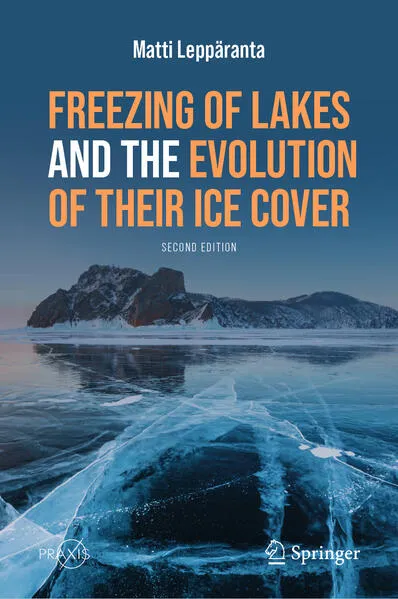
Freezing of Lakes and the Evolution of Their Ice Cover
This book updates the first edition for the status of knowledge in the physics of lake ice and the interactions between the ice cover and the liquid water underneath. Since the first edition was written in 2013, there has been a lot of progress in the field, in particular concerning environmental questions and the impact of climate change. Life conditions in ice-covered lakes and practical matters are now brought more into the picture so that the revision also properly serves as a handbook for applications. The author has worked widely with boreal lakes, polar lakes and Central Asian lakes that provides a wide geographical spectrum.
Chapter 1 gives a brief overview and presents the research fields. The second chapter contains the classification of ice-covered lakes and observation techniques, especially remote sensing. In Chapter 3, the structure and properties of lake ice are presented including optics and geochemistry. Ice growth and melting are treated in Chapter 4, while the following chapter focuses on ice mechanics with applications to traffic on ice and ice loads. Chapter 6 goes into the exotic environment of pro-glacial lakes. Chapter 7 contains the stratification and circulation of the water body beneath lake ice, Chapter 8 presents the winter ecology of freezing lakes and discusses the lake ice interface toward the society, and Chapter 9 summarizes the climate change impact on lake ice seasons. The book ends into a brief closing chapter and list of references. Research problems for student learning are listed throughout the book. Annexes are included to provide numerical data of constants and standard formulae to help practical calculations and student tasks.
Lake ice closely interacts with human living conditions, but people have learnt to live with that and to utilize the ice. In the present time this is true for on-ice traffic and recreation activities. Ice fishing has become a widely enjoyed hobby, and winter sports such as skiing, skating,and ice sailing are popular activities on frozen lakes. The lake ice response to eventual climate warming would appear as a shortening of the ice season due to the increasing air temperature and also as changing of the quality of the ice seasons via changes in ice thickness and structure.The book gives the whole story of lake ice into a single volume. The second, revised edition updates the content based on recent progress in winter limnology and ice physics research and applications. The author has contributed to lake ice research since the 1980s. In particular, his topics have been lake ice structure and thermodynamics, light transfer in ice and snow, ice mechanics in large lakes, and lake ice climatology. Mathematical modeling of ice growth, drift, and decay are covered in this research.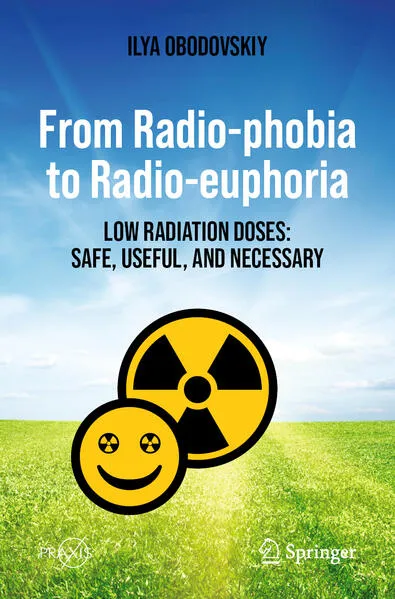
- Autor: Obodovskiy, Ilya
- Anzahl Bewertungen: 0
- Ø Bewertung:
- Medium: Buch
- Veröffentlicht: 12.12.2023
- Genre: Sonstiges
From Radio-phobia to Radio-euphoria
This book gives a detailed discussion of the initial enthusiasm triggered by the discovery of x-rays and radioactive radiation which later turned into fear and repulsion in a significant part of the global population up to the 21st century.
After a historical review, the author discusses the effect of ionizing radiation on living cells, tissues and organisms. He then describes the relationship between the dose of radiation and the effect it produces. He shows how the dose-effect dependence is measured and what models of describing such dependences are used. He also discusses how radiation acts on living organisms: disorders in the genetic apparatus, mutation formation and so on. The book also includes detailed descriptions of the results of numerous health studies of large groups of people who, for one reason or another, were exposed to low doses of ionizing radiation, including those that significantly exceed the natural radiation background.The author concludes that low doses of radiation are safe and can even be beneficial (as known from medical radiation treatment); and also that the natural radiation background is necessary for the normal growth and development and well-being of a living organism. The author also discusses cases and effects of large doses, arguing, however, that dangerous doses of radiation are very unlikely.
This book challenges radio-phobia. It not only offers arguments helping to overcome an unreasonable fear but, based on the latest understanding of science, argues to gradually move back, not to the former radio-euphoria, but to a new, conscious attitude towards radiation.

- Autor: Dirk Schulze-Makuch
- Anzahl Bewertungen: 0
- Ø Bewertung:
- Medium: Buch
- Veröffentlicht: 28.10.2026
- Genre: Sonstiges
Life in the Universe
This highly praised textbook and reference work examines the basic elements of living systems: energy, chemistry, solvents, and habitats in crucial depth. These elements define the opportunities and limitations for life on other worlds. The book argues that life forms we would recognize may be more common in our solar system than many assume. It also considers, however, the possibility of exotic forms of life based on chemistries other than carbon, liquids other than water, and energy other than light. The authors offer an operational definition of life and summarize prevailing thoughts on plausible pathways for its origin on Earth and other worlds. They discuss remarkable adaptations to extreme environments, the nature and detection of biosignatures and possible technosignatures, the future and fate of living systems, and suggestions for the optimization of future exploratory space missions.
The entire text has been thoroughly updated in this fourth edition, with special focus on exoplanets, robotic exploration, synthetic life, detection of life, and life in extreme environments. New sections have been added on international space initiatives, updated plans for human missions to the Moon and Mars, the Fermi Paradox, and current controversies in astrobiology.
The growing impact of artificial intelligence on robotic exploration of the universe and the coevolution of organic and mechanical forms of life in the future are considered. While informed speculation in this emerging field cannot be avoided, the authors have clearly distinguished between known facts and reasonable expectations. They present an objective assessment of the plausibility of life on other worlds that is broad and deep enough for advanced students and experts in astrobiology, while avoiding scientific jargon as much as possible to make this intrinsically interdisciplinary subject understandable to a broad range of readers.