Chronologie aller Bände (1 - 2)

Die Reihenfolge beginnt mit dem Buch "Tetrad Formalism for Exact Cosmological Observables". Wer alle Bücher der Reihe nach lesen möchte, sollte mit diesem Band von Ermis Mitsou beginnen. Der zweite Teil der Reihe "Lorentz Symmetry Breaking—Classical and Quantum Aspects" ist am 10.01.2023 erschienen. Mit insgesamt 2 Bänden wurde die Reihe über einen Zeitraum von ungefähr 3 Jahren fortgesetzt. Der neueste Band trägt den Titel "Lorentz Symmetry Breaking—Classical and Quantum Aspects".
- Anzahl der Bewertungen für die gesamte Reihe: 0
- Ø Bewertung der Reihe: 0
- Start der Reihe: 26.06.2020
- Neueste Folge: 10.01.2023
Diese Reihenfolge enthält 2 unterschiedliche Autoren.
- Autor: Mitsou, Ermis
- Anzahl Bewertungen: 0
- Ø Bewertung:
- Medium: Buch
- Veröffentlicht: 26.06.2020
- Genre: Sonstiges
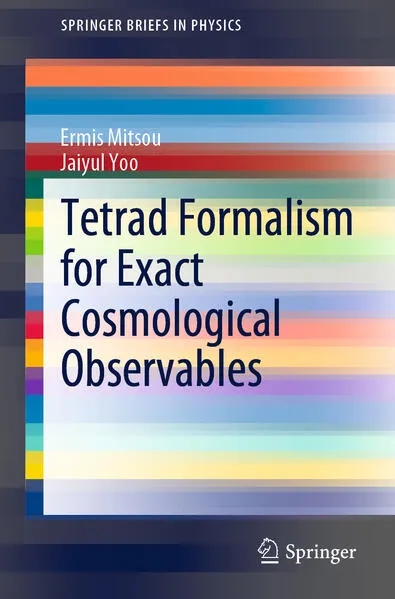
Tetrad Formalism for Exact Cosmological Observables
This book presents a novel mathematical formalism, based on the tetrad formulation of differential geometry, for describing cosmological observables exactly and conveniently. It covers all the standard observables, i.e. distances, weak lensing, number counts and cosmic microwave background, and also includes a detailed derivation of general-relativistic matrix kinetic theory. All the fully nonlinear equations are derived in detail and the mathematical content is self-contained, so that readers require only a basic knowledge of general relativity. Moreover, the authors discuss several subtle issues that are usually overlooked in the literature and, in particular, issues that distinguish this formalism from the more approximative standard practice.
- Autor: Mariz, Tiago
- Anzahl Bewertungen: 0
- Ø Bewertung:
- Medium: Buch
- Veröffentlicht: 10.01.2023
- Genre: Sonstiges
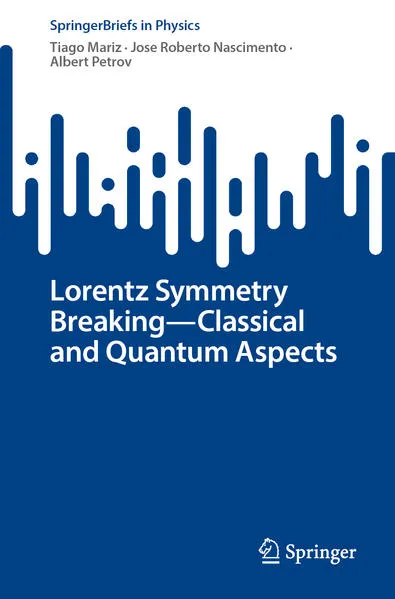
Lorentz Symmetry Breaking—Classical and Quantum Aspects
This book presents a review of various issues related to Lorentz symmetry breaking. Explicitly, we consider (i) motivations for introducing Lorentz symmetry breaking, (ii) classical aspects of Lorentz-breaking field theory models including typical forms of Lorentz-breaking additive terms, wave propagation in Lorentz-breaking theories, and mechanisms for breaking the Lorentz symmetry; (iii) quantum corrections in Lorentz-breaking theories, especially the possibilities for perturbation generating the most interesting Lorentz-breaking terms; (iv) correspondence between non-commutative field theories and Lorentz symmetry breaking; (v) supersymmetric Lorentz-breaking theories; and (vi) Lorentz symmetry breaking in a curved space-time. We close the book with the review of experimental studies of Lorentz symmetry breaking.
The importance and relevance of these topics are explained, first, by studies of limits of applicability of the Lorentz symmetry, second, by searches of the possible extensions of the standard model, including the Lorentz-breaking ones, and need to study their properties, third, by the relation between Lorentz symmetry breaking with string theory, fourth, by the problem of formulating a consistent quantum gravity theory, so that various modified gravity models are to be examined.