Studies in Systems, Decision and Control
Error Logic: Paving Pathways for Intelligent Error Identification and Management
Chronologie aller Bände (1 - 11)
Die Reihenfolge beginnt mit dem Buch "Reduction of the Pareto Set". Wer alle Bücher der Reihe nach lesen möchte, sollte mit diesem Band von Vladimir D. Noghin beginnen. Der zweite Teil der Reihe "Towards Analytical Techniques for Systems Engineering Applications" ist am 06.05.2020 erschienen. Mit insgesamt 11 Bänden wurde die Reihe über einen Zeitraum von ungefähr 8 Jahren fortgesetzt. Der neueste Band trägt den Titel "Inverse Problems Applied to Environmental Modelling of Rivers and Estuaries".
- Anzahl der Bewertungen für die gesamte Reihe: 0
- Ø Bewertung der Reihe: 0
- Start der Reihe: 06.10.2017
- Neueste Folge: 30.12.2025
Diese Reihenfolge enthält 8 unterschiedliche Autoren.
- Autor: Vladimir D. Noghin
- Anzahl Bewertungen: 0
- Ø Bewertung:
- Medium: Buch
- Veröffentlicht: 06.10.2017
- Genre: Sonstiges
Reduction of the Pareto Set
This book focuses on the issues of decision-making with several numerical criteria. It introduces an original general approach to solving multicriteria problems given quantitative information about the preference relation of a decision-maker. It considers the problems with crisp as well as fuzzy preference relations, accepting the four axioms of “reasonable choice”. Further, it defines the notion of an information quantum about the preference relation of a decision-maker and studies the reduction of the Pareto set using a finite collection of information quanta, demonstrating that the original approach yields a good approximation for the set of nondominated alternatives in a multicriteria problem. Lastly, it analyzes a possible combination of the axiomatic approach with other well-known methods. Intended for a wide range of professionals involved in solving multicriteria problems, including researchers, design engineers, product engineers, developers and analysts, the book is also a valuable resource for undergraduate and postgraduate students of mathematics, economics, and engineering.
- Autor: Acosta, Griselda / Smith, Eric / Kreinovich, Vladik
- Anzahl Bewertungen: 0
- Ø Bewertung:
- Medium: Buch
- Veröffentlicht: 07.05.2020
- Genre: Sonstiges
Towards Analytical Techniques for Systems Engineering Applications
- Autor: Liu, Shiyong
- Anzahl Bewertungen: 0
- Ø Bewertung:
- Medium: Buch
- Veröffentlicht: 09.03.2023
- Genre: Sonstiges
Error Logic: Paving Pathways for Intelligent Error Identification and Management

- Autor: Zaporozhets, Artur
- Anzahl Bewertungen: 0
- Ø Bewertung:
- Medium: Buch
- Veröffentlicht: 12.03.2023
- Genre: Politik
Systems, Decision and Control in Energy IV
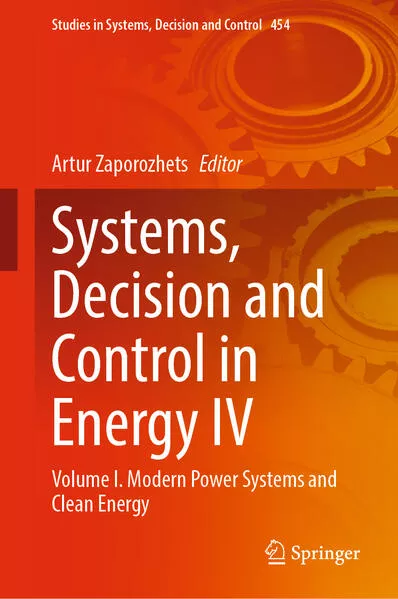
- Autor: Zaporozhets, Artur
- Anzahl Bewertungen: 0
- Ø Bewertung:
- Medium: Buch
- Veröffentlicht: 25.03.2023
- Genre: Politik
Systems, Decision and Control in Energy IV
- Autor: Ammari, Habib M.
- Anzahl Bewertungen: 0
- Ø Bewertung:
- Medium: Buch
- Veröffentlicht: 05.10.2023
- Genre: Sonstiges
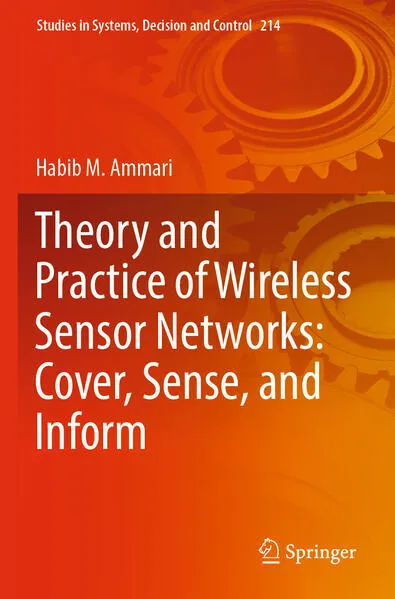
Theory and Practice of Wireless Sensor Networks: Cover, Sense, and Inform
- Autor: Hassanien, Aboul Ella
- Anzahl Bewertungen: 0
- Ø Bewertung:
- Medium: Buch
- Veröffentlicht: 30.11.2025
- Genre: Sonstiges
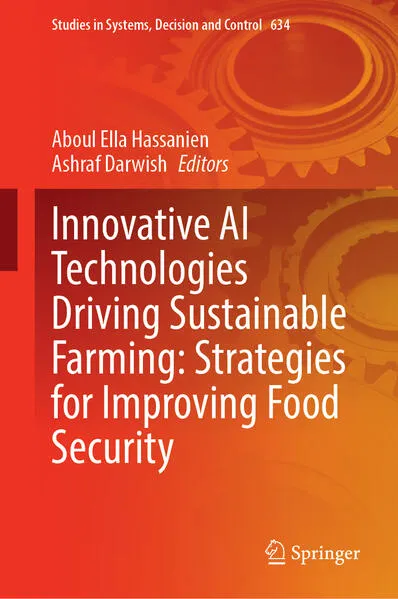
Innovative AI Technologies Driving Sustainable Farming: Strategies for Improving Food Security
This groundbreaking book explores cutting-edge AI applications—from disease detection in crops to yield prediction and food quality classification—empowering farmers, researchers, and policymakers to build a more resilient and sustainable food system. With real-world case studies and advanced methodologies, it offers a powerful roadmap for leveraging AI to enhance productivity, reduce waste, and ensure global food security.
- Autor: Kravets, Alla
- Anzahl Bewertungen: 0
- Ø Bewertung:
- Medium: Buch
- Veröffentlicht: 10.12.2025
- Genre: Sonstiges
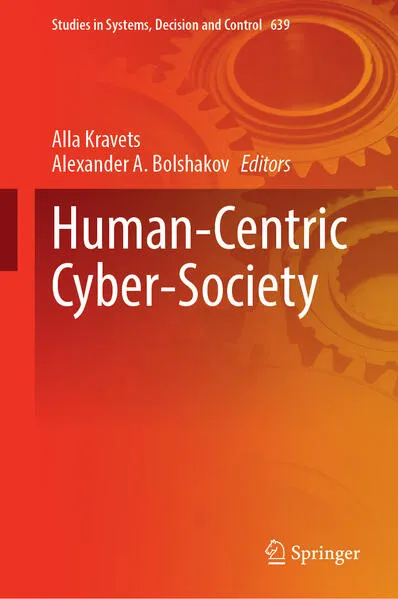
Human-Centric Cyber-Society
This book seeks to examine the profound transformations brought about by the convergence of human-centered principles and advancing cyber-technologies across diverse fields, including industry, environment, healthcare, and interactive media. Each chapter contributes to a broader understanding of how technological progress influences and shapes our social, economic, and ecological landscapes. Part I of the book focuses on the emergence of human-centricity in flexible industries and organizations. The formation of human-centric approaches in management strategies ensures that businesses remain adaptable to rapid changes while maintaining a focus on people. The incorporation of digital configurations allows for greater control over complex organizational systems, fostering flexibility and responsiveness. Additionally, models like Haken’s framework help assess socio-economic conditions, enabling regions to make informed decisions about growth and sustainability. The influence of market dynamics, particularly the effects of demand and cost fluctuations in oligopolistic markets, underscores the complexity of contemporary business ecosystems. Moreover, optimization techniques such as those employed in airline crew scheduling demonstrate the potential for enhanced efficiency when driven by advanced algorithms. Finally, the creation of cargo port risk management models illustrates how technology can mitigate systemic vulnerabilities. In Part II, attention shifts to environmental and ecological challenges. Multidimensional statistical tools analyze agricultural productivity, while small data sample modeling aids in optimizing resource-intensive processes like floodwater management. Innovative machine learning methods further refine the prediction of river flows and other hydrological phenomena. Simulations of fine dust particle dynamics provide deeper insights into atmospheric turbulence, while analyses of vehicular emissions shed light on urban pollution patterns. Part III turns to healthcare innovations, highlighting the role of machine learning in detecting breast cancer risks. Features derived from diagnostic models enhance the precision of detection, and cyber-physical systems leverage thermographic imagery to predict malignancies with greater accuracy.
- Autor: Kravets, Alla
- Anzahl Bewertungen: 0
- Ø Bewertung:
- Medium: Buch
- Veröffentlicht: 12.12.2025
- Genre: Sonstiges
Cyber-Physical Systems: Engineering in Digital Era
This book is a comprehensive exploration of the fundamental principles and contemporary applications of cyber-physical systems (CPS) in various engineering disciplines. This book is structured into five thematic sections, each addressing unique facets of CPS integration and digital transformation in engineering practices. This book opens the discussion by examining the creation and utilization of digital twins and computational models in diverse engineering contexts. Chapter 1 focuses on the digital twin of a functional food product, while subsequent chapters address the modeling of gas well operations under flooding conditions, productivity assessment of horizontal wells with multistage hydraulic fracturing, carbonate reservoir acid treatments, and thermal power plant optimization with combined cycle gas turbines. This book transitions to the specific challenges and opportunities presented by CPS in chemical engineering. Chapters cover the analysis of rarefied flow formation in chemical technology apparatuses, parameter estimation for optimizing polymer compositions, and decision support systems for automating ore phosphate charge production. This book delves into the broader landscape of heterogeneous environments within CPS. Topics include structural-parametric synthesis of global optimization algorithms, the application of pass-through structures for ultra-wideband information processing, and numerical modeling of acoustic instability in supersonic flows. Discussions encompass molecular fingerprint-based analyses of chemical formulas in patents, flexible word linking concepts for verifying recognized administrative documents and quality control mechanisms for administrative document recognition. Chapters highlight integrated computer systems for coke oven battery design training, software for studying key distribution schemes, and formalizations of mental models in human operators. This book is intended for researchers, practitioners, and students interested in the intersection of cyber-physical systems and engineering in the digital era. It provides a holistic view of current trends and best practices, offering valuable insights into the transformative potential of CPS across various engineering domains.
- Autor: Kravets, Alla
- Anzahl Bewertungen: 0
- Ø Bewertung:
- Medium: Buch
- Veröffentlicht: 23.12.2025
- Genre: Sonstiges
Frontiers of Industrial Cyber-Physics
This book represents a comprehensive exploration of the most recent advancements and applications at the intersection of machine learning, cyber-physical systems, and industrial processes. This book is divided into four primary sections, each focusing on distinct yet interconnected themes. The first section, ML-Based Industrial Solutions, highlights the transformative role of machine learning in industrial settings. Topics include the optimization of neural network architectures for atypical load forecasting in power grid cyber-physical systems, the use of vector autoregressive models for analyzing and forecasting consumption indicators, soft sensor-based fault detection and diagnosis in mass transfer processes, and the implementation of ML-based digital twins for predictive diagnostics in thermal power plants. Next, the book turns its attention to cyber-space for equipment reliability. Here, readers will find discussions on software tools for reliability analysis and efficiency assessment of technological equipment, methods for evaluating energy consumption, reliability estimations for automated lines with inter-operational storage devices, and the application of ANFIS network-based fuzzy expert systems for diagnosing power equipment defects. Additionally, this section includes considerations regarding the structure of knowledge models for solving control tasks in plants with parametric uncertainty. The third section, Unmanned Robotics, dives into the exciting world of autonomous systems. It covers topics such as modeling the optimal trajectory of reusable spacecraft entering the Earth's atmosphere, developing new methods for small unmanned helicopter emergency landings in case of onboard equipment failures, robust trajectory tracking control of nonholonomic wheeled mobile robots with external disturbances, and assessing the efficiency of passenger transportation in cyber-transport systems based on unmanned electric cars. Finally, the book concludes with a thorough examination of cybersecurity. The book is an essential resource for researchers, engineers, and professionals engaged in industrial automation, cyber-physical systems, and related disciplines.
- Autor: Lugon Junior, Jader
- Anzahl Bewertungen: 0
- Ø Bewertung:
- Medium: Buch
- Veröffentlicht: 30.12.2025
- Genre: Sonstiges
Inverse Problems Applied to Environmental Modelling of Rivers and Estuaries
This book addresses environmental challenges related to pollutant transport in rivers and estuaries through computational and mathematical modeling, optimization techniques, and computational intelligence. The authors explore methods for estimating the influence of physical processes that govern the distribution and concentration of pollutants. Special emphasis is placed on identifying parameters that characterize pollutant dispersion, as well as the location, intensity, and temporal dynamics of pollutant discharges. Optimization techniques are also presented to estimate the origin and magnitude of pollutant releases, enabling the assessment of environmental liabilities resulting from industrial activities or accidents.