Chronologie aller Bände (1 - 7)
Die Reihenfolge beginnt mit dem Buch "Sustainable Agriculture Reviews 56". Wer alle Bücher der Reihe nach lesen möchte, sollte mit diesem Band von Ajay Rana beginnen. Der zweite Teil der Reihe "Sustainable Agriculture Reviews 57" ist am 24.08.2023 erschienen. Mit insgesamt 7 Bänden wurde die Reihe über einen Zeitraum von ungefähr 2 Jahren fortgesetzt. Der neueste Band trägt den Titel "Sustainable Agriculture Reviews".
- Anzahl der Bewertungen für die gesamte Reihe: 0
- Ø Bewertung der Reihe: 0
- Start der Reihe: 11.02.2023
- Neueste Folge: 19.03.2025
Diese Reihenfolge enthält 6 unterschiedliche Autoren.
- Autor: Rana, Ajay
- Anzahl Bewertungen: 0
- Ø Bewertung:
- Medium: Buch
- Veröffentlicht: 11.02.2023
- Genre: Sonstiges
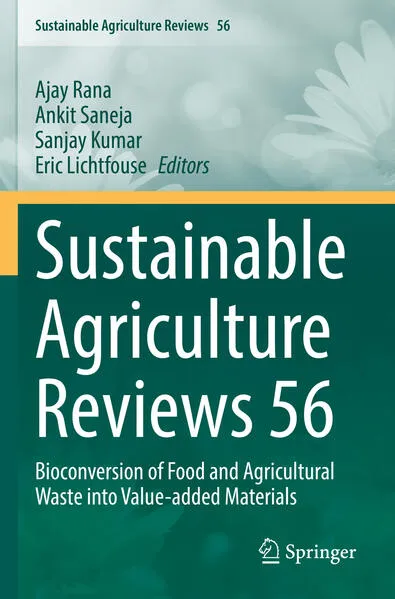
Sustainable Agriculture Reviews 56

- Autor: Singh, N.K.
- Anzahl Bewertungen: 0
- Ø Bewertung:
- Medium: Buch
- Veröffentlicht: 22.02.2023
- Genre: Sonstiges
Sustainable Agriculture Reviews 60

- Autor: Fahad, Shah
- Anzahl Bewertungen: 0
- Ø Bewertung:
- Medium: Buch
- Veröffentlicht: 15.04.2023
- Genre: Sonstiges
Sustainable Agriculture Reviews 61
The book aim to contribute the latest understandings of physiological, biochemical and molecular bases of the responses of major crop plants to a range of different biomass produced biochar to introduce climate resilience crop varieties which leads to enhanced crop productivity and quality under stressful conditions and also for better utilization of natural resources to ensure food security through modern breeding. Finally, this book will be a valuable resource for future plant stress related research with biochar, and can be considered as a reference book for front-line researchers working on sustaining crop production under climate change.
Adverse effects of climate changes on crops has developed the situation quite critical for sustainable agriculture. Food security has become in danger due to low production of agricultural crops by resilient climate and ever increasing human population. Heat, drought, salinity, soil compaction, flooding and poor soil organic carbon induced stress in crops by climate adverse conditions are major concerns in this regard. A mechanistic understanding of the interactions between abiotic stresses response of crops is needed to identify and take advantage of acclimation traits in major crop species as a prerequisite for securing robust yield and good quality. This underpins a need for crops with inherent yield increase, yield stability against multiple abiotic stresses and improved quality. Individual stress tolerance mechanisms have been well documented so far. However, mechanisms behind plants’ tolerance by application of biochar and its interactions with soil and plant roots towards multiple abiotic stresses are not fully understood.
In addition, there will always be some uncertainty associated with modelling the complex relationships between agricultural yields, product quality with biochar under future climate scenarios. Prediction of yield and quality stability, one of mostcomplex agronomic traits, must integrate aspects of plant development, physiology, biochemistry and genetics. Furthermore, the GxExM interactions will complicate the model predications, thus the responses of a given genotype to a defined environment under certain management strategy need to be determined empirically and used to parameterise and refine crop models.
- Autor: Yata, Vinod Kumar
- Anzahl Bewertungen: 0
- Ø Bewertung:
- Medium: Buch
- Veröffentlicht: 24.08.2023
- Genre: Sonstiges
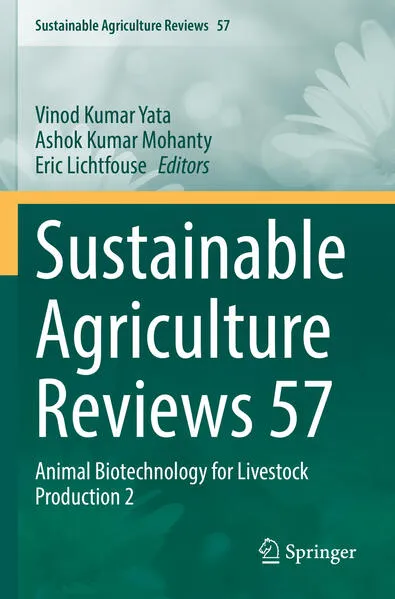
Sustainable Agriculture Reviews 57
This 2nd book provides fundamental concepts and recent applications of biotechnological methods, such as genetic selection, breeding methods and genetic engineering tools. Biotechnology has remarkably improved the productivity of livestock by increasing the reproduction efficiency and decreasing the generation time. The chapters detail the mechanisms of methods for animal reproduction and breeding methods. This book focus on the impact of minerals, steroids metabolic stress, nutritional stress and anti-nutritional factors on the livestock reproduction.
- Autor: Iqbal, Asif
- Anzahl Bewertungen: 0
- Ø Bewertung:
- Medium: Buch
- Veröffentlicht: 17.11.2023
- Genre: Sonstiges
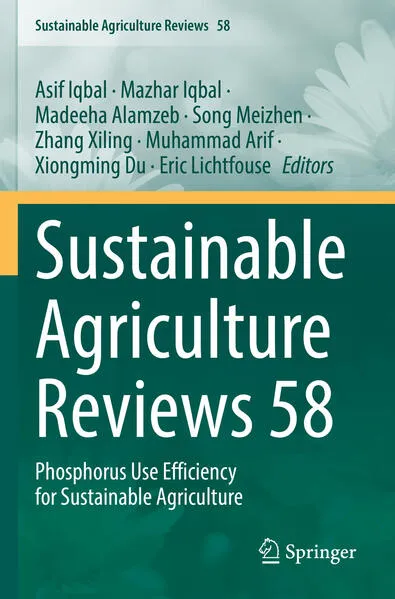
Sustainable Agriculture Reviews 58
- Autor: Yata, Vinod Kumar
- Anzahl Bewertungen: 0
- Ø Bewertung:
- Medium: Buch
- Veröffentlicht: 08.02.2024
- Genre: Sonstiges
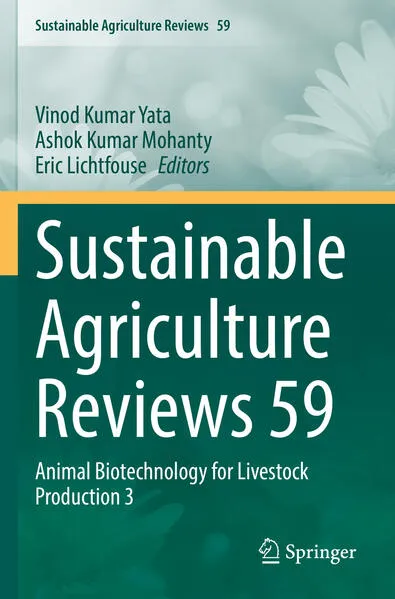
Sustainable Agriculture Reviews 59
The dependency on animal biotechnology in livestock industries has been increased in the recent past. The livestock production research has witnessed remarkable developments on biotechnological methods to produce the elite animal breeds. The global animal food requirement has been steadily increasing, and animal production needs to be increased as per the global needs. This book covers various aspects of animal biotechnology such as, reproductive biotechnologies in sheep and goats, oogenesis and folliculogenesis and ovarian disorders. This book focusses the discussion on proteomics and metabolomics, and separate chapters were dedicated to discuss these topics. The proteomics studies of animal viruses were discussed in this book, and this would be helpful to understand animal viral pathogenesis. The applications of metabolomics in livestock were discussed with focus on data analysis, identification of unknown compounds. The purpose of this book is to provide the recent research trends, and convert all this information to usable guide to professionals, researchers and students who are working the research area of animal biotechnology.
- Autor: Kumar Yata, Vinod
- Anzahl Bewertungen: 0
- Ø Bewertung:
- Medium: Buch
- Veröffentlicht: 19.03.2024
- Genre: Sonstiges
Sustainable Agriculture Reviews
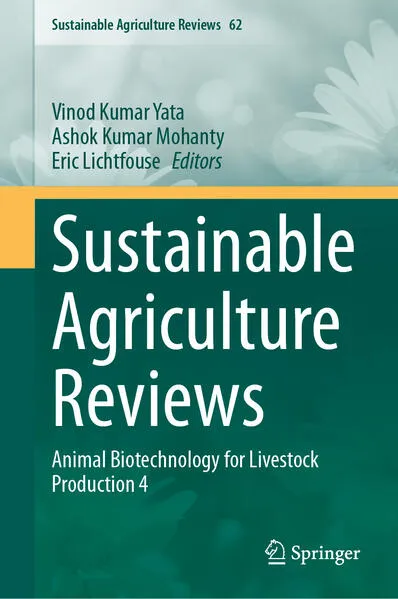
This book presents advanced reviews on latest developments and future trends of animal biotechnology with focus on computational and experimental approaches. The articles in this book discusses the implications of recent methods in animal biotechnology to improve the livestock production. Applications of omics technologies and system biology approaches for livestock production and animal disorders were discussed in detail.
The evolution of transgenic technology, genome editing and markers for early pregnancy detection were elucidated in this book. A couple of chapters were dedicated to understanding the role of gut microbiome, probiotics and prebiotics on livestock health and production. The nanomaterials have been shown been shown beneficial effects in biological applications. This book also discussed the veterinary applications of nanomaterials. The articles of this book provide state of the art information that is appropriate to academicians, researchers and students who are involved in the animal biotechnology research.