Chronologie aller Bände (1 - 2)
Die Reihenfolge beginnt mit dem Buch "Nodal Discontinuous Galerkin Methods". Wer alle Bücher der Reihe nach lesen möchte, sollte mit diesem Band von Jan S. Hesthaven beginnen. Der zweite Teil der Reihe "Nodal Discontinuous Galerkin Methods" ist am 20.12.2007 erschienen. Mit insgesamt 2 Bänden wurde die Reihe über einen Zeitraum von ungefähr 7 Jahren fortgesetzt. Der neueste Band trägt den Titel "Computational Electromagnetics".
- Anzahl der Bewertungen für die gesamte Reihe: 10
- Ø Bewertung der Reihe: 3.73
- Start der Reihe: 18.12.2007
- Neueste Folge: 13.12.2014
Diese Reihenfolge enthält 2 unterschiedliche Autoren.
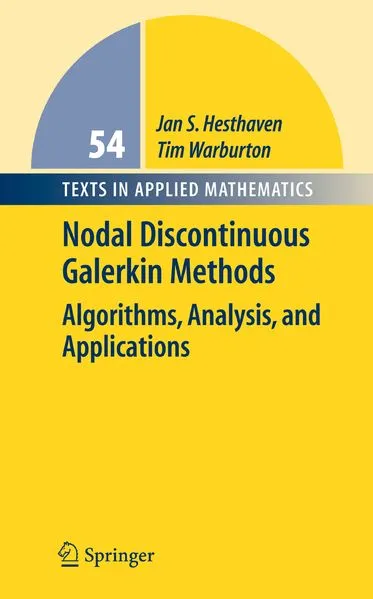
- Autor: Jan S. Hesthaven
- Anzahl Bewertungen: 0
- Ø Bewertung:
- Medium: Buch
- Veröffentlicht: 18.12.2007
- Genre: Sonstiges
Nodal Discontinuous Galerkin Methods
The text offers an introduction to the key ideas, basic analysis, and efficient implementation of discontinuous Galerkin finite element methods (DG-FEM) for the solution of partial differential equations. This is the first text on DG-FEM, suitable both as a textbook and for self study. All key theoretical results are either derived or discussed, including an overview of relevant results from approximation theory, convergence theory for numerical PDE’s, orthogonal polynomials etc. Through embedded Matlab codes, the algorithms are discussed and implemented for a number of classic systems of PDE’s. Attention is paid to both basic analysis and algorithmic issues. The three appendices contain an overview of orthogonal polynomials and associated library routines used throughout, a brief introduction to grid generation, and an overview of the associated software (where to get it, list of variables etc). A variety of exercises are included at the end of most chapters.
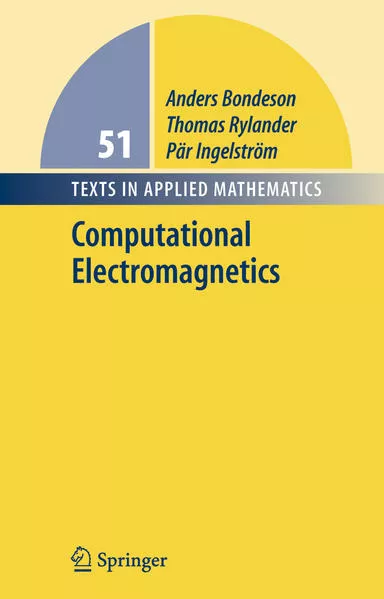
- Band: 51
- Autor: Bondeson, Anders
- Anzahl Bewertungen: 4
- Ø Bewertung: 3.8
- Medium: Buch
- Veröffentlicht: 01.12.2010
- Genre: Autobiographie
Computational Electromagnetics
This book introduces three of the most popular numerical methods for simulating electromagnetic fields: the finite difference method, the finite element method and the method of moments. In particular it focuses on how these methods are used to obtain valid approximations to the solutions of Maxwell's equations. Contains several MATLAB programs and detailed description of practical issues to help students write their own programs.