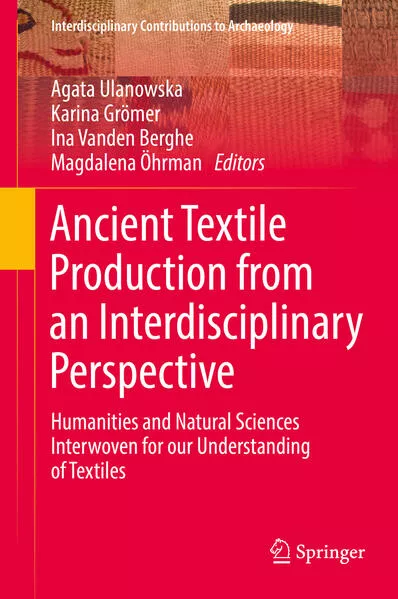
Ancient Textile Production from an Interdisciplinary Perspective
Humanities and Natural Sciences Interwoven for our Understanding of Textiles
The diverse developments in textile research of the last decade, along with the increased recognition of the importance of textile studies in adjacent fields, now merit a dedicated, full-length publication entitled “Ancient Textile Production from an Interdisciplinary Perspective: Humanities and Natural Sciences Interwoven for our Understanding of Textiles”. With this volume, the authors and the editors wish to illustrate to the current impact of textile archaeology on the scholarly perception of the past (not limited to archaeology alone). The volume presents new insights into the consumption, meaning, use and re-use of textiles and dyes, all of which are topics of growing importance in textile research. As indicated by the title, we demonstrate the continued importance of interdisciplinarity by showcasing several ‘interwoven’ approaches to environmental and archaeological remains, textual and iconographic sources, archaeological experiments and ethnographic data, from a large area covering Europe and the Mediterranean, Near East, Africa and Asia. The chronological span is deliberately wide, including materials dating from c. 6th millennium BCE to c. mid-14th century CE.
The volume is organised in four parts that aim to reflect the main areas of the textile research in 2020. After the two introductory chapters (Part I: About this Volume and Textile Research in 2020), follow two chapters referring to dyes and dyeing technology in which analytical and material-based studies are linked to contextual sources (Part II: Interdisciplinarity of Colour: Dye Analyses and Dyeing Technologies). The six chapters of Part III: Interdisciplinary Approaches to Textile Tools discuss textiles and textile production starting from the analyses of tools, whether functional or as representative of technological developments or user identity. Archaeological and cultural contexts as well as textile traditions are the main topics of the six chapters in Part IV: Traditions and Contexts: Fibres, Fabrics, Techniques, Uses and Meanings. The two final chapters in Part V: Digital Tools refer to the use of digital tools in textile research, presenting two different case studies.


Unterstütze den lokalen Buchhandel
Nutze die PLZ-Suche um einen Buchhändler in Deiner Nähe zu finden.
Bestelle dieses Buch im Internet



| Veröffentlichung: | 30.04.2022 |
| Höhe/Breite/Gewicht | H 23,5 cm / B 15,5 cm / - |
| Seiten | 338 |
| Art des Mediums | Buch [Gebundenes Buch] |
| Preis DE | EUR 139.09 |
| Preis AT | EUR 142.99 |
| Reihe | Interdisciplinary Contributions to Archaeology |
| ISBN-13 | 978-3-030-92169-9 |
| ISBN-10 | 3030921697 |

Über den Autor
Agata Ulanowska is an Assistant Professor in the Faculty of Archaeology, University of Warsaw. Her research interests focus on the Bronze Age Aegean, textile production and technology, especially textile tools, experimental archaeology, and Aegean seals, and sealing practices in relation to textiles and textile production. She was awarded with two grants of the National Science Centre of Poland, for the projects: “Textile production in Bronze Age Greece – comparative studies of the Aegean weaving techniques” (2015–2017) and "Textiles and Seals. Relations between textile production and seals and sealing practices in Bronze Age Greece” (2018–2021). She is a chair of the COST Action CA 19131 “EuroWeb. Europe Through Textiles: Network for an integrated and interdisciplinary Humanities”.
Karina Grömer is the head of the Department of Prehistory, Natural History Museum Vienna. She studied Prehistoric Archaeology, Ethnology and Anthropology at the University of Vienna in Austria. Habilitation thesis: “Archaeological Textile Research - Technical, economic and social aspects of textile production and clothing from Neolithic to the Early Modern Era”. She is specialised on interdisciplinary and integrated analysis of textiles, research on textile tools and reconstruction of prehistoric costume. Her research covers a time-span from c. 2500 BC till 1000 AD and a geographical area from Central Europe to Iran (research projects e.g. “DressID - Clothing and Identity in Roman Empire”, “CinBA – Creativity in the Bronze Age” and “Chehrabad Saltmummy & Saltmine Exploration Project”, “EuroWeb. Europe Through Textiles: Network for an integrated and interdisciplinary Humanities”). She is also teaching at the Universities Vienna (Austria) and Southampton (Great Britain).
Ina Vanden Berghe is leading the Textile Research Unit at the Laboratory Department of the Royal Institute for Cultural Heritage (KIK-IRPA) in Brussels. She specialises in the study of materials, techniques and degradation aspects of organic materials. Her main research activities relate to natural and synthetic organic dye and protein identification (amino acid based) with chromatographic, spectroscopic and/or microscopic techniques. Besides, she is also experienced in the study of metal thread and plant fibre identification. For the Leather, Paper and Parchment Research Unit at KIK-IRPA, she covers the research on organic dye/pigments and on the (cellulosic or proteinaceous) primary material. Her special interest however goes to the field of archaeological textiles and the degradation problems related to various burial and preservation conditions. She has participated in several research projects such as “MODHT – Monitoring of the Damage in Historic Tapestries”, “DressID – Clothing and Identity in Roman Empire’, “Eu–Artech – Access, Research and Technology for the Conservation of the European Cultural Heritage”; “Charisma – Cultural heritage Advanced Research Infrastructures: Synergy for a multidisciplinary approach to conservation/restoration” and “Iperion – Integrated platform for European research infrastructures in the field of cultural heritage”.
Magdalena Öhrman is Senior Lecturer in Classics at the University of Wales Trinity Saint David. Trained as a Classical Philologist in Sweden and Germany, her current research interests are in the area of Graeco-Roman textiles and textile production, textile terminology and technology, and in sensory experience in past societies. She held a Marie Skłodowska Curie fellowship at the Centre for Textile Research (University of Copenhagen) in 2016-2018 for the project "Textile Reflections: Multi-Sensory Representation of Textile Work in Latin Poetry and Prose".
Diesen Artikel teilen
0 Kommentar zu diesem Buch
.... weitere Publikationen von Springer International Publishing



Formalwissenschaftlicher Beweis der Existenz Gottes über kalkül - Mathematische Philosophie und Philosophie der Grammatik
Bewerbungsfrist bis zum: 29.10.2026