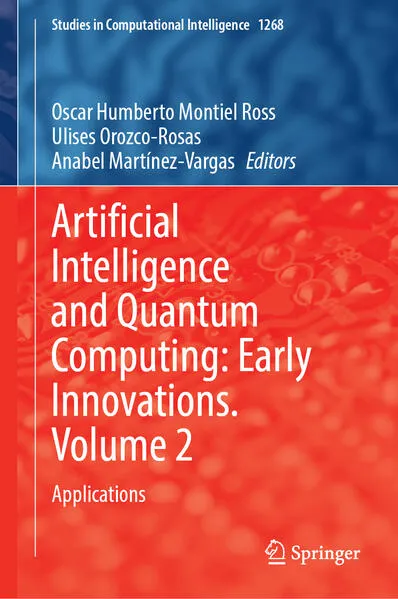
Artificial Intelligence and Quantum Computing: Early Innovations. Volume 2
Applications
This book extends the first volume with contributions that advance the state of the art and demonstrate their impact in real-world applications. In a few years, the convergence of artificial intelligence (AI) and quantum computing has moved from speculation to concrete prototypes and tools.
Key Highlights
• Health and Precision Medicine: Deep learning and hybrid quantum–classical models support osteoporosis screening from dental radiographs, Alzheimer’s staging with 3D MRI, EEG-based cognitive-state assessment, and HIV/TB biomarker classification, strengthening prevention, diagnosis, and personalized treatment.
• Education, Human–AI Interaction and Fairness: An automatic reviewer of handwritten flowcharts scales feedback in programming courses, while a benchmarking study on speaker ID and gender recognition analyzes bias; quantum granular computing provides a Hilbert-space framework for advanced teaching and research.
• Sustainable Production, Cities, and Environment: Vision systems for welding defects, cucumber disease detection, and analogue water-meter digitization improve manufacturing quality, reduce food waste, and enable transparent water management, alongside work on electric fleets, mobile robots, and sea turtle monitoring.
• Data-Centric and Trustworthy AI for the Digital Economy: GAN-based synthetic tabular data, decision-support for cryptocurrency markets, and benchmarks for intrusion detection and malware classification offer tools for scarce or volatile data, with emphasis on robustness, interpretability, and reproducible evaluation.
• Quantum Algorithms, Hardware and Software Infrastructure: Chapters address quantum optimization (QAOA, adiabatic 3-SAT), quantum error correction and superconducting devices, plus experimental QKD, while a C-to-QIR compiler and quantum granules framework provide software and conceptual support for hybrid systems.
•Optimization and Intelligent Systems: Fuzzy fractal search and fuzzy dragonfly metaheuristics optimize neural architectures and controllers and, together with dynamic hypernetworks and RL-based fleet planning, show how advanced optimization can be embedded in practical engineering workflows.
This book is aimed at researchers, graduate students, and practitioners seeking rigorous, application-oriented work at the AI–quantum interface. By linking methodological advances with SDG-aligned use cases in health, education, infrastructure, energy, and security, it offers a concise blueprint for how quantum-aware intelligent technologies can support more resilient and sustainable societies.


Unterstütze den lokalen Buchhandel
Nutze die PLZ-Suche um einen Buchhändler in Deiner Nähe zu finden.
Bestelle dieses Buch im Internet


| Veröffentlichung: | 13.07.2026 |
| Höhe/Breite/Gewicht | H 23,5 cm / B 15,5 cm / - |
| Seiten | 598 |
| Art des Mediums | Buch |
| Preis DE | EUR 213.99 |
| Preis AT | EUR 219.99 |
| Reihe | Studies in Computational Intelligence |
| ISBN-13 | 978-3-032-18049-0 |

Diesen Artikel teilen
0 Kommentar zu diesem Buch
.... weitere Publikationen von Springer International Publishing








Formalwissenschaftlicher Beweis der Existenz Gottes über kalkül - Mathematische Philosophie und Philosophie der Grammatik
Bewerbungsfrist bis zum: 29.10.2026