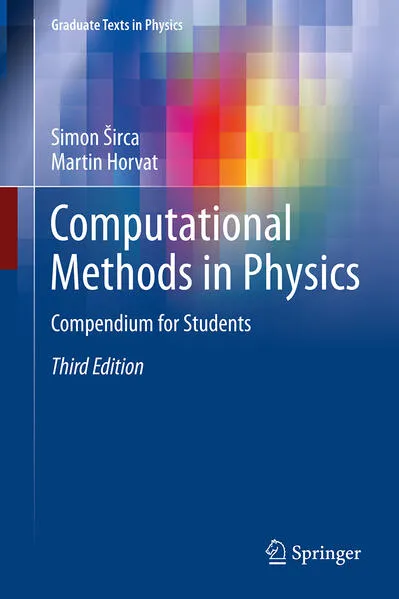
Computational Methods in Physics
Compendium for Students
This textbook provides a compendium of numerical methods to assist physics students and researchers in their daily work. It carefully considers error estimates, stability and convergence issues, the choice of optimal methods, and techniques to increase program execution speeds. The book supplies numerous examples throughout the chapters that are concluded by more comprehensive problems with a strong physics background. Instead of uncritically employing modern black-box tools, the readers are encouraged to develop a more ponderous and skeptical approach.
This revised and expanded edition now includes a new chapter on numerical integration and stable differentiation, as well as fresh material on optimal filtering, integration of gravitational many-body problems, computation of Poincaré maps, regularization of orbits, singular Sturm-Liouville problems, techniques for time evolution and spatial treatment of (semi)infinite domains in spectral methods, and phase retrieval. It also brings updated discussions of algebraic problems involving sparse matrices and of high-resolution schemes for partial differential equations.


Unterstütze den lokalen Buchhandel
Besuche doch eine der folgenden Buchhandlungen in deiner Nähe


Bestelle dieses Buch im Internet


| Veröffentlichung: | 01.04.2025 |
| Seiten | 1029 |
| Art des Mediums | E-Book [Kindle] |
| Auflage | 3. Auflage |
| Reihe | Physics and Astronomy (R0) |
| ISBN-13 | 978-3-031-68566-8 |
| ISBN-10 | 3031685660 |

Über den Autor
Simon Širca was born on February 27, 1969, in Ljubljana, Slovenia. He is Professor of Physics at the Faculty of Mathematics and Physics, University of Ljubljana, where he has been teaching courses on Probability for Physicists, Computational Physics and Model Analysis. He is head of the research group Structure of Hadronic Systems active in the Hall A Collaboration at Thomas Jefferson National Accelerator Facility (USA) and the A1/MAGIX Collaborations at MAMI/MESA in Mainz (Germany). His main research field is the study of hadronic structure and dynamics by scattering of electrons on light nuclei, exploiting polarized beams, polarized targets, and recoil polarimetry. He is also involved in theoretical work on quark models of hadrons, with focus on electroweak processes.
Martin Horvat was born on April 25, 1977, in Maribor, Slovenia. He is Assistant Professor at the Faculty of Mathematics and Physics, University of Ljubljana, where he has led the Physical Laboratory Course and taught Basic Applied Mathematics and Physics. The bulk of his research is devoted to classical and quantum non-linear dynamics, to transport properties in extended systems, to the quantum-classical correspondence, to theoretical and applied aspects of quantum mechanics on the classical phase space, as well as to statistical mechanics and its origin in dynamics. He is also involved in the development of methods for solving the time-dependent Schrödinger equation in atomic physics, in research of autonomic relativistic global navigation satellite systems (RGNSS) for the European Space Agency (ESA), in modeling of astrophysical bodies, mainly eclipsing binary stars and synthesis of their observable, for prominent astrophysical packages PHOEBE and in statistical analysis and modeling of uncertainty in normal-mode decomposition of weather forecasts from the European Centre for Medium-Range Weather Forecasts system (ECMWF).