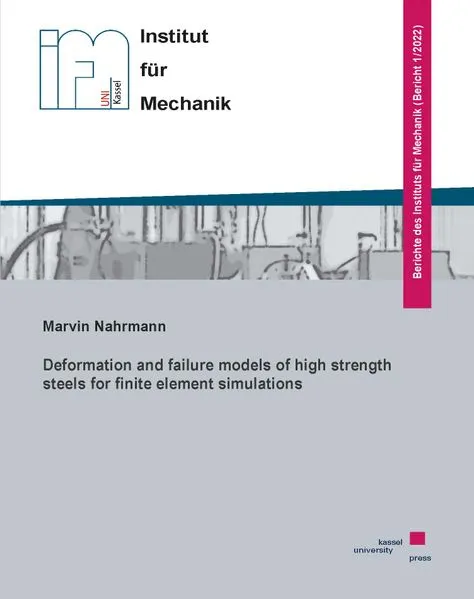
Deformation and failure models of high strength steels for finite element simulations
The aim of this thesis is the development of improved computational material models for the finite element simulation of components and structures made of high strength steels. The first step of this work is the modelling of temperature and strain rate dependent large deformations. The model accounts for isotropic plasticity and introduces a novel nonlinear isotropic hardening approach. The temperature dependency is considered for the yield criterion, hardening and strain rate sensitivity by applying temperature dependent functions. The constitutive equations are implemented as hypo-elastic user defined material model into LS-DYNA® for solid elements. Two methods are discussed for modelling the dissipation of mechanical work into heat. Besides the Taylor-Quinney approximation, a thermo-mechanically consistent approach is presented secondly, based on enhanced rheological elements. In order to evaluate the prediction accuracy of the proposed thermo-viscoplasticity model, its parameters are identified for various steel and aluminium types. Thereby, a wide temperature range and various strain rates are taken into account. Finally, the thermo-viscoplasticity model is validated by a simultaneous hot/cold forging process of a shaft. The second focus of this work is the damage and failure modelling of high strength steels. The stress state dependence of the damage mechanisms is considered by the Hosford-Coulomb model, taking into account the triaxiality and the Lode parameter. Since the Hosford-Coulomb failure model is based only on the current stress state, it is incorporated into a continuum damage mechanics based approach. Thereby, the damage evolution is assumed to be nonlinear, and damage initiation and failure are represented by a critical and a failure strain. Both are Hosford-Coulomb type functions of the stress triaxiality and the Lode parameter. The Hosford-Coulomb based ductile damage model is extended towards nonlocal damage evolution, preventing the pathological mesh sensitivity caused by localisation. Thereby the focus is set on the integral nonlocal formulation and the gradient enhanced damage approach. For the latter, an efficient implementation strategy is discussed. The proposed nonlocal ductile damage model is verified under multiaxial loading. Therefore, test data are considered of a microalloyed steel for various sheet specimen geometries, covering a wide range of stress states. Finally, the nonlocal ductile damage model is validated by a combined shear-tension specimen and a square tube under axial crushing.


Unterstütze den lokalen Buchhandel
Nutze die PLZ-Suche um einen Buchhändler in Deiner Nähe zu finden.
Bestelle dieses Buch im Internet


| Veröffentlichung: | 08.06.2022 |
| Höhe/Breite/Gewicht | H 21 cm / B 14,8 cm / 259 g |
| Seiten | 170 |
| Art des Mediums | Buch |
| Preis DE | EUR 39.00 |
| Preis AT | EUR 40.10 |
| Reihe | Berichte des Instituts für Mechanik 1 |
| ISBN-13 | 978-3-737-61033-9 |

Diesen Artikel teilen
0 Kommentar zu diesem Buch
.... weitere Publikationen von Kassel University Press


Formalwissenschaftlicher Beweis der Existenz Gottes über kalkül - Mathematische Philosophie und Philosophie der Grammatik
Bewerbungsfrist bis zum: 29.10.2026