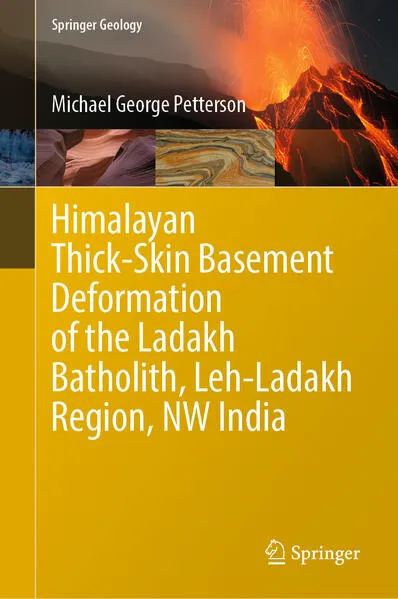
Himalayan Thick-Skin Basement Deformation of the Ladakh Batholith, Leh-Ladakh Region, NW India
This book presents the first report and interpretation of the deformation, structural style, and geo-tectonic evolution of a 600km2 area of the Ladakh batholith, NW India, centred on the city of Leh, Ladakh. The Ladakh (and westerly Kohistan ) batholith comprises a large component of the Jurassic-Oligocene Kohistan-Ladakh Arc-Terrane (KLA), with magmatism spanning island arc, continental margin, and post-Himalayan collision tectonic environments. The KLA is bounded to the north by the Shyok-Northern Suture and to the south by the Indus Suture. The batholith illustrates basement thick-skin tectonic deformation and is divided/partitioned into a series of crustal blocks separated by lateral accommodation structures which allow independent movement in horizontal and vertical space. Thin skinned deformation within the adjacent sedimentary molasse Indus Suture Rocks produced large thrust stacks that predominantly moved towards the N-NE. Whilst deformation within cover sequences influences the basement structures, and helps break up the basement into crustal blocks, there is a clear distinction in deformation between the basement and cover sequences. Basement batholith deformation is more complex and heterogeneous, reflecting the variable transmission of tectonic stress within crystalline crust and the presence of a wide range of precursory inherited weaknesses and anisotropies. Models of time-space deformation are presented using data derived from field and extensive photograph / photo-mosaic image interpretation. The batholith was deformed during at least Palaeocene-Pliocene times at crustal depths that correspond to the ductile-brittle transition zone and shallower.


Unterstütze den lokalen Buchhandel
Nutze die PLZ-Suche um einen Buchhändler in Deiner Nähe zu finden.
Bestelle dieses Buch im Internet


| Veröffentlichung: | 01.06.2023 |
| Seiten | 149 |
| Art des Mediums | E-Book [Kindle] |
| Preis DE | EUR 160.49 |
| Preis AT | EUR 165.00 |
| Reihe | Earth and Environmental Science |
| Reihe | Springer Geology |
| ISBN-13 | 978-3-031-31566-4 |

Über den Autor
Michael G Petterson is currently Professor of Geology, School of Science, and Pro Vice Chancellor / Dean of the Faculty of Health and Environmental Science, Auckland University of Technology, New Zealand. Michael first researched into aspects of the Himalayan geology for his PhD at the Department of Geology, University of Leicester, UK, researching the geology, petrology, geochemistry, age, and structure of the Kohistan batholith, and Arc, North Pakistan. This work, together with collaborations with other Himalayan researchers, led to numerous publications, perhaps most importantly defining the structure and deformation, lithological character, and age span of the Kohistan-Ladakh batholith, developing the idea of different magmatic stages, tectonic environments, and magmatic source regions. Subsequently, working with the British Geological Survey, Professor Petterson researched and published geological aspects of the Kohistan and Afghanistan regions of the Himalayas, with a focus upon crustal terrane accretion (in Afghanistan) and the palaeo-eruptive and tectonic environment of Kohistan-Ladakh volcanic sequences. Michael has also published two comprehensive review papers on aspects of the Kohistan-Ladakh batholith and related volcanic units. Professor Petterson often accompanies his field excursions with his trusty guitar, jamming with locals, and organising singing get togethers: one memorable evening was around an outdoor open fire along with twenty fellow troubadours, and his partner, Lanka Nanayakarra, at 10pm on an extremely cold minus twenty degrees Centigrade evening, by the banks of the mighty River Indus in Ladakh. Adventures such as this inform Michael’s songwriting with his band ‘Strata’ and related blues-rock-acoustic groups.Diesen Artikel teilen
0 Kommentar zu diesem Buch
.... weitere Publikationen von Springer International Publishing








Formalwissenschaftlicher Beweis der Existenz Gottes über kalkül - Mathematische Philosophie und Philosophie der Grammatik
Bewerbungsfrist bis zum: 29.10.2026