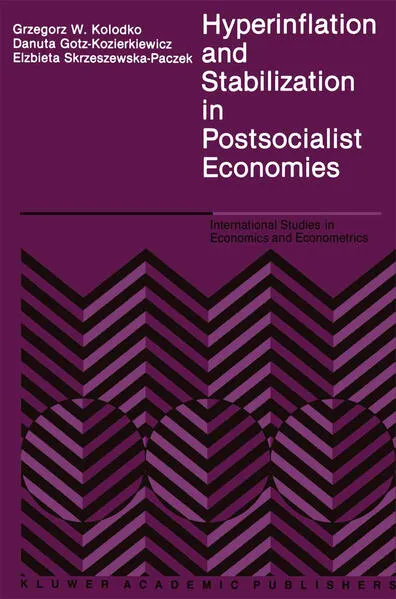
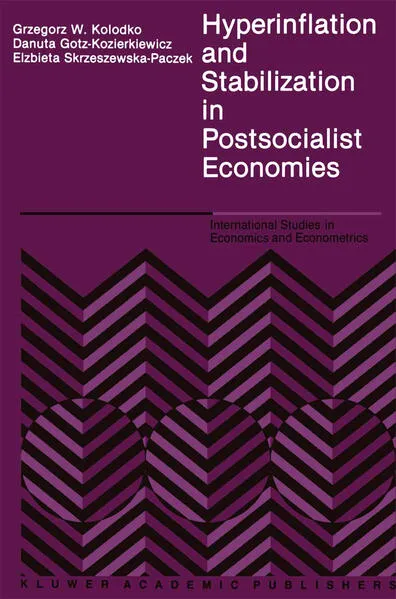
G.W Kolodko
Hyperinflation and Stabilization in Postsocialist Economies
ISBN: 978-9-401-05734-9
186 Seiten | € 53.49
Buch [Taschenbuch]
Erscheinungsdatum:
12.11.2012
Sonstiges
G.W Kolodko
Hyperinflation and Stabilization in Postsocialist Economies
One would think states and peoples have had so many bad experiences with inflation that politicians at the helm of these states would do everything within their power to avoid inflation and, in particular, its very intensive shape, i. e. hyperinflation. However, this has not been the case. After the big inflations of the twenties and the post-war inflations of the fourties, we still witness intensive, economically, socially and politically extremely painful inflationary processes. And the eighties will be particularly engraved in history as a period in which the inflation has assumed an exceptionally dynamic character with respect to some countries. This regards, in the first place, Latin America, but not exclusively. Not without reason -as will be of particular intensity has also affected shown in this book -inflation countries which, according to the passed economic doctrine, were supposed to be completely immune from this economic illness. Most generally, the inflation can be assumed to be a uniform phenomenon which, in each case, can be described by a single, universal definition, while being divided into a number of forms and types distinguishable according to their original and secondary sources, their mechanisms, the ways of their manifestation as well as to their effects and the methods of counteracting them.


Unterstütze den lokalen Buchhandel
Nutze die PLZ-Suche um einen Buchhändler in Deiner Nähe zu finden.
Bestelle dieses Buch im Internet



| Veröffentlichung: | 12.11.2012 |
| Höhe/Breite/Gewicht | H 23,5 cm / B 15,5 cm / - |
| Seiten | 186 |
| Art des Mediums | Buch [Taschenbuch] |
| Preis DE | EUR 53.49 |
| Preis AT | EUR 54.99 |
| Reihe | International Studies in Economics and Econometrics |
| ISBN-13 | 978-9-401-05734-9 |
| ISBN-10 | 9401057346 |

Diesen Artikel teilen
0 Kommentar zu diesem Buch
.... weitere Publikationen von Springer Netherland













Leserunde
Formalwissenschaftlicher Beweis der Existenz Gottes über kalkül - Mathematische Philosophie und Philosophie der Grammatik
Bewerbungsfrist bis zum: 29.10.2026