WWF Deutschland
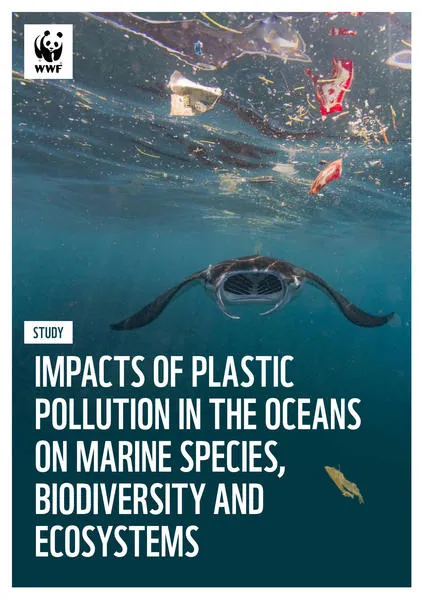
Impacts of Plastic Pollution in the Ocean on Marine Species, Biodiversity an Ecosystems
ISBN: 978-3-946-21146-4
224 Seiten | €
Buch [Taschenbuch]
Erscheinungsdatum:
00.01.2022
Sonstiges
Since the advent of the widespread commercial production and use of plastics
(see Glossary) after the Second World War, the rate of production and the associated emission of plastic waste into the world’s oceans has grown significantly.
In recent decades, much of the plastic pollution came from single-use items.
Annual emissions into the oceans were estimated at 19–23 MMT (see “Metric
ton” in the Glossary) in 2016. Another important feature of plastic pollution is
that, once in the environment, the larger macroplastic items break down into
ever smaller fragments, becoming microplastics, which become nanoplastics.
Because of this fragmentation process, concentrations of microplastics and nanoplastics will continue to rise for decades even if all plastic emissions cease now.
Increasing scientific and public interest
The last decade has seen an unprecedented increase in research findings
coupled with a growing interest in the media and rising concern in the public
sphere. Pictures of beautiful tropical beaches and coral reefs choked by plastic
waste, of dying animals caught up in abandoned fishing nets and throwaway
plastic items, and of birds with stomachs full of plastic waste have played a
prominent role in raising awareness of this issue to gain public attention
globally.
Meanwhile, scientists have worked on more and more questions related to
plastic pollution, with thousands of studies now covering many different aspects
of this pervasive environmental problem. In this report, we review the scientific
literature to summarise and evaluate the current state of knowledge on the
effects of plastic pollution on marine populations, species and ecosystems.
Spatial distribution
One important result from this research is that plastic pollution is now ubiquitous. It has reached every part of the ocean, from the sea surface to the deep
ocean floor, from the poles to coastlines of the most remote islands and is
detectable in the smallest plankton up to the largest whale.
Once in the oceans, plastics spread very unevenly among marine regions, species and ecosystems. There are only a few areas where little to no plastic pollution has been detected, in most areas it has and some hotspots are already
severely polluted. Such accumulation ‘hotspots’, are, for example, the five big
ocean gyre systems, areas near major source points, like long polluted rivers
and ecosystems such as coral reefs, mangrove forests and deep-sea canyons.
Moreover, certain regions, such as parts of the Mediterranean, East China and
Yellow Sea are considered pollution hotspots.
WWF Deutschland
Impacts of Plastic Pollution in the Ocean on Marine Species, Biodiversity an Ecosystems
Auszug
Current plastic pollutionSince the advent of the widespread commercial production and use of plastics
(see Glossary) after the Second World War, the rate of production and the associated emission of plastic waste into the world’s oceans has grown significantly.
In recent decades, much of the plastic pollution came from single-use items.
Annual emissions into the oceans were estimated at 19–23 MMT (see “Metric
ton” in the Glossary) in 2016. Another important feature of plastic pollution is
that, once in the environment, the larger macroplastic items break down into
ever smaller fragments, becoming microplastics, which become nanoplastics.
Because of this fragmentation process, concentrations of microplastics and nanoplastics will continue to rise for decades even if all plastic emissions cease now.
Increasing scientific and public interest
The last decade has seen an unprecedented increase in research findings
coupled with a growing interest in the media and rising concern in the public
sphere. Pictures of beautiful tropical beaches and coral reefs choked by plastic
waste, of dying animals caught up in abandoned fishing nets and throwaway
plastic items, and of birds with stomachs full of plastic waste have played a
prominent role in raising awareness of this issue to gain public attention
globally.
Meanwhile, scientists have worked on more and more questions related to
plastic pollution, with thousands of studies now covering many different aspects
of this pervasive environmental problem. In this report, we review the scientific
literature to summarise and evaluate the current state of knowledge on the
effects of plastic pollution on marine populations, species and ecosystems.
Spatial distribution
One important result from this research is that plastic pollution is now ubiquitous. It has reached every part of the ocean, from the sea surface to the deep
ocean floor, from the poles to coastlines of the most remote islands and is
detectable in the smallest plankton up to the largest whale.
Once in the oceans, plastics spread very unevenly among marine regions, species and ecosystems. There are only a few areas where little to no plastic pollution has been detected, in most areas it has and some hotspots are already
severely polluted. Such accumulation ‘hotspots’, are, for example, the five big
ocean gyre systems, areas near major source points, like long polluted rivers
and ecosystems such as coral reefs, mangrove forests and deep-sea canyons.
Moreover, certain regions, such as parts of the Mediterranean, East China and
Yellow Sea are considered pollution hotspots.


Unterstütze den lokalen Buchhandel
Nutze die PLZ-Suche um einen Buchhändler in Deiner Nähe zu finden.
Bestelle dieses Buch im Internet



| Veröffentlichung: | 00.01.2022 |
| Seiten | 224 |
| Art des Mediums | Buch [Taschenbuch] |
| Auflage | 1. Auflage |
| ISBN-13 | 978-3-946-21146-4 |
| ISBN-10 | 3946211461 |
Diesen Artikel teilen
0 Kommentar zu diesem Buch
... weitere Publikationen von WWF Deutschland
Leserunde
Formalwissenschaftlicher Beweis der Existenz Gottes über kalkül - Mathematische Philosophie und Philosophie der Grammatik
Bewerbungsfrist bis zum: 29.10.2026