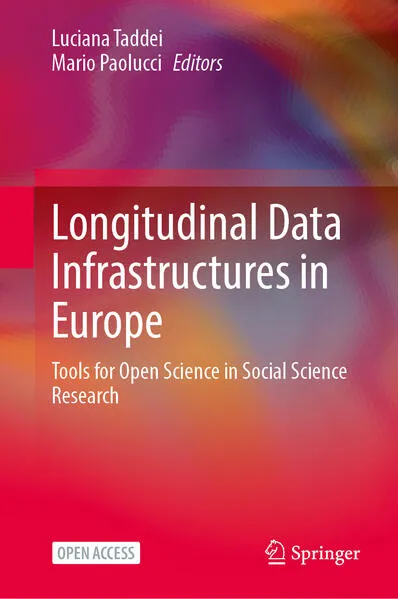
Longitudinal Data Infrastructures in Europe
Tools for Open Science in Social Science Research
This open access book explores panels, infrastructures, open science, and the opportunities they offer. More than that, it shares our experiences in creating them. This is not a technical manual, but an accessible guide about social sciences infrastructures, how they work, and why they are essential for collaboration and the sharing of knowledge. Through stories, examples, and insights, we show that infrastructures are not only technological tools but living ecosystems that nurture ideas, connect people, and add to everyone’s work. The book speaks to students, teachers, researchers, and decision-makers, but also to citizens, communities, and those curious about the future of knowledge in social sciences. Open science here is not just theory, but a hands-on practice that widens horizons and makes discovery a shared adventure.


Unterstütze den lokalen Buchhandel
Nutze die PLZ-Suche um einen Buchhändler in Deiner Nähe zu finden.
Bestelle dieses Buch im Internet



| Veröffentlichung: | 27.12.2025 |
| Seiten | 166 |
| Art des Mediums | Digital [Kindle] |
| Reihe | Social Sciences |
| Reihe | Social Sciences (R0) |
| ISBN-13 | 978-3-032-07005-0 |
| ISBN-10 | 3032070058 |

Über den Autor
Luciana Taddei is a researcher with the Italian National Research Council (CNR). Her work focuses on research methodology and techniques, with a particular interest in methodological innovation, especially digital methods, open science, and the integration of quantitative and qualitative approaches.
Luciana is currently involved in the FOSSR – Fostering Open Science in Social Science Research project at the “Institute for Research on Population and Social Policies” (IRPPS), and she serves as Adjunct Professor at the University “Magna Graecia” of Catanzaro and at the University of Calabria, where she teaches Methodology and Techniques of Social Research and Social Research Methodology for Sport Management.
She received a degree in Sociology and a specialization in Sociology and Advanced Social Research from the Sapienza University of Rome, a PhD in Migration and Intercultural Processes from the University of Genoa and a PhD in History from the Universidad Nacional de Tres de Febrero (UNTREF), Buenos Aires. She has also been a visiting researcher and lecturer in Prague (Czech Republic) and Timișoara (Romania).
She is the author of more than 40 scientific publications, including textbooks on social research methodology and techniques, and articles in peer-reviewed journals such as Italian Sociological Review, Scuola Democratica, and Current Politics and Economics of Europe.
Mario Paolucci is a researcher with the Italian National Research Council (CNR). He carries out interdisciplinary research in the field of computational social sciences, applying multi-agent computational model of social phenomena with a generative approach.
Mario is currently the director of the CNR “Institute for Research on Population and Social Policies” (IRPPS). He has been co-PI, together with Giulia Andrighetto, of the Laboratory of Agent-based Social Simulation (LABSS), located at the CNR Institute of Cognitive Sciences and Technologies (ISTC). He has been scientific coordinator and PI of EC-funded projects (eRep, FuturICT 2.0).
He received a degree in Physics from the Sapienza University of Rome and a PhD from the University of Florence, carrying out research activity with Rosaria Conte and Cristiano Castelfranchi.
He taught courses at Sapienza University of Rome, University of Perugia and University of Bologna.
He is also author of over 100 scientific publications, among which a monograph on Reputation written with Rosaria Conte, and articles on peer-reviewed journal such as Advances in Complex Systems, Scientometrics, and the International Journal of Approximate Reasoning.
Diesen Artikel teilen
0 Kommentar zu diesem Buch
.... weitere Publikationen von Springer International Publishing





Formalwissenschaftlicher Beweis der Existenz Gottes über kalkül - Mathematische Philosophie und Philosophie der Grammatik
Bewerbungsfrist bis zum: 29.10.2026