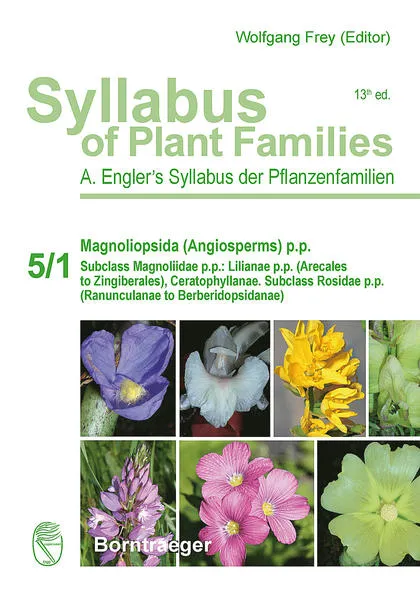
Syllabus of Plant Families - A. Engler's Syllabus der Pflanzenfamilien Part 5/1: Magnoliopsida (Angiosperms) p.p.
Subclass Magnoliidae p.p.: Lilianae p.p. (Arecales to Zingiberales), Ceratophyllanae, Subclass Rosidae p.p. (Ranunculanae to Berberidopsidanae)
Since its first publication in 1887 Engler’s Syllabus of Plant Families has aimed to provide both the researcher, and particularly the students with a concise survey of the „plant“ kingdom (including the fungi and prokaryotic algae), presenting all higher systematic units right down to families and genera of plants, algae and fungi. In 1954, more than 65 years ago, the 12th edition of the well-known „Syllabus der Pflanzenfamilien“(„Syllabus of Plant Families“), set a standard. Now, the completely restructured and revised 13th edition of Engler’s Syllabus published in 5 parts for the first time also considers molecular data, which have only recently become available in order to provide an up-to-date evolutionary and systematic overview of all plant and fungal groups treated.
In our „molecular times“ there is a vitally important and growing need to preserve the knowledge of the entire range of diversity and biology of organisms for coming generations, as there is a decline in „classical“ morphological and taxonomical expertise.
Accordingly, the 13th edition of the Syllabus of Plant Families synthesizes both modern data and classical expertise, serving to educate future experts who will maintain our knowledge of the full range of Earth’s biodiversity.
Syllabus of Plant Families is a mandatory reference for students, experts and researchers from all fields of biological sciences, particularly botany and mycology.



Unterstütze den lokalen Buchhandel
Nutze die PLZ-Suche um einen Buchhändler in Deiner Nähe zu finden.
Bestelle dieses Buch im Internet



| Veröffentlichung: | 06.07.2022 |
| Höhe/Breite/Gewicht | H 25 cm / B 18 cm / 1570 g |
| Seiten | 671 |
| Art des Mediums | Buch [Gebundenes Buch] |
| Preis DE | EUR 219.00 |
| Preis AT | EUR 225.20 |
| ISBN-13 | 978-3-443-01173-4 |
| ISBN-10 | 344301173X |

Über den Autor
Nach einem Studium der Politikwissenschaft hat Wolfgang Frey als Journalist viele Jahre für führende Medien in Deutschland, Liechtenstein und der Schweiz gearbeitet. Auf seiner Referenzenliste finden sich unter anderem die Nachrichtenagenturen «ddp» und «AP», «Der Spiegel», die «NZZ am Sonntag» oder der «Deutschlandfunk». Neben seiner Arbeit als Autor, Pressefotograf und Publizist hat er begonnen, Seife zu rühren, 2015 schließlich eine eigene Manufaktur gegründet und sich daneben eingehend mit der Geschichte, den Herstellungstechniken und der Chemie der Seife befasst. Davon zeugt sein aufwändig recherchierter und dokumentierter Band «Die Renaissance der Seife», der sowohl auf theoretischem Fach- als auch auf praktischem Erfahrungswissen gründet. Wolfgang Frey lebt und arbeitet in Heiligkreuz im Schweizer Seeztal.
Diesen Artikel teilen
0 Kommentar zu diesem Buch
Formalwissenschaftlicher Beweis der Existenz Gottes über kalkül - Mathematische Philosophie und Philosophie der Grammatik
Bewerbungsfrist bis zum: 29.10.2026