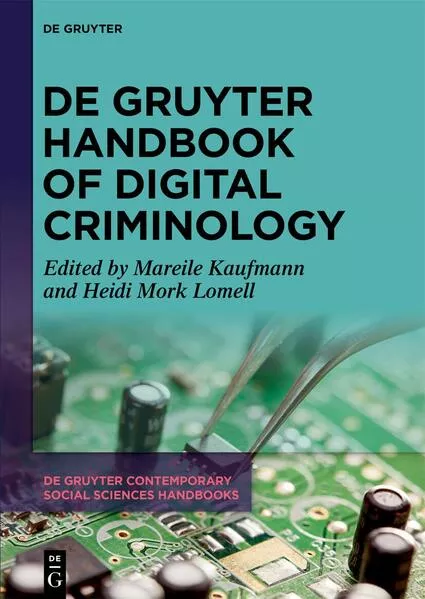
De Gruyter Handbook of Digital Criminology
The De Gruyter Handbook of Digital Criminology examines how digital devices spread and cut across all fields of crime and control. Providing a glossary of key theoretical, methodological and criminological concepts, the book defines and further establishes a vibrant and rapidly developing field. At the same time, Digital Criminology is not only presented as a novelty, but also as a continuation of the discipline's history.
Each chapter can be read as a free-standing contribution or texts can be combined to gain a more holistic understanding of Digital Criminology or to design a research project. Expert contributions vary from Criminology, Sociology, Law, Science and Technology Studies, to Information Science and Digital Humanities. Together, these supply readers with rich and original perspectives on the digitization of crime and control.
All contents of the De Gruyter Handbook of Digital Criminology are openly accessible. Open access has been funded by the European Research Council, as outlined in the respective chapters, and by the Department of Criminology and Sociology of Law at the University of Oslo.
Mareile and Heidi would like to thank Vilde B. Winge for her commitment and excellent research assistance in the realization of this book project. Thanks are also due to Gerhard Boomgaarden and his team at De Gruyter who saw this book through to production.


Unterstütze den lokalen Buchhandel
Nutze die PLZ-Suche um einen Buchhändler in Deiner Nähe zu finden.
Bestelle dieses Buch im Internet



| Veröffentlichung: | 17.03.2025 |
| Höhe/Breite/Gewicht | H 24 cm / B 17 cm / 1004 g |
| Seiten | 524 |
| Art des Mediums | Buch [Gebundenes Buch] |
| Preis DE | EUR 149.95 |
| Preis AT | EUR 149.95 |
| Auflage | 1. Auflage |
| Reihe | De Gruyter Contemporary Social Sciences Handbooks 6 |
| ISBN-13 | 978-3-111-06193-1 |
| ISBN-10 | 3111061930 |

Über den Autor
Mareile Kaufmann is a professor at the Department of Criminology and Sociology of Law, University of Oslo, where she seeks to consolidate the field of Digital Criminology. She has led a range of research projects in this field and her work was awarded several prizes. Mareile has extensive editing experience from working on special issues and her engagement on editorial boards.
Heidi Mork Lomell is a professor at the Department of Criminology and Sociology of Law, University of Oslo. Her research focuses mainly on policing and crime control, with a special interest in the introduction of various forms of (surveillance) technologies and other preventive measures in the criminal justice system. Currently, she is studying digitization and privatization of knowledge production, with a special interest in the role of private actors as providers of the knowledge foundation in criminal justice reforms.