Chronologie aller Bände (1 - 5)
Die Reihenfolge beginnt mit dem Buch "Toxin and Bioregulator Weapons". Wer alle Bücher der Reihe nach lesen möchte, sollte mit diesem Band von Michael Crowley beginnen. Der zweite Teil der Reihe "Toxin and Bioregulator Weapons" ist am 23.11.2023 erschienen. Mit insgesamt 5 Bänden wurde die Reihe über einen Zeitraum von ungefähr 2 Jahren fortgesetzt. Der neueste Band trägt den Titel "Shari'a and the Constitution in Contemporary Legal Models".
- Anzahl der Bewertungen für die gesamte Reihe: 0
- Ø Bewertung der Reihe: 0
- Start der Reihe: 23.11.2022
- Neueste Folge: 24.03.2025
Diese Reihenfolge enthält 4 unterschiedliche Autoren.
- Autor: Crowley, Michael
- Anzahl Bewertungen: 0
- Ø Bewertung:
- Medium: Buch
- Veröffentlicht: 23.11.2022
- Genre: Politik
Toxin and Bioregulator Weapons
This book explores how revolutionary developments and convergence of the chemical, life and associated sciences are impacting contemporary toxin and bioregulator research, and examines the risks of such research being misused for malign purposes. Investigating illustrative cases of dual use research of potential concern in China, India, Iran, Russia, Syria and the USA, the authors discuss how states can ensure such research and related activities are not utilised in weapons development. Although toxins and bioregulators are, in theory, covered by both the Biological and Toxin Weapons Convention and Chemical Weapons Convention, this apparent overlap in reality masks a dangerous regulatory gap – with neither Convention implemented effectively to address threats of weaponisation. This book highlights the potentially damaging consequences for international peace and security, and proposes realistic routes for action by states and the scientific community.
- Autor: Ramaioli, Federico Lorenzo
- Anzahl Bewertungen: 0
- Ø Bewertung:
- Medium: Buch
- Veröffentlicht: 19.11.2023
- Genre: Politik
Juridical Perspectives between Islam and the West
"Published in cooperation with gLAWcal - Global Law Initiatives for Sustainable Development, Hornchurch, Essex, United Kingdom".
- Autor: Ramaioli, Federico Lorenzo
- Anzahl Bewertungen: 0
- Ø Bewertung:
- Medium: Buch
- Veröffentlicht: 14.12.2023
- Genre: Politik
Shari'a and the Constitution in Contemporary Legal Models
"Published in cooperation with gLAWcal - Global Law Initiatives for Sustainable Development, Hornchurch, Essex, United Kingdom".
- Autor: Iglesias Márquez, Daniel
- Anzahl Bewertungen: 0
- Ø Bewertung:
- Medium: Buch
- Veröffentlicht: 25.09.2024
- Genre: Politik
Legal Challenges at the End of the Fossil Fuel Era
This edited collection proposes a wide range of approaches to address the legal issues pertaining to the end of the fossil fuel era. While the fossil fuel era is coming to an end both because of the inherent limits of its resources and because of the need to prevent to further pump out CO2 in an already saturated atmosphere, the legal dispositions to ensure an ordered and rational shift toward cleaner energy still need to be developed. Not only in relation to CO2 emissions themselves but also in relation to the manifold issues related to environmental justice in an era of global climate change and global warming. This book is unique in that it provides a theoretical framework but also works to address cutting edge issues through a series of case studies.
- Autor: Kałduński, Marcin
- Anzahl Bewertungen: 0
- Ø Bewertung:
- Medium: Buch
- Veröffentlicht: 28.12.2024
- Genre: Politik
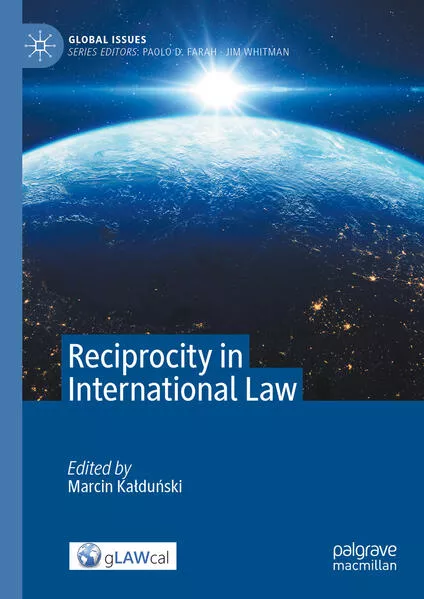
Reciprocity in International Law
The world is changing. The era of globalization – where the states have been eager to cooperate towards common aims – might seem to be disappearing. Russia expresses a contempt for international law, China makes claim to power, while the United States, at least temporarily, shows disregard to international institutions they themselves created (in particular, the WTO and the WHO). The growing phenomenon of nationalistic and authoritarian leaders may seem to hamper the development of community interests. Some states may be more inclined to resort to reciprocal behaviour as certain events indicate (e.g., the exchange of prisoners-of-war in the Russia-Ukraine conflict and an exchange of economic sanctions – tit-for-tat or tat-for-tat). The field of international law appears to be returning to first principles in the light of multiple world crises. Thus, reciprocity – as a classic concept of international law – may “come back from the shadows,” be reinvented and reinforced to form one of the basic pillars in the relations among states. Given the above, the purpose of the book is to rediscover and identify the position and role of reciprocity in contemporary international law.