Chronologie aller Bände (1 - 5)

Die Reihenfolge beginnt mit dem Buch "Journal für Entwicklungspolitik 1/2-2023". Wer alle Bücher der Reihe nach lesen möchte, sollte mit diesem Band von Claudia Mattersburger Kreis für Entwicklungspolitik / Brunner beginnen. Der zweite Teil der Reihe "Journal für Entwicklungspolitik 3/4-2023" ist am 23.01.2024 erschienen. Die Reihe umfasst derzeit 5 Bände. Der neueste Band trägt den Titel "Journal für Entwicklungspolitik 4-2024".
- Anzahl der Bewertungen für die gesamte Reihe: 0
- Ø Bewertung der Reihe: 0
- Start der Reihe: 30.06.2023
- Neueste Folge: 01.04.2025
Diese Reihenfolge enthält 4 unterschiedliche Autoren.
- Autor: Mattersburger Kreis für Entwicklungspolitik / Brunner, Claudia
- Anzahl Bewertungen: 0
- Ø Bewertung:
- Medium: Buch
- Veröffentlicht: 30.06.2023
- Genre: Politik
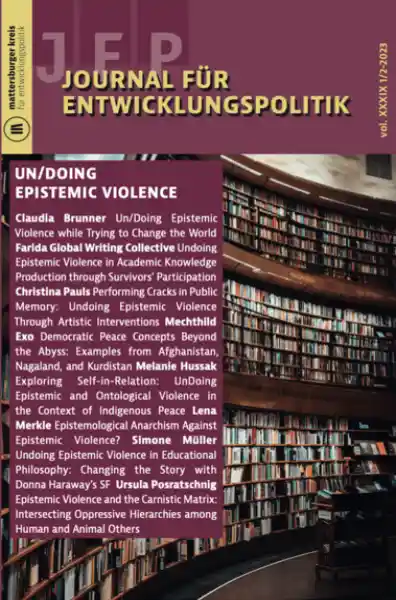
Journal für Entwicklungspolitik 1/2-2023
In Western academia, knowledge is often seen as being opposed to violence, whereas the latter, separated from its ideational and material context, is reduced to its most visible manifestations. As a consequence, the global entanglements of Western knowledge and the violent conditions of global modernity have become an academic non-issue, obscuring the role of knowledge in colonial and imperial enterprises. In contrast, the concept of epistemic violence brings into focus the constitutive relationship between knowledge, domination and violence in colonial modernity. Building on the critical traditions of feminist, post- and decolonial, and indigenous theorists, as well as including experiences from and within social movements, authors of this special issue explore violent formations of knowledge regarding the Global South and connect them to other forms of violence. They show how deeply embedded epistemic violence is in research practices, scholarly disciplines and academia in general. Furthermore, they search for counter-hegemonic ways of challenging and changing imperial modes of knowing the world and highlight the complex challenges of trying to undo epistemic violence.
- Band: 1
- Autor: Mattersburger Kreis für Entwicklungspolitik
- Anzahl Bewertungen: 0
- Ø Bewertung:
- Medium: Buch
- Veröffentlicht: 01.09.2024
- Genre: Politik
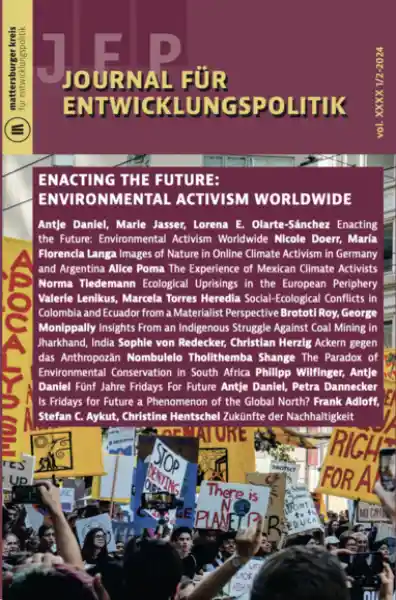
Journal für Entwicklungspolitik 1/2-2024
The effects of climate change and of the overexploitation of natural resources are becoming more noticeable on a worldwide level. Nevetheless, public discourse and supranational negotiations are often dominated by the Global North. Against this background, this special issue provides a wide array of analyses of different forms of self-organisation that have emerged globally to address the causes and unfolding consequences of climate disasters and of socio-ecological conflicts. The research articles as well as essays and interviews in this issue, offer novel theoretical and empirical contributions that examine how various social movements envision, negotiate, and strive for differing futures. While growing bodies of research in this field exist in both the Global North and South, they have largely remained isolated. We therefore aim to bridge this gap by placing special emphasis on contributions from the Global South as a starting ground for a dialogue that fosters environmental justice and enhances a more equal knowledge production.
- Band: 3
- Autor: Mattersburger Kreis für Entwicklungspolitik
- Anzahl Bewertungen: 0
- Ø Bewertung:
- Medium: Buch
- Veröffentlicht: 23.01.2024
- Genre: Politik
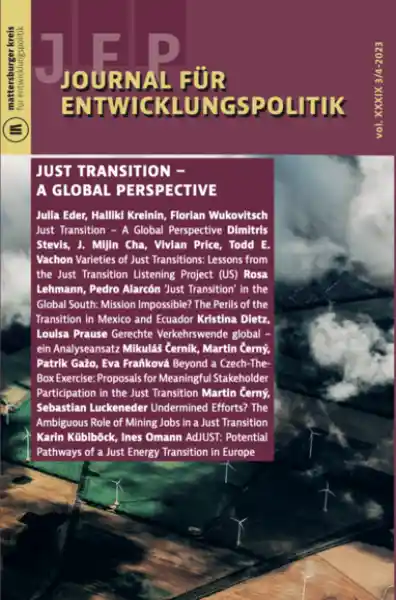
Journal für Entwicklungspolitik 3/4-2023
Just transition is a concept used by various actors with conflicting interests, from trade unions and NGOs to governments and companies. Confronted with the problem of defining and achieving justice in the context of the ecological crisis and the connected transformation, this special issue contributes to developing a ‘global perspective’ on just transition, advocating for a comprehensive approach that both addresses transnational labour solidarity and reduces global inequalities. The diverse contributions in this volume shed light on the challenges, solutions, struggles, and competing interpretations of (un)just transition(s), and are based on case studies from the United States, Mexico, Ecuador, Europe’s peripheries and beyond, while examining the impact of transitioning on workers, communities, and global inequalities.
- Band: 3
- Autor: Durán, Gonzalo
- Anzahl Bewertungen: 0
- Ø Bewertung:
- Medium: Buch
- Veröffentlicht: 01.03.2025
- Genre: Politik
Journal für Entwicklungspolitik 3-2024
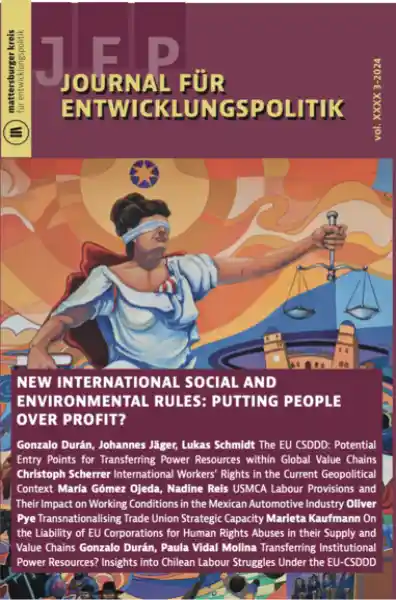
Binding international regulations rather than voluntary measures are essential for promoting human rights and protecting the environment. The contributors examine how effective existing regulations and new rules are in meeting these goals. The recently proposed EU supply chain legislation (Corporate Sustainability Due Diligence Directive – CSDDD) potentially represents a paradigmatic shift in international economic governance structures and is intended to defend human rights. This special issue contextualises and critically assesses the European due diligence legislation and similar legal instruments. Its emancipatory potential as well as possible downsides are analysed. The contributors deal with the question of how these new developments can be characterised. Are these changes progressive in that they genuinely strengthen workers globally, or do they legitimise and stabilise the existing neoliberal global economy? Interestingly, the authors come to different conclusions on these important questions
- Band: 4
- Autor: Faschingeder, Gerald
- Anzahl Bewertungen: 0
- Ø Bewertung:
- Medium: Buch
- Veröffentlicht: 01.04.2025
- Genre: Politik
Journal für Entwicklungspolitik 4-2024
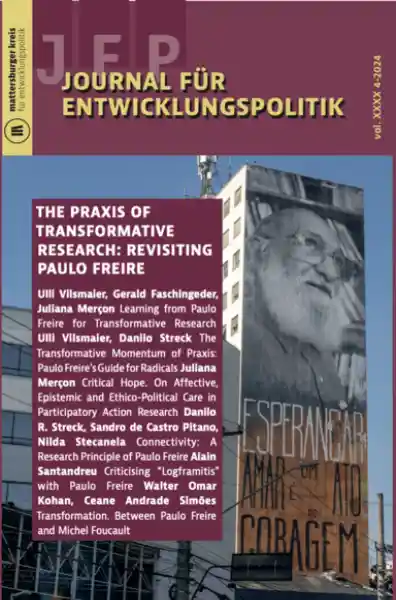
The demand that research on social-ecological problems should develop transformative power has manifested itself in the concept of transformative research. It combines knowledge production with transformative action dealing with the concrete situations at stake and has brought forth collaborative research approaches and alliances across societal domains. In Paulo Freire’s work we encounter a radical vision of research and learning as abilities to understand and transform the world that this special issue mobilises for current discourses. The contributions elaborate on Freire’s notion of transformation, connectivity as research principle, affectivity as an important dimension of research, and critically examine the project-centrism in contemporary societies as well as the concept of transformation itself.