Chronologie aller Bände (1 - 2)
Die Reihenfolge beginnt mit dem eBook "From the Maluku to Molecules". Wer alle eBookz der Reihe nach lesen möchte, sollte mit diesem Band von Oliver Kayser beginnen. Der zweite Teil der Reihe "Justus von Liebig" ist am 31.07.2025 erschienen. Die Reihe umfasst derzeit 2 Bände. Der neueste Band trägt den Titel "Justus von Liebig".
- Anzahl der Bewertungen für die gesamte Reihe: 0
- Ø Bewertung der Reihe: 0
Diese Reihenfolge enthält 2 unterschiedliche Autoren.
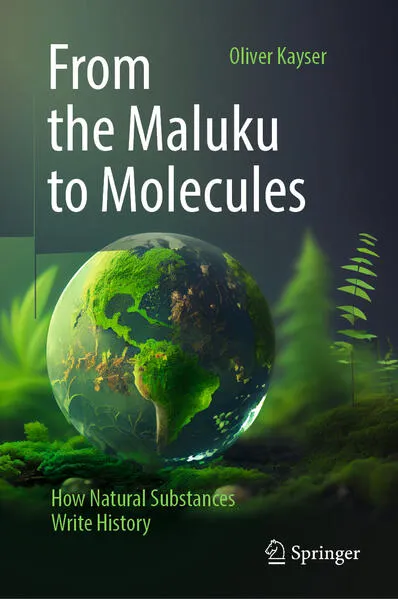
- Autor: Kayser, Oliver
- Anzahl Bewertungen: 0
- Ø Bewertung:
- Medium: E-Book
- Veröffentlicht: 28.11.2024
- Genre: Sonstiges
From the Maluku to Molecules
Natural products are a marvel of evolution. Plants are chemical factories and have produced a vast number of highly diverse and interesting natural substances with their extraordinary properties, which we humans have been using for centuries to relieve and cure diseases. At the latest since the discovery of penicillin, natural substances have become an important source of medicines, but we know only very few of the presumably many millions that are still waiting to be discovered. Important antibiotics, immunosuppressants, anticancer agents, hormones, and antiviral agents are among the natural products. But do natural products still matter in the age of biotechnology and genetic engineering? Yes, more than ever, because medicinal chemists draw creative inspiration for their syntheses from nature to develop the next blockbuster in medicine.
Oliver Kayser tells the story of natural products and medicinal plants in this book in a highly informative and amusing way from a new perspective. He explores how natural products from naturopathy gave birth to the pharmaceutical industry, how they shaped our society as medicines and remedies, enabled wars, and paved the way to Nobel Prizes. The author paints a fascinating panorama of natural product chemistry in plants, microorganisms, and animals. Starting with the first isolations at the beginning of the industrial revolution, he leads us with the ideas and enthusiasm of many scientists into the modern era of drug testing, computer chemistry, and the highly successful serendipitous discoveries of active ingredients. Natural product research in the laboratory has an enormous impact on our lives today. The author offers a glimpse over the shoulder of how the search for the new drugs of tomorrow works today. This book is the ultimate book from the pen of a scientist deeply rooted in research, providing the reader with an enlightening and at the same time entertaining insight into how scientists think and how arduous research can be.
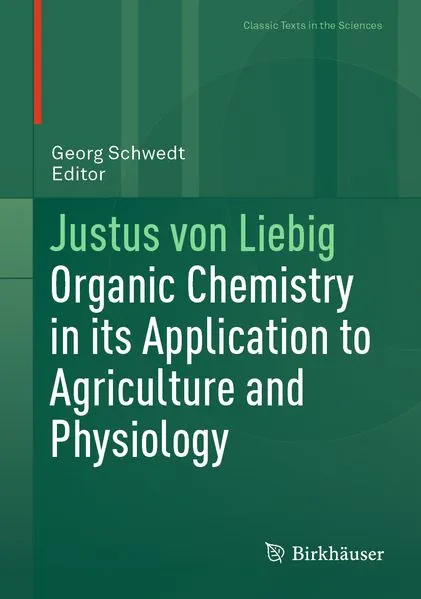
- Autor: Schwedt, Georg
- Anzahl Bewertungen: 0
- Ø Bewertung:
- Medium: E-Book
- Veröffentlicht: 31.07.2025
- Genre: Sonstiges
Justus von Liebig
This book presents the English translation of "Organic Chemistry in Its Application to Agriculture and Physiology", a foundational work by Justus von Liebig (1803–1873), the father of modern agrochemistry and mineral fertilization, along with expert commentary.
At just 21, Liebig—recommended by Alexander von Humboldt —was appointed professor of chemistry at the University of Giessen. There, he perfected elemental analysis and pioneered the isolation and synthesis of organic compounds. In connection with an invitation from the British Association for the Advancement of Science in Liverpool, Liebig travelled through England and Ireland, visited numerous chemical factories. This journey inspired him to explore applied chemistry, and in 1840, he authored "Organic Chemistry in Its Application to Agriculture and Physiology", the text reproduced in this volume. In this work, Liebig laid the foundation for agricultural chemistry, introduced the concept of the carbon cycle, and ignited debates that reshaped scientific thought.
Essential reading for scholars, students, and enthusiasts, this volume offers deep insight into the history of chemistry and its lasting impact on agriculture and environmental science.